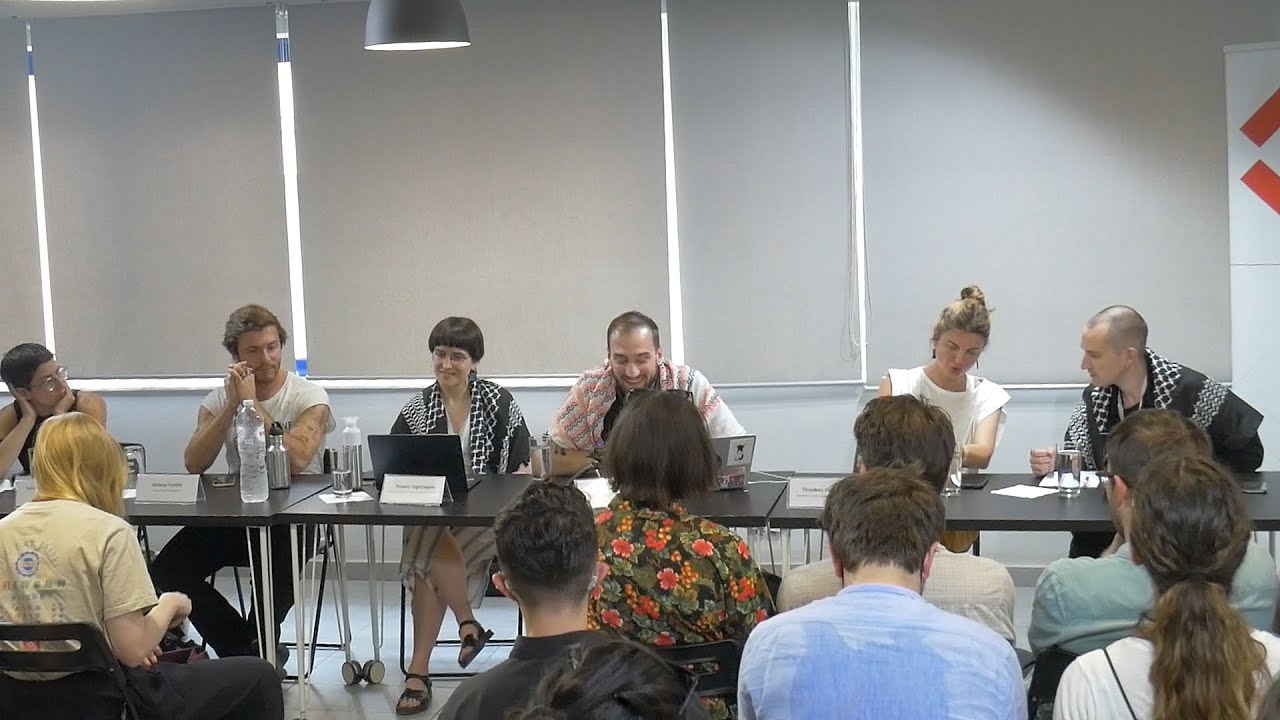
The workshop is part of the ACM Conference on Fairness, Accountability, and Transparency, which is being held for the first time in Greece (June 23-26). A computer science conference with a cross-disciplinary focus that brings together researchers and practitioners interested in fairness, accountability, and transparency in socio-technical systems.* This workshop focuses on the construction of data centers in Greece, with an emphasis on the climate impact and the ongoing debate in the EU on digital sovereignty.
Geopolitical tensions and concerns regarding security and control over infrastructures, technologies and data have given rise to national and supranational claims over digital sovereignty, which commonly refers to the ability to act independently in the digital domain and, therefore, implies investing in domestic infrastructures. Among others, China, Russia, and the United States have adopted policies and strategies to assert digital sovereignty, which is also one of the EU’s core policy objectives. The responsibilities of the new Executive Vice-President for Tech Sovereignty, Security and Democracy, for example, include “boosting Artificial Intelligence innovation, working with Member States, industry and civil society to develop an Apply AI Strategy”. In that context, seven AI Factories will be established across Europe, including one in Athens, Greece (EuroHPC). The Blueprint for Greece’s AI transformation equally refers to European digital sovereignty to counter US and Chinese tech domination. The Blueprint promotes Greece as “well-positioned to become an attractive destination for such an HPC facility”, underscoring the importance of data centres in developing and implementing AI.
Indeed, Greece has witnessed a boom in the development of data centres, primarily by American tech giants. A case in point is Microsoft’s investment in three data centres in Attica, a move that was championed as a success story of modernisation by Greek officials and facilitated by the Greek government. To attract investments, accommodating regulatory adjustments were made, including expedited regulatory procedures and tax exemptions. However, inviting such foreign investment is in obvious tension with the EU’s own digital sovereignty ambitions. Meanwhile, policymakers and mainstream media paint a particularly techno-optimist picture of data centres and AI; they are presented as critical for society, industry, the economy and the environment. Yet, a well-rounded consideration of labour, environmental and societal implications at the local level are often neglected. In contrast to, for example, the Netherlands, there has been almost no public debate or civic questioning of these plans in Greece, nor an attempt to make the decision-making process more inclusive. Between global conglomerates and the usual EU industrial French, German and Benelux suspects, Greece might be–cynically–selling out to the highest bidder while still reeling from the financial crisis.
Following a cross-disciplinary dialogue, participants will be equipped to critically reflect on the currently promoted digital future that embraces large-scale adoption of AI as a means of furthering growth and achieving digital sovereignty. The line-up includes local professionals engaged in analysing Greece’s transformation into an important geopolitical hub for material infrastructure investments, such as data centres and undersea cables. Drawing from this local experience, the workshop will raise broader questions of who carries the burden of building and sustaining these infrastructures vis-à-vis who profits, how decision-making processes for such projects could be more participatory, and how communities can resist and imagine alternative futures of affective infrastructures in light of the above-discussed power imbalances.
Laurens Naudts, University of Amsterdam, AI Media and Democracy Lab
Charis Papaevangelou, University of Amsterdam, AlgoSoc/ Institute for Information Law
Plixavra Vogiatzoglou, University of Amsterdam, Amsterdam Center for International Law
Theodora Kotsaka, Coordinator Commons Observatory ΕΝΑ Institute
Christos Vrettos, Electra Energy Cooperative
Lydia Emmanouilidou, Solomon
With the support of ACM Fairness, Accountability, and Transparency FAccT and the Observatory of the Commons ENA Institute
*ACM FAccT is an interdisciplinary conference dedicated to bringing together a diverse community of scholars from computer science, law, social sciences, and humanities to investigate and tackle issues in this emerging area. https://facctconference.org/

Информация по комментариям в разработке