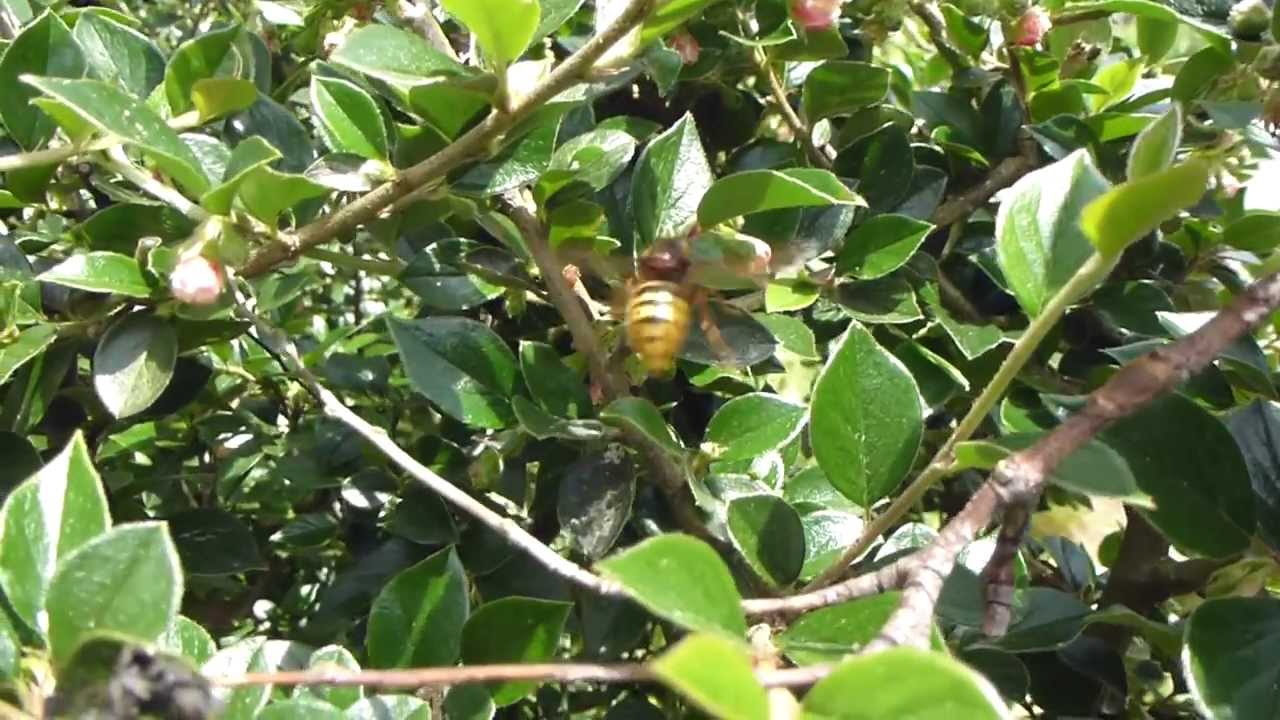
Cotoneaster - Mispill - Rósaætt - Rosaceae and Common wasp - Vespula vulgaris - Adult workers of the common wasp measure about 12--17 mm from head to abdomen, and have a mass of 84.1±19.0 mg whereas the queen is about 20 mm long. It has aposematic colours of black and yellow and is very similar to the German wasp - Vespula germanica - but seen head on, its face lacks the three black dots characteristic of that species. Additionally, it can be distinguished by a lack of black dots on its back (gastral terga), which are located further up and form part of the black rings on each of the abdomen's six segments. Furthermore, the genal area -- the part of the head to which the jaws of an insect are attached -- is usually broken by black (although sometimes narrowly).
Common wasps are colloquially known as "jaspers" in certain regions of England (such as Dorset and Lincolnshire, and more commonly the English Midlands), although it is not clear whether the etymology refers to the Latin name "vespa" or the striped abdomen, which echoes the striped mineral jasper. : http://en.wikipedia.org/wiki/Common_wasp
Ættkvíslin Cotoneaster, misplar, er ættkvísl í rósaætt, Rosaceae með útbreiðslu um tempruðubelti Evrasíu. Tegundafjöldi er mjög breytilegur, frá um 70 til 300 eftir því hvernig tegundir eru skilgreindar. Mestur tegundafjöldi er í fjöllum SV-Kína og Himalajafjöllum. Flestar tegundir eru runnar, jarðlægar tegundir vaxa hátt til fjalla, hærri runnar nær sjávarmáli. Lesa meira: https://www.gardaflora.is/blomstrandi...
Cotoneaster adpressus - Skriðmispill
Cotoneaster congestus - Kúlumispill/slútmispill
Cotoneaster integerrimus - Grámispill
Cotoneaster lucidus - Gljámispill
Cotoneaster x suecicus - Breiðumispill
Cotoneaster purpureus - Purpuramispill
Taldar um 50 tegundir sumargrænna og sígrænna runna. Flestir eru upprunnir frá Kína eða Himalayafjöllum. Mikill breytileiki er innann ættarinnar, bæði á hæð og útliti, allt frá því að vera jarðlægir upp í 3 til 4 m. hæð í sínum heimkynnum. Margar eru þéttvaxnir og fagrir garðrunnar. Nokkrar tegundir fá rauða haustliti. Sumar þola all vel lélegan jarðveg, og flestar þrífast betur í frekar þurrum jarðvegi. Nokkrar tegundir þrífast all vel hérlendis. : http://www.rettarholl.is/runnar.html
Jarðlægur smávaxinn runni, góðu þekjuplanta .Blómin lítil bleik í júlí, síðan rauð ber.Fallegir haustlitir. Skuggþolinn og harðgerður. : http://www.ingibjorg.is/treogrunnar.html
Insects like Wasps are involuntarily transporting pollen from flower to flower play an important role in many plants' reproductive cycles.
While the vast majority of wasps play no role in pollination, a few species can effectively transport pollen and therefore contribute for the pollination of several plant species, being potential or even efficient pollinators; in a few cases such as figs pollinated by fig wasps, they are the only pollinators, and thus they are crucial to the survival of their host plants. : http://en.wikipedia.org/wiki/Wasp
The transfer of pollen grains to the female reproductive structure (pistil in angiosperms) is called pollination. This transfer can be mediated by the wind, in which case the plant is described as anemophilous (literally wind-loving). Anemophilous plants typically produce great quantities of very lightweight pollen grains, sometimes with air-sacs. Non-flowering seed plants (e.g. pine trees) are characteristically anemophilous. Anemophilous flowering plants generally have inconspicuous flowers. Entomophilous (literally insect-loving) plants produce pollen that is relatively heavy, sticky and protein-rich, for dispersal by insect pollinators attracted to their flowers. Many insects and some mites are specialized to feed on pollen, and are called palynivores.
In non-flowering seed plants, pollen germinates in the pollen chamber, located beneath and inside the micropyle. A pollen tube is produced, which grows into the nucellus to provide nutrients for the developing sperm cells. Sperm cells of Pinophyta and Gnetophyta are without flagella, and are carried by the pollen tube, while those of Cycadophyta and Ginkgophyta have many flagella.
When placed on the stigma of a flowering plant, under favorable circumstances, a pollen grain puts forth a pollen tube, which grows down the tissue of the style to the ovary, and makes its way along the placenta, guided by projections or hairs, to the micropyle of an ovule. The nucleus of the tube cell has meanwhile passed into the tube, as does also the generative nucleus, which divides (if it hasn't already) to form two sperm cells. The sperm cells are carried to their destination in the tip of the pollen-tube. : http://en.wikipedia.org/wiki/Pollen

Информация по комментариям в разработке