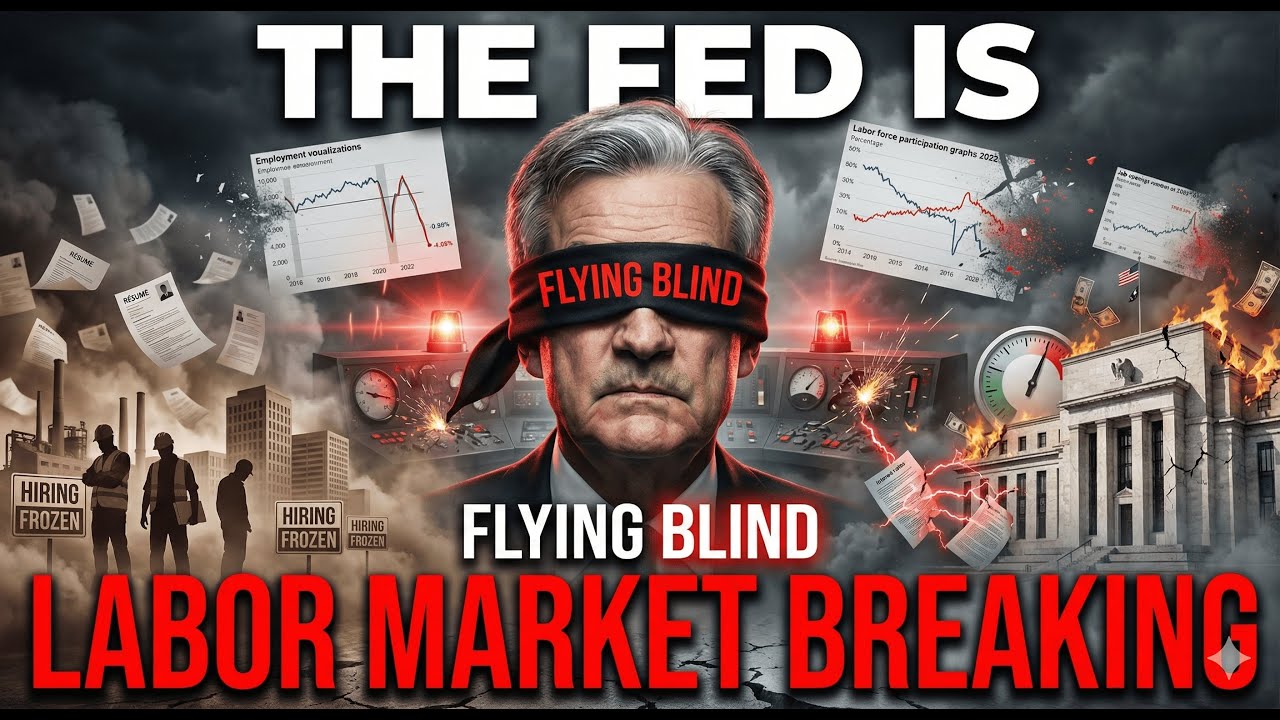
The latest data paints a concerning picture for the "us economy", with a shrinking "job market" and job creation concentrated in just a few industries. Despite official reports, revised payroll numbers suggest "market contraction", indicating that the labor market is weaker than it appears. These "economic trends" point towards potential instability, raising questions about the true "economic stability" and increasing the risk of a "recession" with more "layoffs" to come.
Timestamps:
0:00 — The Unemployment Rate Looks Fine, But Something Is Breaking Beneath the Surface
1:01 — Inflation Picture: Goods, Services, and Shelter All Cooling Despite Hawk Warnings
4:49 — Labor Market Danger: Hiring Collapsed, Diffusion Below 50%, U-6 Spiking
9:25 — Fed's Blindspot: Relying on Low Claims While Labor Demand Implodes
10:53 — Fed Division: The Most Fractured FOMC in Years (Hawks vs. Doves)
12:41 — Three Wild Cards: Missing Data, Tariff Uncertainty, Political Price Messaging
14:43 — What Will the Fed Actually Do? Hold vs. Hawkish Cut (30% vs. 69%)
16:28 — What This Means for You: The Real Risk Is Waiting Too Long
Key Questions Answered in This Video
Q: Why is the labor market actually breaking despite 4.4% unemployment?
Four hidden signals reveal deterioration the headline rate misses: Job diffusion has been below 50% since April 2025 (hiring concentrated in only healthcare, leisure/hospitality, government), payroll has hit "stall speed" at 60k monthly vs 600-700k in 2022, U-6 underemployment is surging to 4-year highs, and NFP has been revised down 900k jobs over the past year with two actual months of negative growth (June -13k, August -4k). The US has completed the first four steps of labor market weakening (stop hiring, cut hours, shift to part-time, freeze backfilling) with mass layoffs being step five—by the time jobless claims spike, the inflection point has already passed.
Q: How is inflation actually cooling despite the Fed's hawkish concerns?
Goods inflation has been nearly flat for 6-8 months with tariffs only passing through 20% to prices (contributing just 0.7-0.9 percentage points to CPI with no wage-price spiral), services are softening when you strip out statistical quirks like imputed portfolio management fees, and real-time rental data shows dramatic cooling—Zillow Rent Index at 2.35% YoY, Apartment List at -0.9%, Cleveland Fed New Tenant Rent at -9.3%—while apartment completions hit 30-year highs and vacancy rates reached 7.2%. CPI shelter data is backward-looking by 6-12 months, so when it catches up in 2026, shelter will become one of the strongest disinflation forces in the entire price basket.
Q: Why is the Fed "flying blind" and what critical data are they missing?
The government shutdown through October delayed critical reports—October CPI didn't come out on time, October and November employment data were delayed—leaving the Fed entering the December meeting with only data through September for one of the most consequential decisions of the year. Additionally, the Fed is relying on initial jobless claims as their favorite labor signal, which only captures mass layoffs and completely misses that hiring has collapsed, diffusion has fallen below 50%, hours are being cut, and involuntary part-time work is surging—claims are a lagging fire alarm that only rings when flames have reached the door.
Q: How divided is the Federal Reserve, and why does this matter?
Q4 2025 marks the most fractured FOMC in eight years, split between hawks (Hammack, Bostic, Schmid) wanting to hold rates because they believe inflation is still the primary risk, and doves (Waller, Miran, Williams) believing the labor market is weakening silently but dangerously with over-tightening risk exceeding early-cutting risk. Powell has remained silent from late October through December, creating a "free-for-all Fedspeak environment" where the market is counting individual member votes instead of following Fed consensus—dissent is rising from both directions for the first time under Powell's tenure, making December's decision the closest call in years.
Q: What are the realistic scenarios for the December Fed meeting, and what do they signal?
Two scenarios dominate: 30% probability the Fed holds rates (lacks complete data, protects inflation credibility, shifts to reactive mode where they'll only act when bad data hits them), or 69% probability they cut 25 basis points with hawkish language (compromise acknowledging hiring rate at lowest since 2011, diffusion below 50% for months, U-6 rising sharply, and 900k payroll revision downward). A 50bp cut is essentially off the table at ~1% probability with no break event, unemployment spike, or funding crisis. Regardless of which path, December won't be a turning point but a holding pattern—the real decisions come in 2026 once the Fed has complete data and can see whether the labor market is stabilizing or breaking non linearly.

Информация по комментариям в разработке