A History of the Infinite
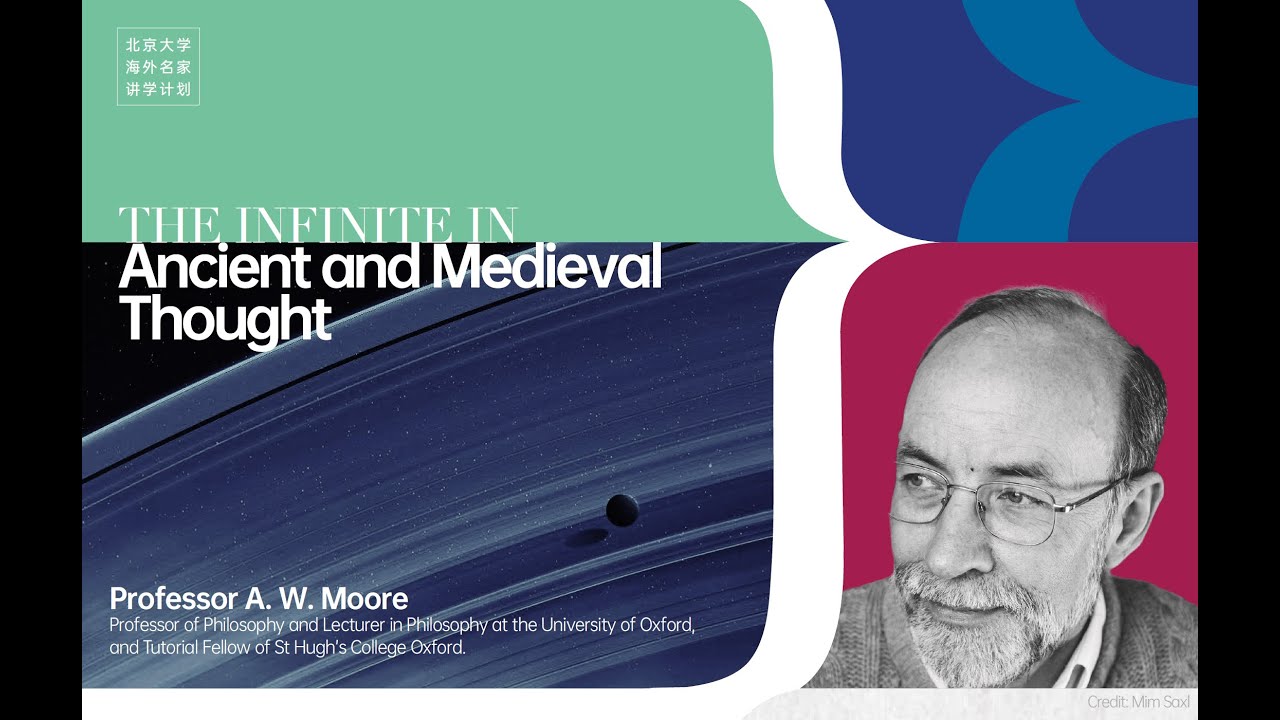
Four lectures by Prof. A. W. Moore of the University of Oxford
These lectures will trace the history of thought about the infinite during the last two and a half thousand years. I shall look at the infinite in philosophical terms, in theological terms, in scientific terms, and in mathematical terms. As I hope to demonstrate, part of the importance of the topic is that, in trying to make sense of the infinite, we are also trying to make sense of ourselves. We are trying to make sense of our own experiences and our own limitations, and what these tell us about our place in the world. Always, in the background of these lectures, there will be a sense of our own finitude. Always the question will come back to how we, in our finitude, relate to what surpasses that finitude. In whatever way the history of the infinite develops, it is sure to be, as it has always been, a vital part of our own history.
Lecture 1: The Infinite in Ancient and Medieval Thought
Lecture 2: The Infinite in Science and Technology
Lecture 3: The Infinite in Mathematics
Lecture 4: Human Finitude
About the speaker
A. W. Moore is Professor of Philosophy and Lecturer in Philosophy at the University of Oxford, and Tutorial Fellow of St Hugh’s College Oxford. He studied philosophy as an undergraduate at King’s College Cambridge, and did postgraduate work at Balliol College Oxford, where he obtained his doctorate under the supervision of Michael Dummett. Since 2015 he has been joint editor, with Lucy O’Brien, of MIND. He has published five books, and edited or co-edited four more. The most recent of these are, in a third edition, The Infinite (Routledge, 2019) and Language, World, and Limits: Essays in the Philosophy of Language and Metaphysics (Oxford University Press, 2019).
Chair
Sebastian Sunday Grève (王小塞), Peking University
Panellists
Chen Bo 陈波, Wuhan University
Han Linhe 韩林合, Peking University
Li Qilin 李麒麟, Peking University
Mei Jianhua 梅剑华, Shanxi University
Nan Xing 南星, Peking University
Sun Yongping 孙永平, Peking University
Wang Wei 王纬, Fudan University
Wang Yanjing 王彦晶, Peking University
Wu Tianyue 吴天岳, Peking University
Yan Chunling 颜春玲, Chinese Academy of Sciences
Ye Feng 叶峰, Capital Normal University
Zhao You 赵悠, Peking University
Lecture 1: The Infinite in Ancient and Medieval Thought
I shall begin by exploring the old adage that ‘the Greeks abhorred the infinite’, and show why and how they did so. I shall focus in particular on Pythagoras and his followers, who divided the world into two fundamental cosmic principles: what they called Peras (the Limited) and Apeiron (the Unlimited, or the Infinite). The former subsumed everything that was good, and the latter everything that was bad. The Pythagoreans thought they could explain the world around them in terms of the natural numbers 1, 2, 3, 4, et cetera—the numbers that we use to count finite collections of things—and they were dismayed when they discovered that that this was not so. According to legend one of them was shipwrecked at sea for revealing this discovery to their enemies! I shall also consider Zeno of Elea, who, after wrestling with the notion of infinity and discovering various associated paradoxes involving motion, came to the conclusion that motion itself was impossible. But the primary focus of this lecture will be Aristotle, who sought a reconciliation between the idea that things can go on for ever and the Greeks’ abhorrence of any such idea. Aristotle famously distinguished between the potential infinite and the actual infinite, and argued that the former, and the former alone, was the acceptable face of infinity. This enabled him to revisit Zeno’s paradoxes and to provide his own solution to them without denying the very possibility of motion. Aristotle’s views held sway for thousands of years. In particular, they had a very significant impact on medieval thought. This was largely through the intermediary St Thomas Aquinas, who attempted to reconcile Aristotle’s teachings on the infinite with the doctrines of the Catholic church. He enjoyed some success in this endeavour, and, once the church had embraced Aristotle’s teachings as the new orthodoxy, philosophers stepped out of line at their peril. I shall signal in particular Galilei Galileo, who did just that. He dared to add some new paradoxes of his own to discussion of the infinite: these foreshadowed later thinking on the infinite (as I shall discuss in Lecture Three) and showed that Aristotle’s views were not as straightforward as they had come to seem.
Sections
0:00 Introduction
7:39 Lecture
1:12:52 Moderation
1:16:54 Panellist comments I
1:21:24 Replies I
1:29:50 Panellist comments II
1:45:05 Replies II
2:04:01 Livestream Q&A

Информация по комментариям в разработке