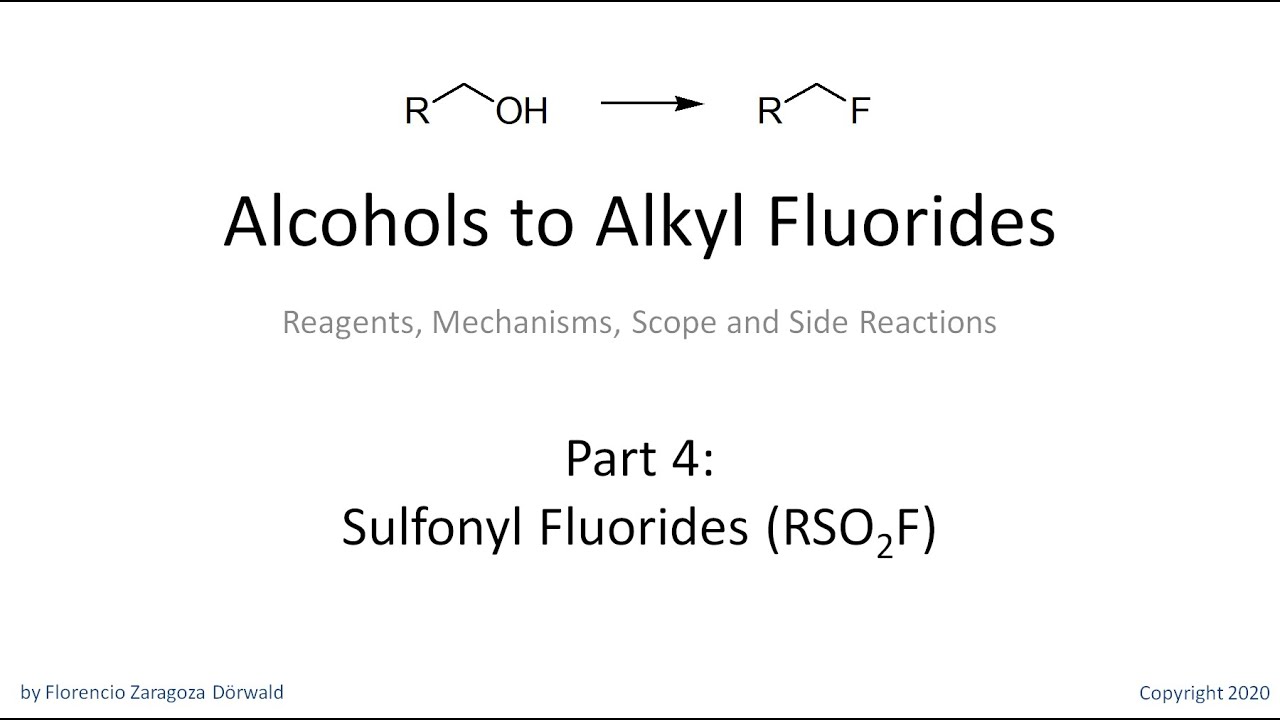
This presentation is about the conversion of aliphatic alcohols into alkyl fluorides by means of sulfonyl fluorides as deoxyfluorinating reagents. These are less reactive than aminosulfur trifluorides or fluoroalkylamines, but more reactive and versatile than anhydrous HF.
Although the two-step strategy of converting an alcohol into a sulfonate, followed by SN2 displacement with fluoride, has been known for many years, the one-pot procedure using a sulfonyl fluoride has only recently emerged as a viable deoxyfluorinating protocol.
The most common sulfonyl fluorides used for deoxyfluorinations include perfluorobutanesulfonyl fluoride, which boils at 64 °C, 2-pyridinesulfonyl fluoride, which is a solid and melts at 29 °C, and for phenols sulfuryl fluoride, which is a gas with a boiling point of -55 °C.
The main advantages of sulfonyl fluorides as deoxyfluorinating reagents are the simplicity of their handling and the high yields that can be attained. Sulfuryl fluoride, which is an inexpensive fumigant, has only been used to deoxyfluorinate phenols, but may be suitable for aliphatic alcohols, too.
Further examples:
J. Am. Chem. Soc. 2018, 140, 5004-5008;
J. Am. Chem. Soc. 2017, 139, 1452-1455 (SO2F2; phenols only);
J. Am. Chem. Soc. 2015, 137, 9571-9574 (PyFluor);
US 6248889 (2001; perfluorobutanesulfonyl fluoride);
Tetrahedron Lett. 1995, 36, 2611-2614 (perfluorobutanesulfonyl fluoride);
J. Fluorine Chem. 1987, 35, 677-683 (MeSO2F);
Tetrahedron Lett. 1985, 26, 4207-4210.
Reviews:
Org. Proc. Res. Dev. 2020, 24, 470-480;
Molecules 2017, 22, 977-1003 (application in heterocycle synthesis);
Synthesis 2017, 49, 4917-4930;
Org. Proc. Res. Dev. 2008, 12, 305-321.
Информация по комментариям в разработке