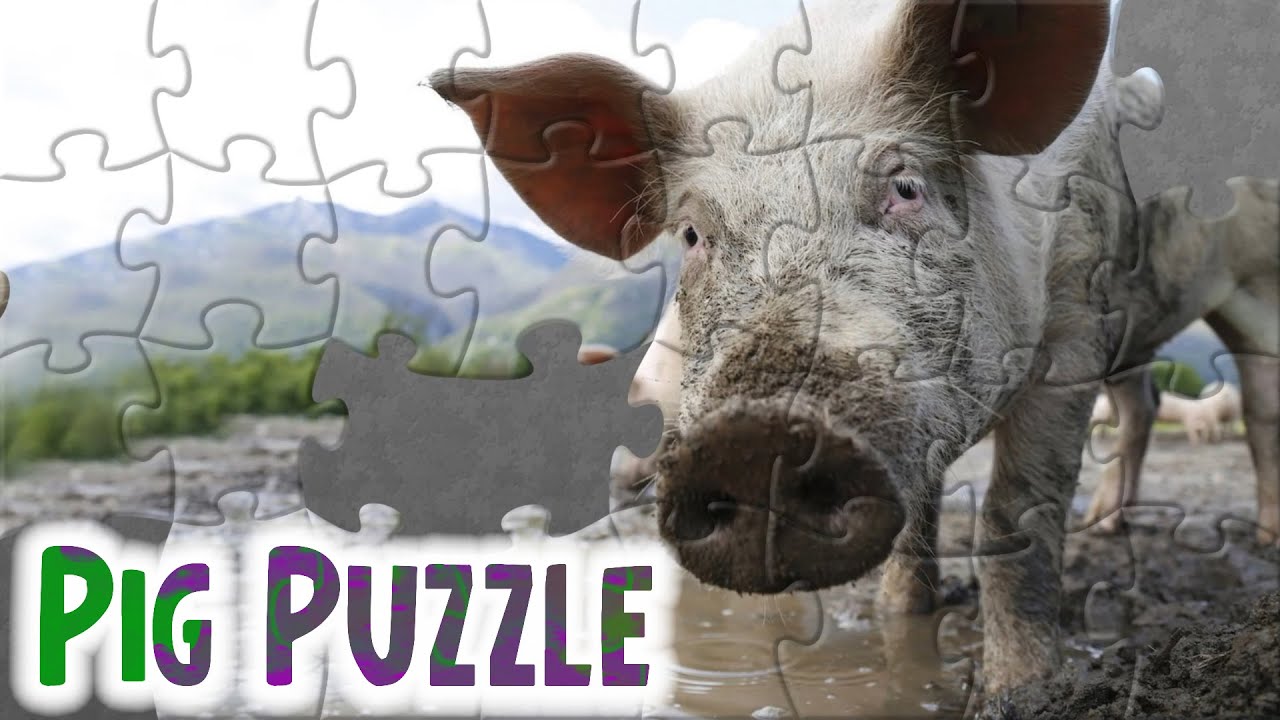
Pig Puzzle for kids and adults.
Probably the pig is the most stereotypical animal. It is associated with dirt and stench, but this is far from the case. Let's take a closer look at these grunting creatures.
A little biology.
Pigs (lat. Suidae) are a family of non-ruminant artiodactyla (Artiodactyla), which includes 22 genera of pigs, of which 5 are modern, including the only European representative - the wild boar, which is the ancestor of the domestic pig. A baby pig is called a piglet. The domestic pig (lat. Sus scrofa domesticus) is a large artiodactyl, a subspecies of wild boar, domesticated by humans about 7 thousand years ago (according to some studies, much earlier) and distributed mainly in Western countries, East Asia and Oceania. Feral pigs (razorbacks) are found in North America, Australia and New Zealand. The body length ranges from 0.9 to 1.8 m, an adult weighs from 50 to 150 kg. Compared to other artiodactyls, which are more often herbivorous, the domestic pig is omnivorous, like its ancestor, the wild boar.
Pigs are characterized by a compact build and a long muzzle, ending in a bare cartilaginous movable “patch” - this is a device for loosening the earth in search of food. The canines are well developed, sharp, curved upward. The limbs are four-fingered; the lateral toes (second and fourth) barely touch the ground. Like all artiodactyls, the fingers end in hooves. The hairline is sparse, consisting mainly of stubble. The stomach is simple. The natural range of pigs covers Eurasia and Africa, but thanks to humans, domestic pigs are present on all continents except Antarctica and have formed partly feral populations everywhere. Most pig species live in forests. Pigs are raised primarily for their meat. World pork production in 2005 was 97.2 million tons. Decorative dwarf breeds of pigs (mini pigs) are popular animals for keeping at home. In France, specially trained pigs search for truffles.
Domestication
Archaeological finds indicate that already 12,700 - 13,000 years ago, wild pigs began to be domesticated in the Middle East in the Tigris basin regions. Initially, they were kept in a semi-wild state in the wild, just as pigs are kept today in New Guinea. The remains of pigs dating back to more than 11,400 years ago have been found in Cyprus. Pigs could only get to the island from the mainland, which suggests movement with humans and domestication. Independently of this, pig domestication occurred in China, which took place about 8,000 years ago. A study of DNA from pig teeth and bones found in Neolithic European settlements suggests that the first domestic pigs were brought to Europe from the Middle East. This stimulated the domestication of European wild pigs, which led in a short time to the third important moment in the history of domestication - the displacement of breeds of Middle Eastern origin in Europe. The high adaptability and omnivorous nature of wild pigs allowed primitive man to domesticate them very quickly. Pigs were raised primarily for their meat, but their skins, bones, and bristles were also used to make tools and weapons. In India, domestic pigs were bred for a long period mainly in Goa. Pigs were brought to North America from Europe by Hernando de Soto and other Spanish pioneers. The escaped pigs led a wild lifestyle and caused great damage to the economy of the indigenous population. Feral domestic pigs have appeared in many parts of the world and caused great harm to the environment. They become an environmental threat and damage agricultural crops (they are among the hundred most harmful animals). This is especially true in South America from Uruguay to the Brazilian states of Mato Grosso do Sul and Sao Paulo, where they are called javaporcos. With a standing population of approximately one billion individuals, domestic pigs are one of the most numerous large mammals on the planet.
Interesting facts Pigs constantly communicate with each other. Scientists have differentiated more than twenty different sounds that pigs make. Moreover, these sounds have very different meanings, ranging from flirting with the opposite sex and requests for help, ending with a signal of the desire to eat. - Pigs are able to communicate with each other, emphasizing what is “said” with intonation. - Pigs can't look up. - A pig is able to experience an orgasm that lasts for as long as 30 minutes. - There are pig fishermen in the world who are able to catch fish at a depth of up to 15 meters. - Insulin is produced from the extract of the pig pancreas. - Pigs treat others the same way they treat them. They will treat a good and affectionate owner with devotion, and in case of rudeness they are always able to stand up for themselves. - A pig's squeal can reach a volume of 115 decibels. This is 3 decibels higher than the sound of a supersonic airliner. - A pig can drink 14 liters of water per day.
Subscribe to the channel WAP Puzzle / @animalisticpuzzle

Информация по комментариям в разработке