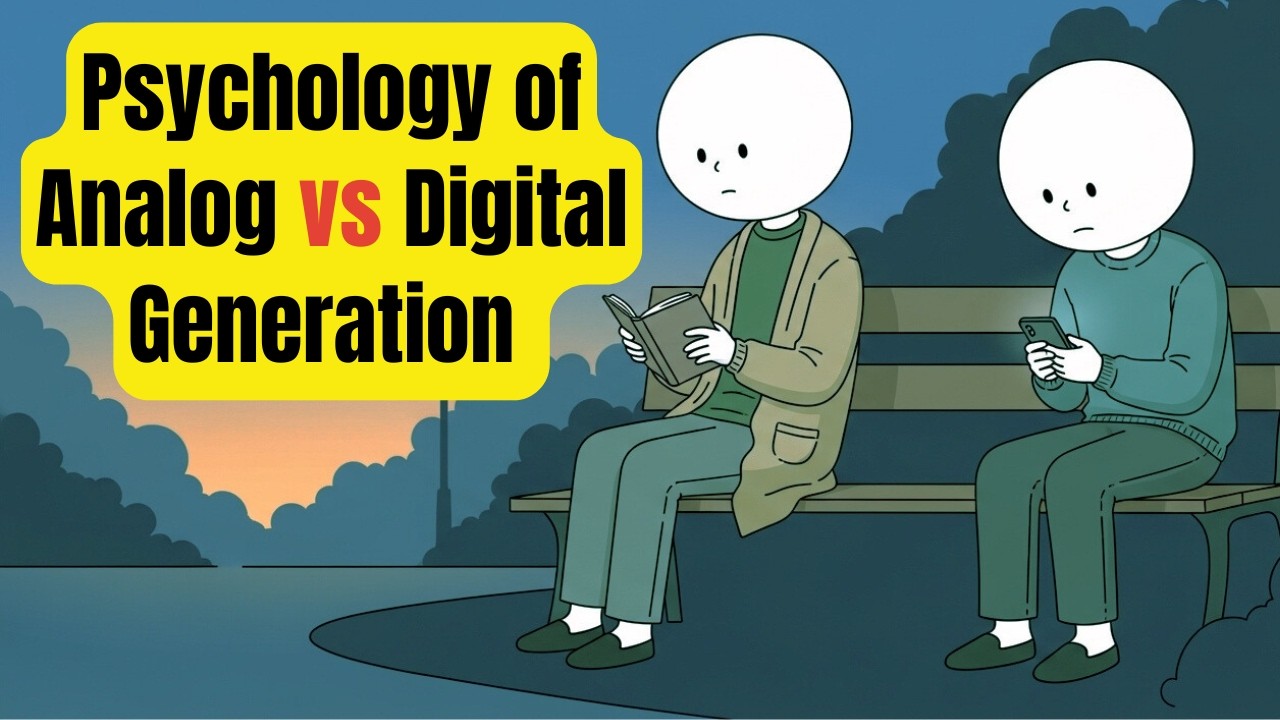
Psychology of the Analog Generation vs the Digital Generation
---
Why do some people feel calm in silence, while others feel restless without constant input?
In this video, we break down the psychology of the analog generation vs the digital generation, exploring how the environment you grew up in shapes attention, emotional regulation, identity, and nervous system stress patterns. The analog world trained patience, deeper focus, and slower social feedback. The digital world trained rapid switching, constant social signals, and instant stimulation. Over time, those differences can create misunderstandings, different coping styles, and very different internal rhythms.
In this video, you will learn:
How analog vs digital environments shape attention and focus
Why silence and boredom feel different depending on your generation
The nervous system impact of constant stimulation and constant cues
How social feedback changes emotional regulation and self-image
Why the two generations misunderstand each other so easily
How privacy, availability, and connection changed across eras
If you’ve ever felt like people are living by completely different rules, this breakdown explains what’s happening beneath the surface.
This video is perfect for those interested in:
✔ psychology and human behavior
✔ attention and focus psychology
✔ overstimulation and nervous system patterns
✔ emotional regulation and coping styles
✔ social comparison and identity
✔ generational psychology
✔ digital life and mental health
Whether you grew up in the analog world or the digital world, this video offers a clear psychological deep dive into why the same life can feel completely different depending on what your brain was trained to expect.
👍 like the video if you enjoy psychology content
💬 comment whether you relate more to analog or digital
🔔 subscribe for more videos on psychology, mindset, and human behavior
References:
1. “Cognitive control in media multitaskers.” (2009). Proceedings of the National Academy of Sciences, 106(37), 15583–15587. doi:10.1073/pnas.0903620106
2. “The costs of interrupted work: More speed and stress.” (2008). Proceedings of the SIGCHI Conference on Human Factors in Computing Systems, 107–110. doi:10.1145/1357054.1357072
3. “Passive Facebook usage undermines affective well-being: Experimental and longitudinal evidence.” (2015). Journal of Experimental Psychology: General, 144(2), 480–488. doi:10.1037/xge0000057
4. “Social media use and perceived social isolation among young adults in the U.S.” (2017). American Journal of Preventive Medicine, 53(1), 1–8. doi:10.1016/j.amepre.2017.01.010
5. “A theory of social comparison processes.” (1954). Human Relations, 7(2), 117–140.
6. “Digital technology use and adolescent well-being: Evidence from multiple large datasets.” (2019). Psychological Science, 30(8), 1170–1182. doi:10.1177/0956797619830329
7. “Emerging adulthood: A theory of development from the late teens through the twenties.” (2000). American Psychologist, 55(5), 469–480.
#psychology #humanbehavior #generationalpsychology #analog #digitalgeneration #attention #focus #overstimulation #emotionalregulation #socialcomparison #mentalhealth #selfawareness
----
Disclaimer: This channel is created for educational and informational purposes only. It is not intended to replace professional psychological, medical, or therapeutic advice.











Информация по комментариям в разработке