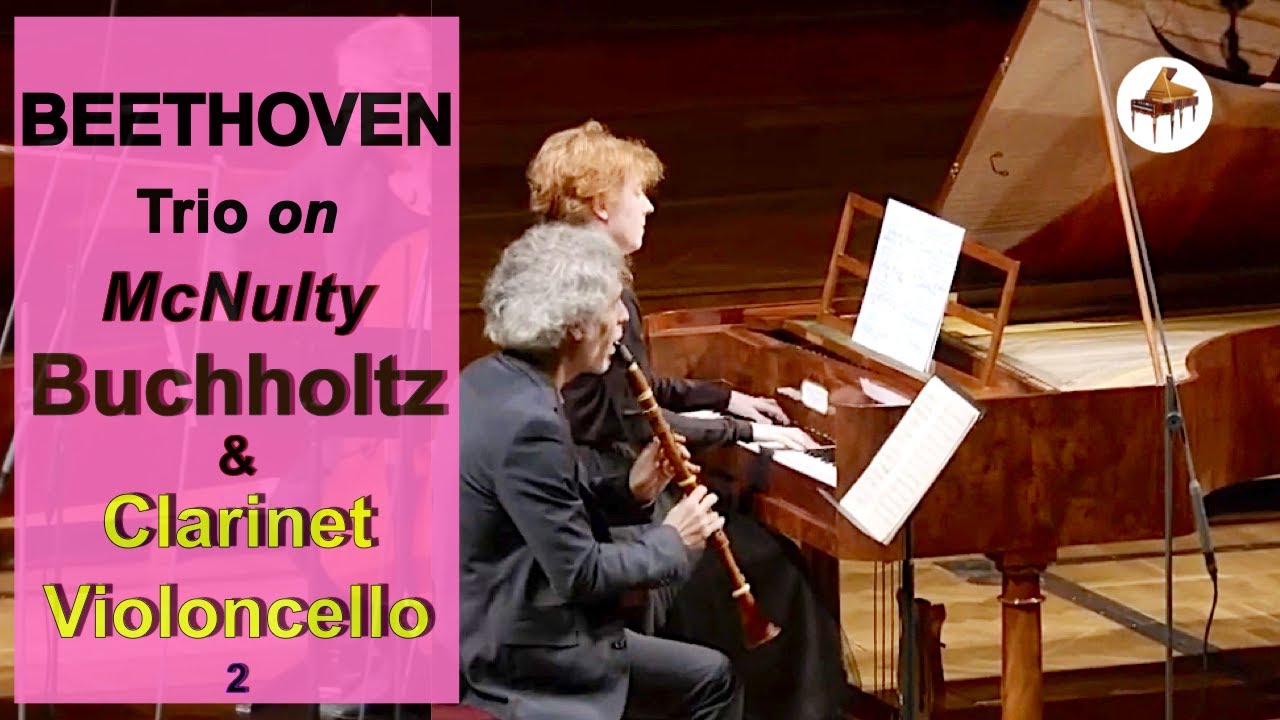
Beethoven’s Trio No. 4 in B-flat Major, Op. 11, movement 2 "Adagio", for clarinet, violoncello, and fortepiano, performed on a Buchholtz fortepiano. 🎶
This performance features Ensemble Dialoghi, captured on a McNulty Buchholtz fortepiano — often referred to as “Chopin’s Warsaw piano.” The instrument was commissioned by the Warsaw Chopin Institute from Paul McNulty, who recreated the Buchholtz piano — Poland’s finest instrument of the early 19th century, on which Chopin premiered his Piano Concerto No. 2 in F minor. Subscribe to our YouTube channel for more fortepiano performances, insights into historical instruments, and the sound world of Beethoven, Chopin, and their contemporaries. 🎹
Paul McNulty fortepianos website: https://www.fortepiano.eu/
McNulty's Facebook Page: / mcnultypianos
Paul McNulty's Instagram: https://www.instagram.com/mcnulty_for...
Ensemble Dialoghi, formed in 2014 in Barcelona, is a group of musicians dedicated to exploring historical performance practice and deepening the connection with their audiences. By performing on period instruments, they seek to rediscover the full expressive potential of the music.
The ensemble features Cristina Esclapez on the McNulty Buchholtz fortepiano, Lorenzo Coppola on clarinet, and Kristin von der Goltz on violoncello.
Paul McNulty became interested in instrument building after studying at the Peabody Conservatory in Baltimore. He specialized in piano technology in Boston and earned guild qualification as a tuning examiner. Over his career, he has built more than 300 fortepianos after historical makers such as Silbermann, Stein, Walter, Hofmann, Fritz, Buchholtz, Graf, Pleyel, Boisselot, and Streicher.
His instruments are used by leading musicians and prestigious institutions worldwide, including:
Warsaw Chopin Festival, Competition & Institute (Graf 1819, Pleyel 1830, Buchholtz “Chopin’s Warsaw piano”),
Klassik Stiftung Weimar (copy of Liszt’s 1846 Boisselot piano),
Royal Academy of Music and Royal College of Music, London,
Paris Conservatoire, Trossingen Hochschule für Musik, Koeln, Augsburg & Hannover Hochschule,
Paris Sorbonne, Stanford, Cornell & Harvard University, Oberlin College, Basel Musik Hochschule, Schola Cantorum Musik-Akademie Basel,
Musik und Kunst Privatuniversität Wien, Turin Conservatorium, Vicenza Conservatory, Amsterdam & Den Haag Conservatory, Anton Bruckner Privatuniversität Linz,
Glyndebourne Festival, Opera National de Paris, Royal Danish Opera Copenhagen, and many others.
Prominent musicians who play McNulty fortepianos include Prof. Paul Badura-Skoda, Alice & Nikolaus Harnoncourt, Prof. Malcolm Bilson, Katia & Marielle Labeque, Kristian Bezuidenhout, Ronald Brautigam, Robert Levin, Trevor Pinnock, John Irving, Trudelies Leonhardt, Geoffrey Lancaster, Neal Peres da Costa, and many others.
Experience the unique sound world of historical keyboard instruments — fortepianos after Silbermann, Stein, Walter, Hofmann, Fritz, Buchholtz, Graf, Pleyel, Boisselot, and Streicher. Period pianos differ significantly from modern instruments, revealing the colors, phrasing, and expressive nuances that composers such as Bach, Mozart, Beethoven, Schubert, Chopin, Liszt, and Brahms intended.
Paul McNulty’s concert-quality replicas bring classical music from the past into today’s concert halls and recordings. You can buy or rent fortepianos modeled after Mozart’s Walter & Stein, Chopin’s Pleyel, Beethoven’s Graf, Liszt’s Boisselot, and Brahms’s Streicher. Visit our website for more information.
Thank you for watching! Please subscribe to our channel to discover more about fortepianos, historical instruments, and classical music. Listening to historical keyboard instruments can enhance your study, relaxation, mental focus, and well-being, allowing you to experience music as it was originally imagined, bringing harmony, calm, and joy into your daily life.
#fortepiano #mcnultyfortepianos #buchholtz #beethoven #pianotrio #violoncello #classicalmusic #ensemble #gassenhauer

Информация по комментариям в разработке