Revolutionising sustainable distributed energy: Prof. WANG Zhonglin’s Distinguished Lecture on TENGs
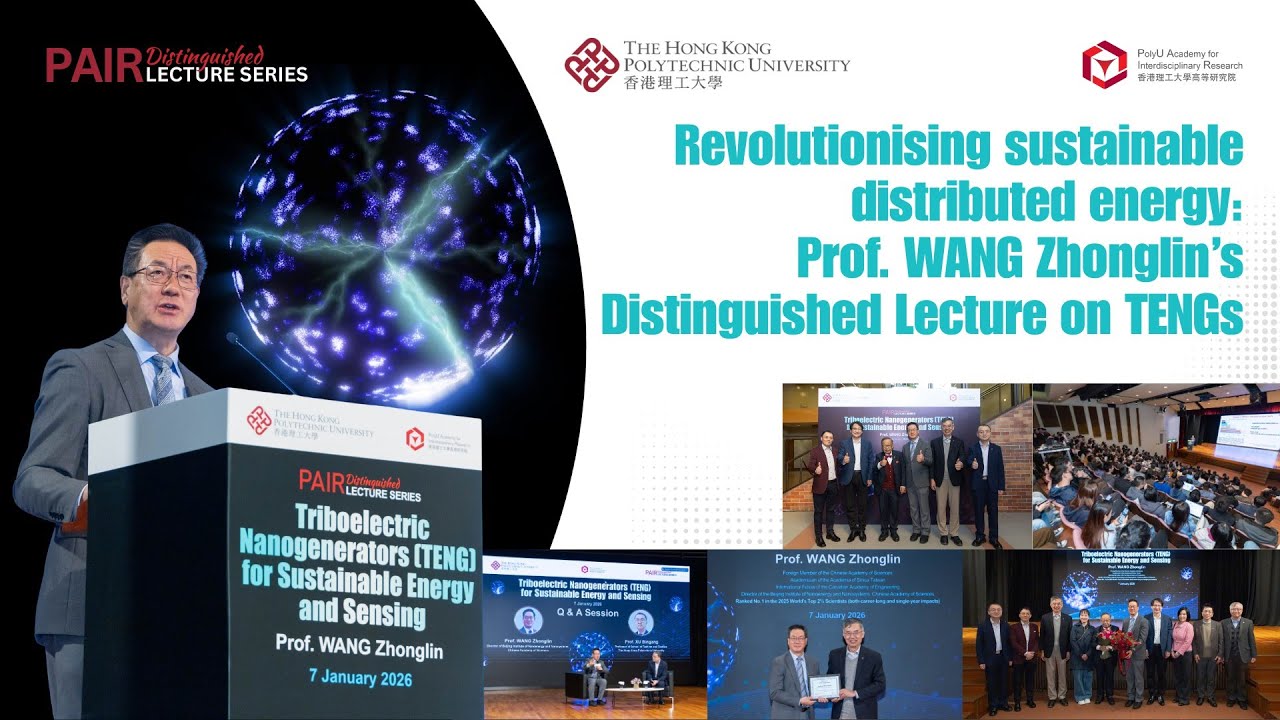
On 7 January 2026, Prof. WANG Zhonglin, Director of Beijing Institute of Nanoenergy and Nanosystems, Chinese Academy of Sciences, delivered a PAIR Distinguished Lecture titled “Triboelectric nanogenerators (TENG) for sustainable energy and sensing”. The event drew a full house at the Chiang Chen Studio Theatre, with over 240 in-person participants, and reached an impressive online audience of more than 16,600 across social media platforms.
Prof. Wang began by outlining the historical development of triboelectricity and its significant contributions to human civilisation. He introduced TENGs as innovative devices that convert mechanical energy—such as motion, vibration or pressure—into electrical energy through the triboelectric effect and electrostatic induction. By combining layers of materials with different electron affinities and then separating them, TENGs generate a voltage difference that drives current through an external circuit. Their lightweight, flexible design and use of inexpensive materials make them particularly effective at harvesting low-frequency, high-entropy energy—random, low-density mechanical energy that is widely distributed in the environment. This positions TENGs as vital components in distributed energy systems and self-powered technologies, with applications spanning the Internet of Things, artificial intelligence, environmental monitoring, medical science and security.
Delving deeper, Prof. Wang emphasised the unique capability of TENGs to harvest high-entropy energy from everyday sources such as footsteps, wind and water movement. Unlike traditional electromagnetic generators, which require consistent and high-quality energy input, TENGs excel at capturing dispersed, low-amplitude mechanical motions. This makes them ideal for powering small devices and sensors in environments where energy is otherwise wasted or difficult to capture. Their versatility is further enhanced by the wide range of materials that can be utilised, allowing TENGs to be tailored for specific applications—from wearable electronics and medical devices to environmental sensors and industrial monitoring. This adaptability unlocks vast possibilities for TENG technology, enabling integration into diverse fields such as smart textiles, robotics, ocean science, healthcare, and precision agriculture.
In conclusion, Prof. Wang highlighted the profound impact of TENGs on both fundamental science and current technologies. TENGs enable the development of self-powered devices, promote sustainable and green energy harvesting, and offer low-cost, scalable production methods. Their flexibility and customisability allow seamless integration into clothing, infrastructure, and even medical implants, while their dual role as energy sources and sensors enhances smart infrastructure and remote monitoring systems. As TENG technology matures, it is expected to drive the emergence of new commercial products across industries, contributing positively to the sustainability and advancement of human society. Prof. Wang expressed confidence that TENGs will play a crucial role in supporting the sustainable development of humankind.
Following the presentation was a lively question-and-answer session moderated by Prof. XU Bingang, Management Committee Member of Research Institute for Intelligent Wearable Systems (RI-IWEAR) and Professor of School of Fashion and Textiles. Both on-site and online audiences engaged actively in a thoughtful exchange with Prof. Wang.
Upcoming PAIR Events: https://www.polyu.edu.hk/pair/news-an...
PAIR Facebook : / polyu.pair
PAIR Instagram : / pair_polyu
LinkedIn : / pair-polyu-47224722b
X : / pair_polyu
Pinterest : / pair_polyu
YouTube Channel: / @pairpolyu3024
WeChat : https://www.polyu.edu.hk/pair/-/media...
Xiaohongshu : https://www.xiaohongshu.com/user/prof...

Информация по комментариям в разработке