Most developers treat their database as the only source of truth, but at scale, this breaks. In this video, we explore why modern architectures are moving away from monolithic databases toward log-based data integration and unified stream processing.
Designing Data-Intensive Applications || Chapter Summarized
Use coupon code PROGRAMMERCAVE on https://app.emergent.sh/?via=programm... to get 5% off on all your payments.
Tired of coding? [Lovable](https://lovable.dev/?via=programmerca... your AI-powered full-stack engineer! Go from idea to fully functional app in minutes. Perfect for founders, designers, and product teams. Try it now!
Elevate your tech career with [Scaler](https://www.scaler.com/?unlock_code=M...! Join a community dedicated to transforming careers in technology. With over 15,000 successful career transitions and partnerships with 900+ placement partners, [Scaler](https://www.scaler.com/?unlock_code=M... tailored learning experiences that can help you become part of the top 1% in the tech industry.
Explore a variety of programs, participate in live classes, and gain access to valuable resources designed to enhance your skills. Whether you're looking to advance in your current role or pivot to a new career, [Scaler](https://www.scaler.com/?unlock_code=M... the support and guidance you need to succeed. Don't miss out—book your free live class today!
https://programmercave.com/
The Summary:
We break down the complex world of distributed data systems, moving beyond simple CRUD apps to robust, scalable architectures. You'll learn how to keep different data systems (search indexes, caches, analytics) in sync without using fragile distributed transactions. We also cover the convergence of batch and stream processing, how to achieve "exactly-once" semantics in a messy network, and the critical trade-offs between "Write Path" and "Read Path" optimization.
What You Will Learn:
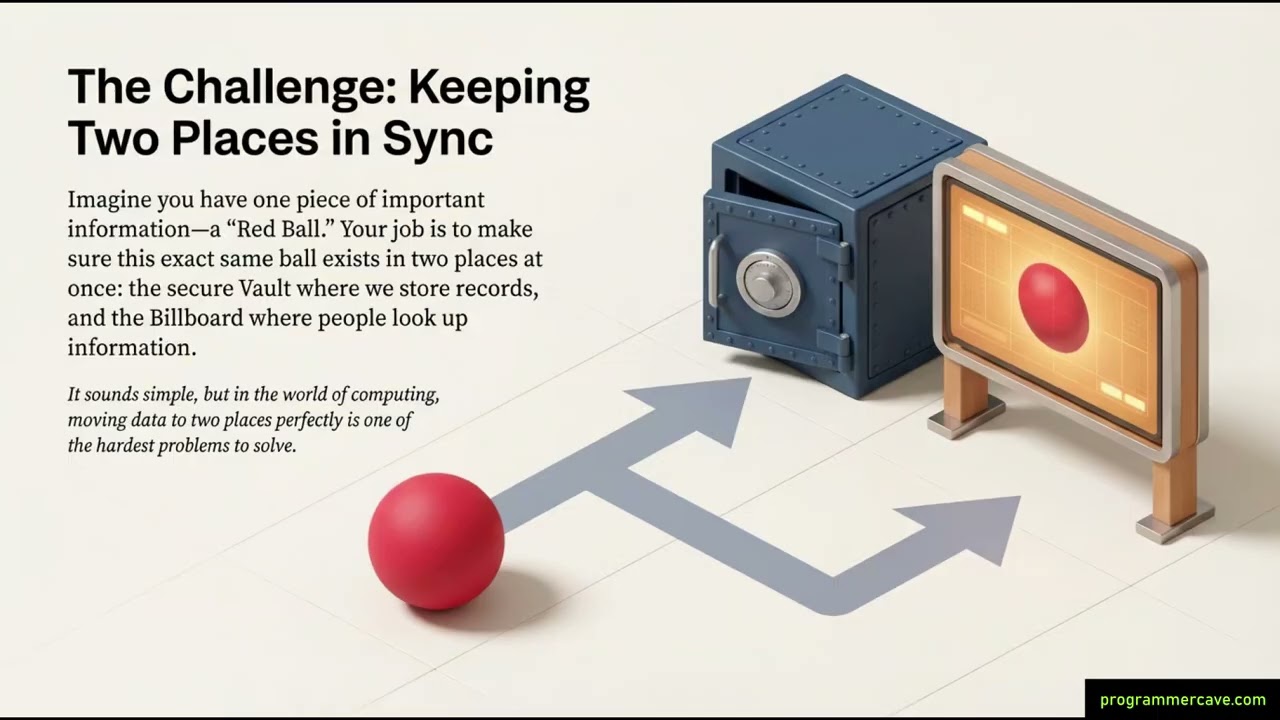
Data Integration Strategy: Why "Dual Writes" kill consistency and how to use Change Data Capture (CDC) and Event Logs instead.
Batch vs. Stream Processing: Understanding the Lambda vs. Kappa architecture and how modern tools unify historical replay with real-time events.
The Idempotence Key: How to solve the "double-charge" problem and achieve exactly-once semantics using operation IDs and deterministic processing.
Read vs. Write Path: How to optimize latency by shifting work (indexing, caching) to the write path, illustrated by Twitter's fan-out architecture.
Senior Engineer Reality Checks: Real-world production pitfalls like "Last Writer Wins" lies, state management explosions, and the hidden costs of microservices.
Target Audience:
Perfect for Backend Engineers, Senior Developers, and anyone preparing for System Design Interviews (L5/L6 level) who wants to understand the deep principles behind tools like Kafka, Flink, and Elasticsearch.
3. SEO Tags & Category
Keywords (15-20):
System Design, Distributed Systems, Data Integration, Stream Processing, Batch Processing, Change Data Capture, CDC, Idempotence, Exactly-Once Semantics, Kafka Architecture, Event Sourcing, CQRS, Microservices Patterns, Software Architecture, Backend Engineering, CAP Theorem, Apache Flink, Data Engineering, DDIA, System Design Interview.
Hashtags:
#SystemDesign #DistributedSystems #SoftwareEngineering #BackendDeveloper #DataArchitecture
YouTube Category:
Science & Technology

Информация по комментариям в разработке