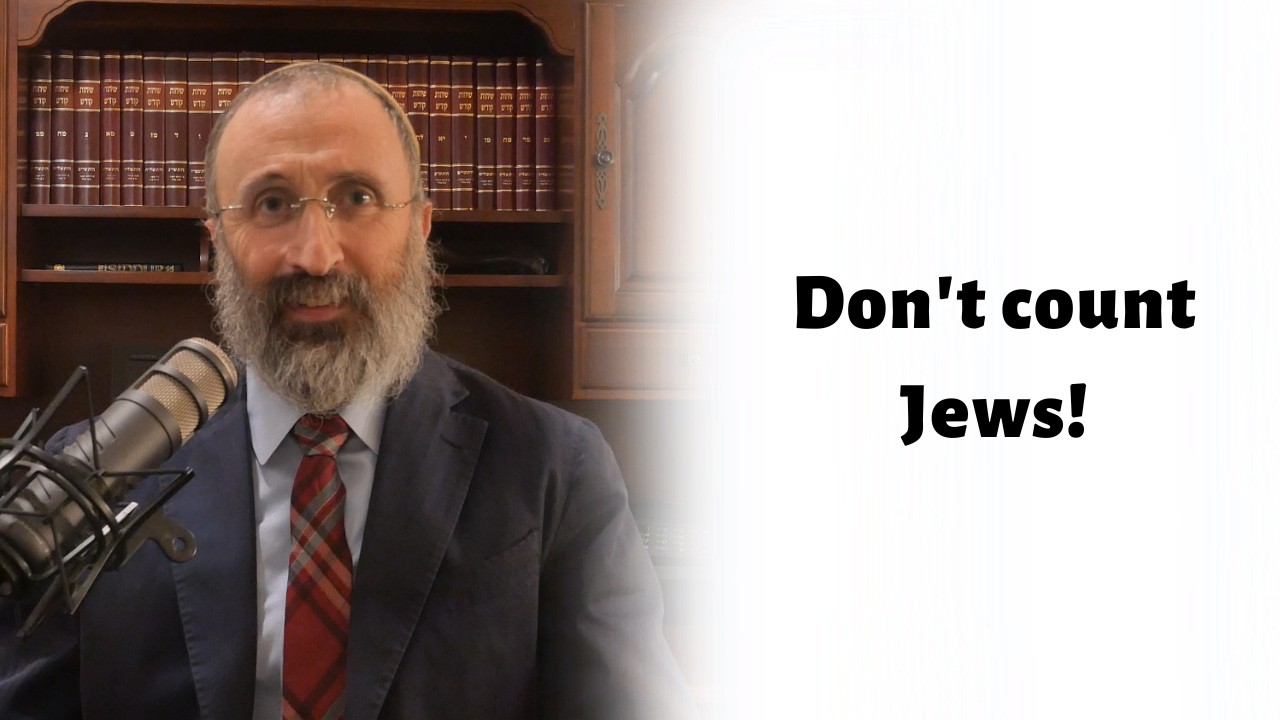
You’ve probably heard about the Jewish custom of not counting Jews directly.
It is based on a Talmudic teaching: blessing rests on things that are hidden from the eye — things that are not counted or measured.
And in the Torah, we’re told that the Jewish people will be “like the sand of the sea, which cannot be counted.”
Also, counting highlights separation. It turns each person into an isolated unit: one, two, three. But the Jewish vision is different. We’re not meant to see ourselves as disconnected individuals — we are parts of one whole.
So, what happens when we actually need to count?
For example, to see if we have ten men for a Minyan — a communal prayer service in the synagogue, we get creative. Sometimes we count kippahs in the room. Or recite a verse from the Torah that has ten words — almost like a children’s counting rhyme.
This idea goes all the way back to the desert.
When Moses needed to conduct a census of the Jewish people, he told each person to give a half-shekel coin to the Temple fund — and then counted the coins.
“This is what they shall give,” he said. Half a shekel.
Later, when leaders needed to count people, they used similar methods. King Shaul made a census of his soldiers by having them bring animals — and he counted the flock instead of the men.
The late Chief Rabbi of the United Kingdom, Jonathan Sacks, explained this in a beautiful way.
He said: Don’t count Jews — because if you count us, it can be very depressing.
We are about 0.2% of the world’s population. There are nearly 100 times more Indians than Jews. If you look only at the numbers, we seem insignificant.
So how should you count the Jewish people?
Moses already gave the answer: “This is what they shall give.”
Count Jews by what they give. Count their contribution.
Look at Jewish philosophers, scientists, and artists. Think of Sigmund Freud, Albert Einstein, Jonas Salk.
But as extraordinary as individual Jewish contributions have been, they pale in comparison to what the Jewish people as a whole have given humanity: a worldview, a moral vision, a value system that reshaped civilization.
It is no accident that the religions that came to influence most of the world emerged from the Jewish people. Jewish ideas shaped the culture and moral language of Europe and Asia, parts of Africa, and later the Americas. Concepts that once were revolutionary — the dignity of every human being, the sanctity of life, the idea of moral responsibility — became so deeply embedded in global consciousness that today many people consider them self-evident.
And again, we see the same pattern:
As great as the contributions of individual Jews are, what we gave together is infinitely greater.
So don’t count Jews as separate entities.
Count us as one whole.
Don’t count our numbers.
Count our contributions.
🎙️ Listen to Rabbi Belinsky's podcast:
On Spotify:
https://open.spotify.com/show/36xL5Vr...
On Apple Podcasts (iTunes):
https://podcasts.apple.com/us/podcast...
On Amazon Music:
https://music.amazon.com/podcasts/97e...

Информация по комментариям в разработке