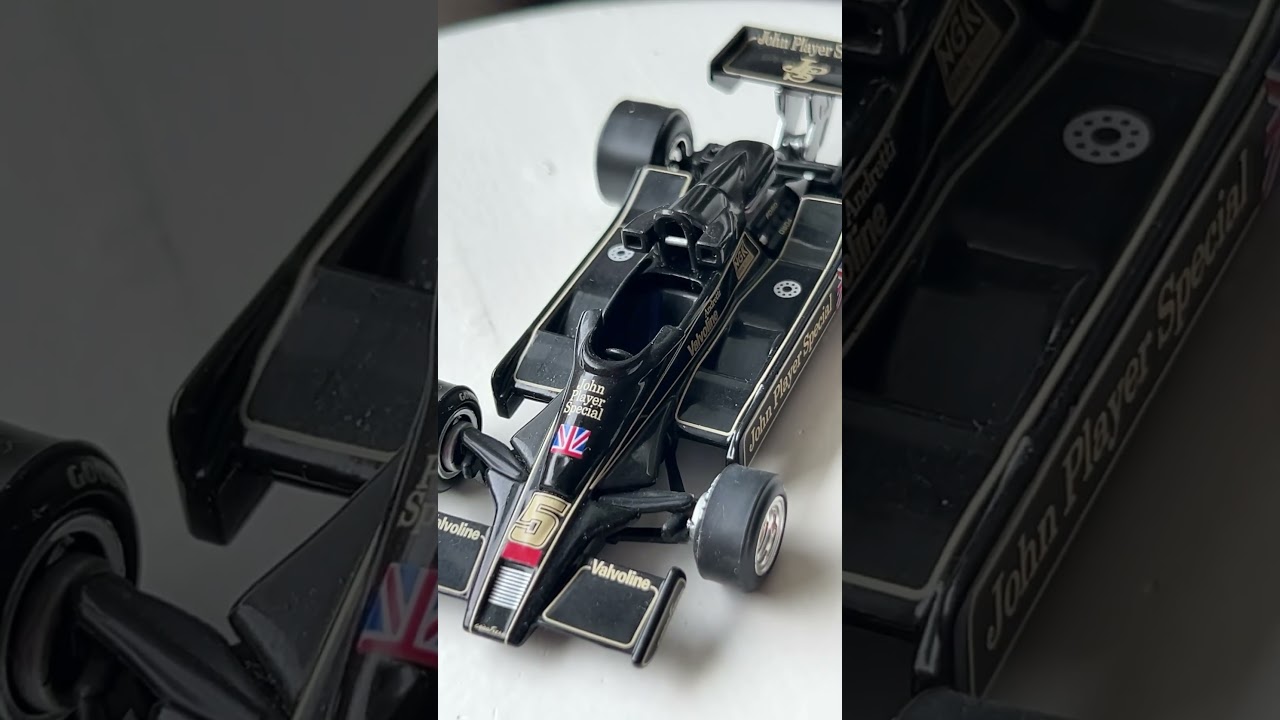
Formula 1 diecast 1:43
The Lotus 78 was a Formula One racing car used in the 1977 and 1978 seasons. It was designed by Peter Wright, Colin Chapman, Martin Ogilvie and Tony Rudd, and was the first ground effect car in Formula One.
In early 1976, spurred on by a disappointing lack of pace of the ageing Lotus 72 the previous season and the indifferent performance of the current Lotus 77, Lotus’ founder and principal design engineer Colin Chapman wrote a 27-page document detailing some new ideas on low drag air penetration. Having studied the de Havilland Mosquito fighter bomber, he had paid close attention to its wing mounted radiators, and the hot air outlets that were designed to induce lift. Chapman realised that, inverted, such a system could give significant downforce. Careful examination of Bernoulli's principle of fluid dynamics confirmed his thoughts on the effects of an upturned aeroplane wing profile fitted to a car, and he finally handed the document to his head of engineering, Tony Rudd.
Rudd appointed a team to work on the project: chief designer Ralph Bellamy, vehicle engineer Martin Ogilvie and aerodynamicist Peter Wright. Rudd and Wright had previously worked for BRM, and before joining Lotus in 1970 had done a design study into the possibility of an inverted wing profile fitted to one of their cars. Rudd had tested a number of scale models, but lack of the right testing methods and BRM's declining fortunes meant development had never got beyond the experimental stage. However, Wright remembered their work and brought it into the project.
Wright then set about experimenting with F1 car body shapes using a wind tunnel and a rolling road, when by happy accident he began to get remarkable results in one of the models. Closer inspection found that as the rolling road's speed increased, the shaped underbody was being drawn closer to the surface of the road. Wright experimented with pieces of cardboard attached to the side of the model car body, and the level of perceived downforce produced was phenomenal. The results were presented to Colin Chapman, who gave the team free rein to come up with an F1 chassis design.
After a round of design sketches and engineering drawings and further work in the wind tunnel at Imperial College, the car was put into production. Five examples were built, codenamed John Player Special Mk. III, otherwise known as the Lotus 78 which appeared in July 1976. Mario Andretti wanted to introduce the car early, possibly at the Dutch Grand Prix that year but was overruled by Chapman, as he didn't want other teams discovering what Lotus had achieved.
The 78 was introduced at the first race of 1977, and proved to be the class car of the field that season, winning five races. The car proved relatively easy to set up and modify, with particular attention paid to the undercar aerodynamics and their interaction with the track surface, hence a stiffer suspension design which was required to maintain the aerodynamic effects.
The 78 was loosely based on the Lotus 72, sharing the same basic wedge shape and internal layout, but featuring detailed aerodynamic improvements, better weight distribution and a longer wheelbase. It had a slimmer, stronger monocoque made from aluminium sheet and honeycomb, which was developed from the 77. The bodywork was made up of fibreglass body panels with aluminium used to strengthen the chassis at points. The car created quite a stir when it first appeared, and outwardly seemed ahead of its time. Internally of course, it was a quantum leap ahead. Andretti worked hard with the car, testing for many thousands of miles at the Lotus test track in Hethel.
Based on Bernoulli's discoveries, the underside of the sidepods were shaped as inverted aerofoils, in the same vein as conventional wings but on a much larger scale. Wright and Chapman had discovered that by shaping the floor of the car in this way, they could accelerate the air passing through the gap between the ground and the underside, thereby reducing the air pressure under the car relative to that over it. This created significant underpressure, effectively sucking the vehicle down and forcing the tyres harder onto the track.
Copying the Mosquito's radiator design, the radiators were positioned so that the hot air escaping would pass over the upper bodywork of the car, creating even more downforce. To make the suction effect as great as possible, the monocoque was slimmer, forcing the air passing through between the ground and the inverted wing shape cover as much as possible.
The greater force downwards on the tyres gave more grip and thus higher cornering speeds. This ground effect had the great advantage of being a low drag solution unlike conventional wings, meaning that the increased cornering ability was not compromised by a decrease in straight-line speed. If anything, because of the decreased air resistance, the top speed of the car also increased accordingly.
Source: Wikipedia.

Информация по комментариям в разработке