Shining Cliff Woods holds a unique industrial past that played a role in shaping Derbyshire’s economic and social landscape. Preserving and studying this history is important for several reasons.
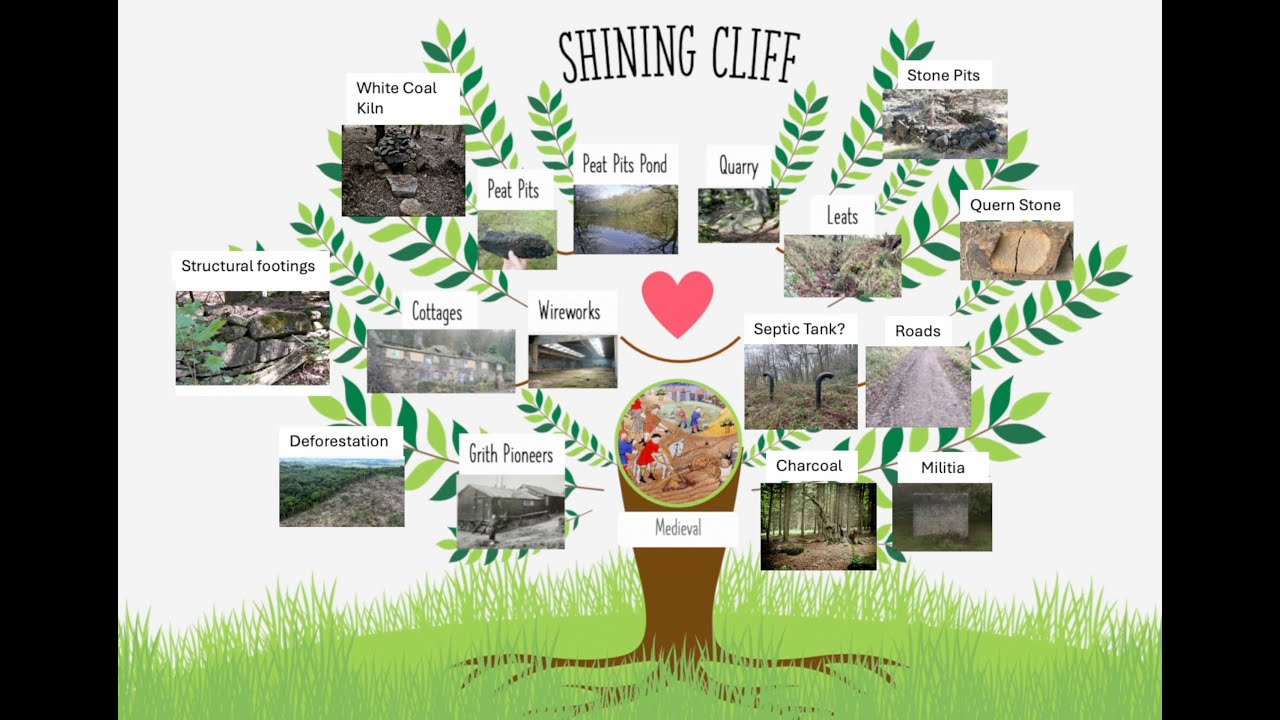
Shining Cliff Woods has a wealth of history and lots of remnants of industrial archaeology just lying underfoot, undisturbed for years. The woods have so much more medieval history to it than those large slabs of recent history of the old Wire Works factory, Oakhurst House, or the famous nursery rhyme Hush a Bye Baby.
Even the name Shining Cliff Wood in medieval times was known as “Schymynde-Cliffe” and was part of the seven royal parks within Duffield Frith, which belonged to Edmund Crouchback, Earl of Lancaster.
The woods borders Alderwasley and Ambergate and were historically significant, but they were not powerful parishes in the same way as major ecclesiastical or urban centres. Instead, they were important industrial and landowning areas within Derbyshire, particularly from the medieval period through the Industrial Revolution.
While Derbyshire is well-known for its mills and mining, the industries in Shining Cliff Woods—charcoal burning, white coal kilns, quarrying, and wire manufacturing—are often overlooked.
• These industries powered the larger Industrial Revolution by supplying materials for smelting, construction, and transport.
• Many of the structures and remnants are at risk of disappearing due to natural erosion, vandalism, or development.
2. A Link to Local and National History
• Shining Cliff was directly connected to major industrial sites such as the Derwent Valley Mills and the Ambergate Wireworks.
• Industries here were part of Britain’s wider transformation from a rural society to an industrial powerhouse.
• Understanding these sites helps fill in the gaps of how smaller, hidden industries supported larger industrial centres.
3. Archaeological and Educational Value
• LiDAR technology has revealed hidden features in the landscape, providing new opportunities for archaeological research.
• Schools, universities, and history groups can use this site to study early industrial techniques, woodland management, and historical ecology.
• Public awareness through documentaries, guided walks, and conservation projects can ensure that these stories are not lost.
4. Connection Between Industry and Nature
• Once a heavily industrialised landscape, Shining Cliff Woods has now been reclaimed by nature.
• Understanding the impact of industry on the environment can inform modern discussions on conservation and sustainable resource use.
• It demonstrates the resilience of nature, showing how landscapes evolve over time.
5. Boosting Local Tourism and Interest
• Many people visit Shining Cliff Woods for its beauty, unaware of its rich industrial past.
• Proper interpretation (signs, trails, or digital resources) could enhance visitor experience and attract history enthusiasts.
• Heritage projects can help support the local economy by encouraging tourism linked to Derbyshire’s industrial past.
6. A Sense of Identity and Legacy
• Many families in Derbyshire have ancestors who worked in these industries.
• Preserving and documenting this history connects current generations with their heritage.
• These industries shaped communities, work culture, and technological advancements that still influence us today.
Protecting the Past for the Future
Shining Cliff Woods is more than just a beautiful landscape—it is a living museum of industrial history. Without preservation, these industries could be lost forever. By researching, documenting, and sharing this history, we ensure that future generations can appreciate and learn from the past.
I have written a paper which details the full history of Shining Cliff Woods. The paper can be found here.
www.academia.edu/128180388/Searching_out_the_industrial_past_of_Shining_Cliff_Woods_Ambergate
The musicis is by "Message To Bears"

Информация по комментариям в разработке