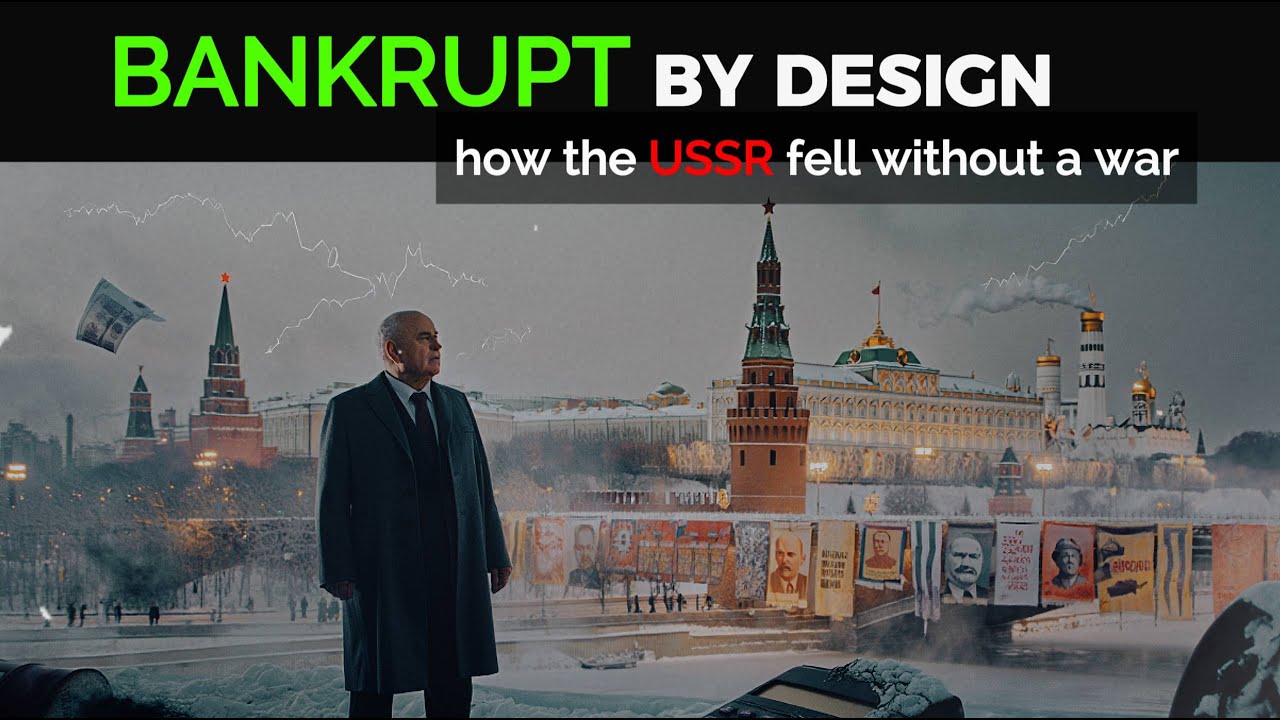
What if the collapse of the Soviet Union wasn’t about ideology or politics — but about money? 💰 Everyone knows the story of communism versus capitalism, but few understand the deeper truth: the USSR didn’t fall to the West — it fell to arithmetic. This documentary reveals the hidden financial collapse of the Soviet economy, exposing how a global superpower was destroyed not by war or revolution, but by numbers that stopped adding up. In the 1980s, while the world saw tanks, speeches, and reforms, the real battle was taking place inside the Soviet money system, where oil prices, ruble valuations, and dollar debts quietly rewrote history. 📉
For decades, the USSR maintained an illusion of power through centralized economic planning, state-controlled banks, and artificial exchange rates. The ruble looked strong on paper, but behind the Iron Curtain, it was collapsing. When oil prices crashed in 1986, the empire’s financial foundation shattered. The State Bank (Gosbank) could print rubles — but it couldn’t print trust. This video uncovers how monetary illusion, oil dependency, and dual-currency accounting turned the world’s second superpower into an empire of paper.
If you’ve ever wondered how money, energy, and politics intertwine to shape empires — this is the untold story. ⚖️ You’ll see how the USSR became a warning for every modern economy: when currencies detach from value, and when governments treat debt as money, collapse is only a matter of time. Just as Rome debased silver, France printed assignats, and modern nations inflate their currencies, the Soviet Union repeated an ancient mistake — believing that power can rewrite economics.
Through real events, data, and historic parallels, the documentary connects the fall of the Soviet system to today’s global financial structure — showing that history doesn’t repeat, it compounds. The same centralized credit creation, artificial interest rates, and political manipulation of money that once doomed the ruble now echo in the world’s most powerful economies. The Federal Reserve, the European Central Bank, and the IMF are today’s new Gosbank — managing confidence instead of value. 🏦
Discover how Mikhail Gorbachev’s perestroika, once seen as reform, was in fact an emergency accounting maneuver, and why the ruble’s death preceded the Soviet Union’s political collapse. Learn how the oil boom of the 1970s masked structural decay, and how black markets, hyperinflation, and trust erosion finished what ideology began. The result wasn’t just the end of communism — it was the beginning of a global experiment in fiat money, debt expansion, and financial illusions that continues today.
This video dives into the hidden history of finance, explaining complex ideas in simple terms — how currencies work, why empires depend on resource pricing, and how arithmetic becomes destiny. Whether you’re passionate about economic history, monetary policy, or geopolitical finance, this story connects the past and present with stunning clarity. The collapse of the Soviet Union wasn’t just an event — it was a monetary warning to every future empire.
If you care about inflation, energy economics, currency devaluation, or the future of global money, you’ll find this video eye-opening. 💸 It exposes the truth behind phrases like “monetary illusion,” “petrodollar dependency,” and “central bank control.” It shows how empires rise on trust — and fall when that trust breaks.
Because in the end, numbers don’t lie — empires do.
Watch until the end to understand why the collapse of the ruble wasn’t just a Soviet tragedy — it was a glimpse into our own financial future. 🌍. #History #Economics #Finance #SovietUnionCollapse #MonetaryHistory #OilCrisis1986 #HiddenMoneyCollapse #RubleDevaluation #GorbachevEra #EconomicIllusion

Информация по комментариям в разработке