The World Bank and the International Monetary Fund are calling on creditor nations to provide debt relief to the world’s poorest nations amid the coronavirus pandemic.
The United States and Federal Reserve have pledged, so far, to inject around $6 trillion into the US economy.
But poorer nations don’t have the same financial firepower of the world’s richer nations. So the move from the IMF and World Bank to ease the pressure on the poorest nations comes at a crucial time.
Health services in rich nations are being stretched by this crisis and developing and poor nations will require support.
The World Bank is making available $12bn to support health and primary care services in low- and middle-income nations. And the IMF has made $50bn available to support emerging markets.
Rising powers are also under pressure. India, for example, where 1.3 billion people are under lockdown, spends 3.7 percent of its gross domestic product (GDP) on healthcare. That is less than China, which spends almost 5 percent, according to data from the World Bank.
The next hot spot for the pandemic could be Africa. According to the Economist, more than half of African countries are above the IMF's recommended limit for public debt.
Ethiopia's Prime Minister Abiy Ahmed has called on the G20 to provide $150bn in emergency funding for the continent.
Andrew Farlow, a senior fellow at the Oxford Martin School, which is part of the University of Oxford, explains there are a number of factors that impact whether people isolate themselves to keep the number of infections low.
"You have to tell people to do things that are actually, to some degree, financially damaging to them, and you need a system to protect them."
Rich nations picking up paycheques
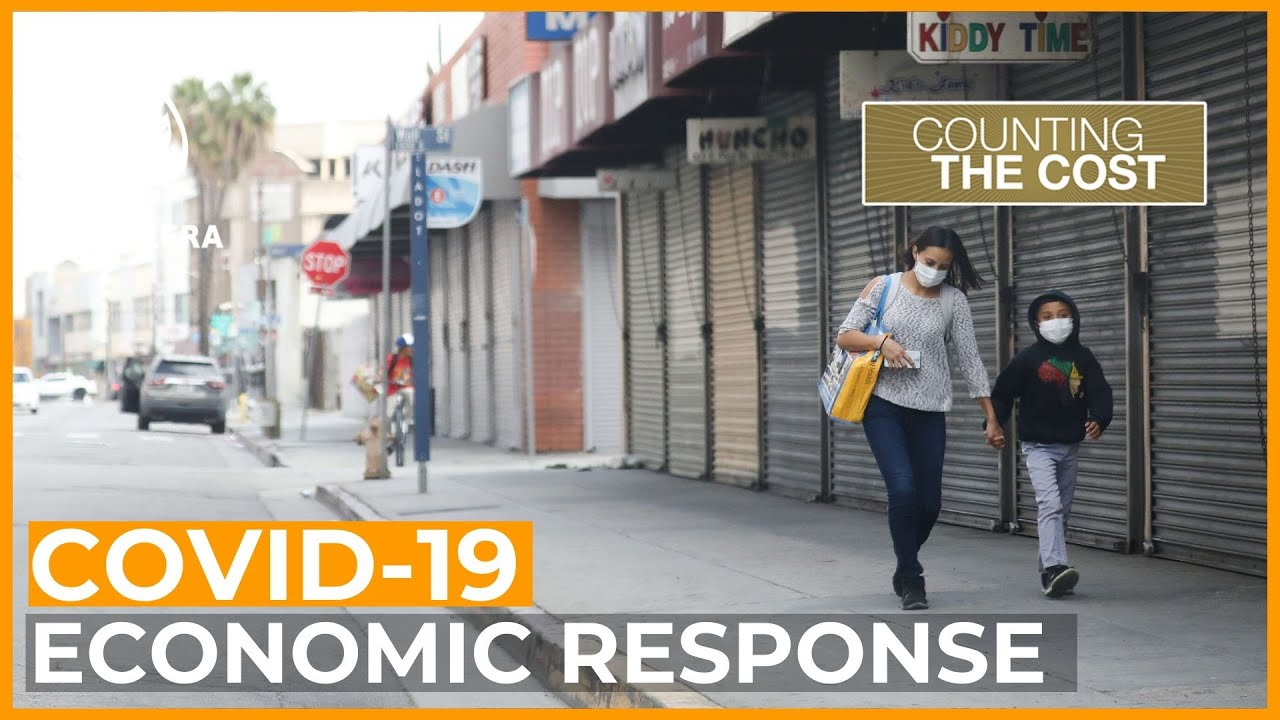
Now, as more than two billion people go into lockdown, many living from paycheque to paycheque and those working in the gig and informal economy are about to lose their livelihoods.
The number of people filing for unemployment benefits rose to more than six million people in the United States - the biggest surge on record.
Rich nations have stepped in to cover lost paycheques. As part of the $2.2 trillion stimulus, many Americans will receive up to $1,200, plus $500 per child.
In the United Kingdom, the government has offered to pay 80 percent of each worker's monthly pay up to 2,500 pounds ($3,065). And in Hong Kong, residents were sent cheques for $1,200 each.
When central banks print money it is called "helicopter money", an idea first introduced in 1969 by Nobel Prize-winning economist Milton Friedman. The idea is to get money directly into the hands of consumers and is seen as a better way to revive an economy.
Alfie Stirling, head of economics at the New Economics Foundation, tells Al Jazeera that all response from government is financed through debt, whether it be loans from a bank or providing income to people, and is very less likely to be "inflationary" at this moment because people are less likely to spend now.
"In the median term, if it were to be inflation, that's actually a sign of the economy warming up again and recovering and central banks are able to adjust interest rates to absorb that but in the short-time, the real crisis is that we don't have enough inflation, we don't have enough spending pressure in the economy because people have lost their incomes."
Subscribe to our channel: http://aje.io/AJSubscribe
Follow us on Twitter: / ajenglish
Find us on Facebook: / aljazeera
Check our website: https://www.aljazeera.com/

Информация по комментариям в разработке