The primary objective of this contemporary review is to discuss health economic evaluation and enhance the understanding of its common methodology. In an era of escalating healthcare expenditures and finite resources, it is crucial for physicians to consider the economic implications of their interventions. The authors emphasize that understanding the common methodologies involved in health economic evaluation will improve the critical appraisal of existing literature and optimize future economic evaluations. This knowledge is particularly relevant for clinicians, such as surgeons, who often encounter new, potentially more effective but higher-cost devices and need to make an economic case for their implementation to decision-makers.
The article provides a comprehensive overview of various types of economic evaluations and related concepts, including:
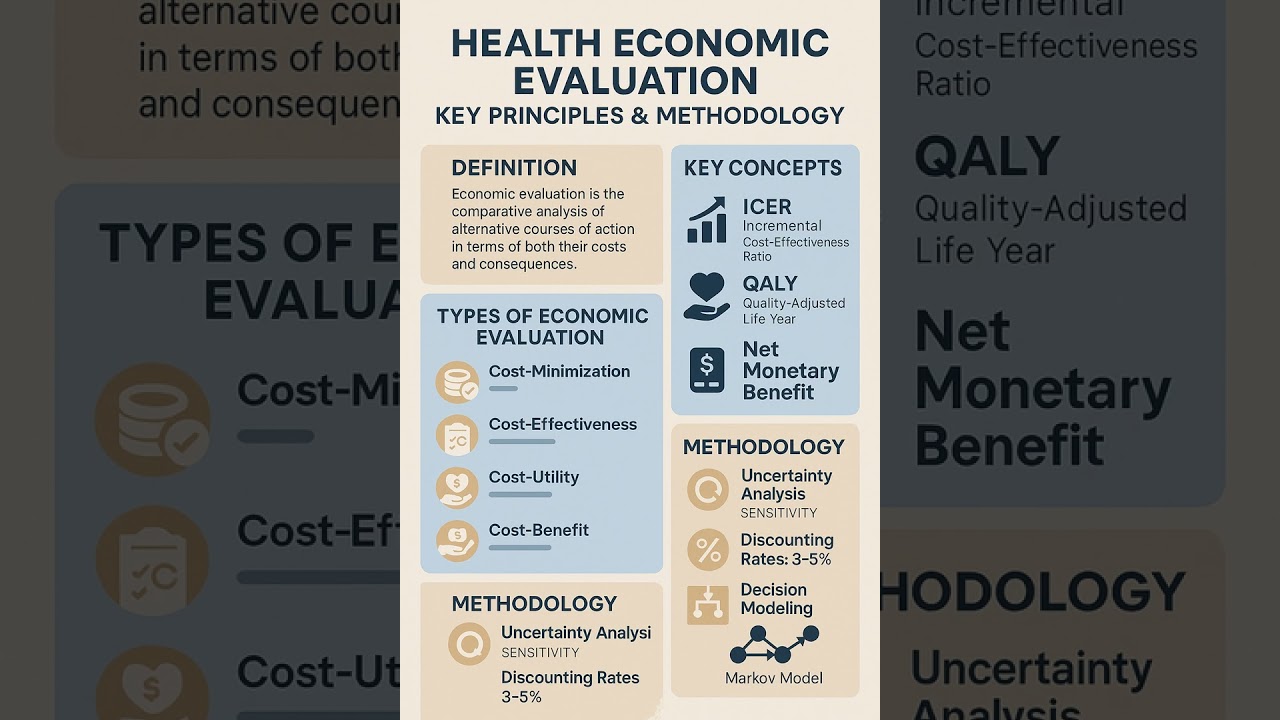
Types of Economic Evaluations Discussed:
Cost-minimization analysis (CMA): Used when the consequences of two interventions are assumed to be identical, focusing solely on identifying the lowest cost.
Cost-effectiveness analysis (CEA): Evaluates costs and consequences using clinical outcomes in "natural units" (e.g., life years gained, complications avoided). Its goal is to maximize societal health benefits within a constrained budget. The article details the Incremental Cost-Effectiveness Ratio (ICER), the cost-effectiveness plane, and the Net Monetary Benefit (NMB) as methods for presenting results.
Cost-utility analysis (CUA): A form of economic evaluation that measures patient preference for a particular health state using a "utility score," most commonly reported as the cost per quality-adjusted life year (QALY). It allows for comparisons across different disease states and can measure the opportunity cost of reallocating scarce resources.
Cost-benefit analysis (CBA): Considered the most comprehensive method, where both the costs and consequences (benefits) of an intervention are valued in monetary terms. This method allows for comparing returns on health investments with investments in other economic sectors.
Key Methodological Topics Covered:
Health-state utility measures: Discusses methods like Time-trade off (TTO) and Standard gamble (SG), as well as generic preference-based systems such as the Health Utilities Index (HUI), EQ-5D, and SF-6D.
Quality-adjusted life year (QALY): Defined as the product of life expectancy and quality of life in remaining years, it captures gains from reduced morbidity and mortality into a single measure. The article also addresses its advantages and inherent limitations.
Uncertainty analysis: Emphasizes the importance of sensitivity analysis (SA), including simple SA (one-way SA, Tornado diagram), scenario SA, threshold SA, and the robust probabilistic SA, which typically presents results using a cost-effectiveness acceptability curve (CEAC).
Discounting: Explains the practice of discounting future costs due to time preference and discusses the debate and current practice regarding discounting effectiveness outcomes.
Economic modeling: Focuses on evaluating specific clinical decisions or pathways by incorporating data from various sources. The two most common modeling methods discussed are:
Decision tree analysis: Identifies expected costs and effects by following patients through clinical pathways from a single discrete time point, though limited for chronic conditions.
Markov modeling: Overcomes decision tree limitations by cycling patients through "health states" over a defined number of cycles, accumulating costs and effects based on the state occupied, making it suitable for long-term evaluations of chronic diseases.
Reference: Rudmik, L., & Drummond, M. (2013). Health economic evaluation: Important principles and methodology. The Laryngoscope, 123, 1341–1347.

Информация по комментариям в разработке