From Heaven Distilled a Clemency, March 2017
Under the direction of Dr. Anne J. Matlack
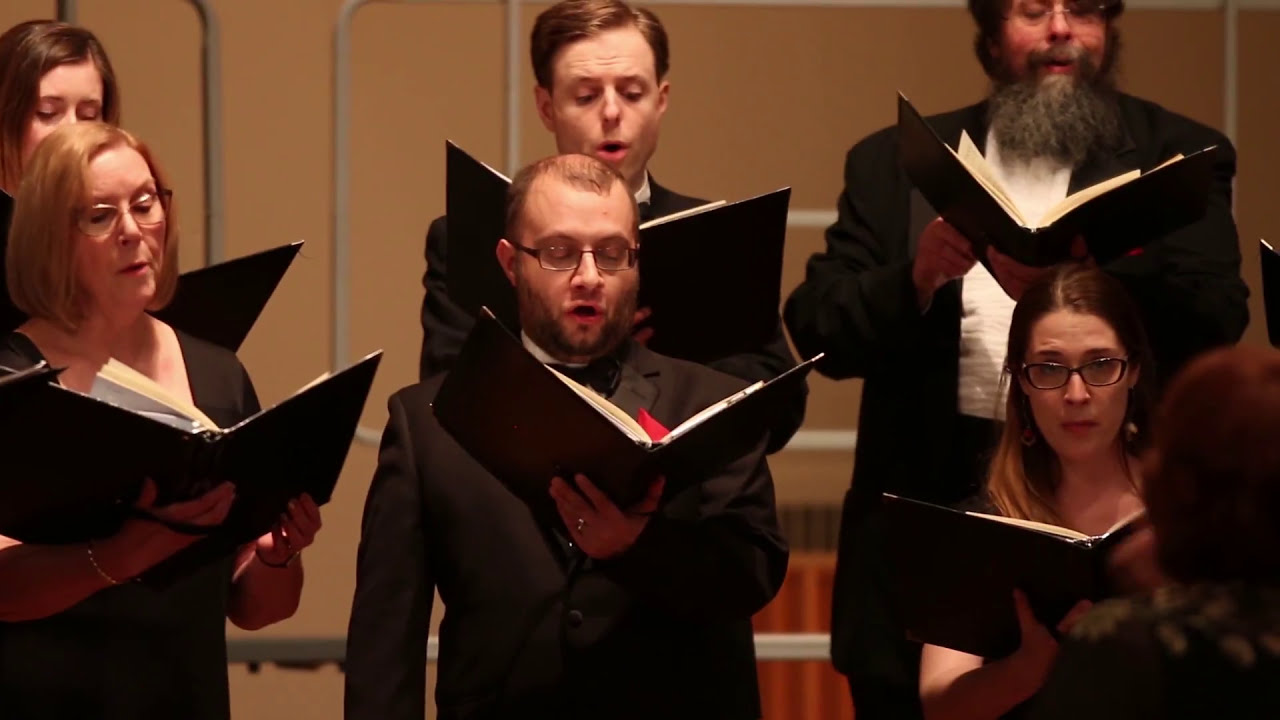
Harmonium Choral Society Chamber Singers
Chatham United Methodist Church, Chatham, New Jersey
Francis Poulenc was a child of Paris, and a mixture of eclectic influences. His cosmopolitan, cultured mother taught him piano beginning at age 5, while his provincial father was a devout Roman Catholic. His mother and uncle hosted actors and artists at their apartment, and took him to concerts and galleries in the vibrant cultural life of the early twentieth-century Paris of Debussy, Ravel, Stravinsky, Proust, Picasso and Diaghilev. His summers were spent in the suburb of Nogent-sur-Marne, where he heard the wild accordion music of river boats and cafés with which he later sought to infuse his own music. His musical training began with the Spanish pianist Ricardi Vines, who introduced him to Satie, the surrealist Jean Cocteau, and Stravinsky. By the time he was 17, he became part of an avant-garde group of young composers dubbed “Les Six”—Poulenc, Auric, Durey, Honegger, Milhaud and Tailleferre—who rebelled against the grandiosity of Wagner and the vagueness of Impressionism. They sought clarity and more emotional restraint, and celebrated the primitive, the everyday, and self-mockery.
James Reel of the Arizona Daily Star has a wonderful website called The Timid Soul’s Guide to Classical Music in which he states, “Poulenc and his circle hit the 1920s classical music scene with the same biting, nihilistic force with which the punk rock movement slammed into popular music in the 1970s.”
As Poulenc developed his largely self-taught style into a full-blown career, he was influenced by the neoclassic works of Stravinsky, the Dadaism of Satie, the surreal poets Apollinaire, Cocteau, and Éluard, and such contrasting influences as Schubert’s Winterreise (as he accompanied the baritone Pierre Bernac). Says Reel, “as his career progressed, Poulenc did retain his taste for tart harmonies and unexpected turns of phrase. But he also developed a fondness for traditional French qualities of grace, charm, and light melodiousness.”
A huge turning point in Poulenc’s life came in the summer of 1936: while he was vacationing in Uzerche, news reached him that his close friend, musician Pierre-Octave Ferroud, had been killed in a car accident. Severely shaken, he drove to a pilgrimage site at Rocamour, a place his father had told him of. The statue of the Black Virgin here had such a profound emotional and spiritual impact that he found himself returning to the faith of his childhood, and began work that night on his Litanies à la vierge noir, a work of “country devotion.” For the rest of his life, Poulenc espoused and was inspired by his rediscovered religious fervor, and turned more and more to sacred music. Poulenc composed the Four Lenten Motets shortly after finishing his Mass in G in 1937. The texts are very old poems conflating and adapting Biblical passages from Psalm 55 (“Timor et tremor”), the Gospels (“Tenebrae factae sunt” and “Tristis est anima mea”), and Isaiah 5 (“Vinea mea electa”).
These motets include high levels of dissonance alternating with sweet and diatonic moments, chosen to illuminate the emotional impact of the text. Poulenc said he thought his sacred choral music represented “the best and most genuine part” of himself: he used great care and variety of range (highs and lows), divisi (from single line and 2-part to 8 and 9 voice textures), dynamics (louds and softs) to serve the text. These motets seem to be very much set in the point of view of the sacrificial Jesus on the cross.
Timor et tremor alternates impassioned forte outcries with spooky hushed piano sections. Dissonant outcries and chromatics are also used to create the urgent plea.
Program notes: http://www.harmonium.org/s/2016-from-...
Follow us on socials!
Facebook: / harmoniumchoral
Instagram: / harmoniumchoral
Apple Music: / harmonium-choral-society
Spotify: https://open.spotify.com/artist/0xGCh...
Amazon: https://www.amazon.com/s?i=popular&rh...

Информация по комментариям в разработке