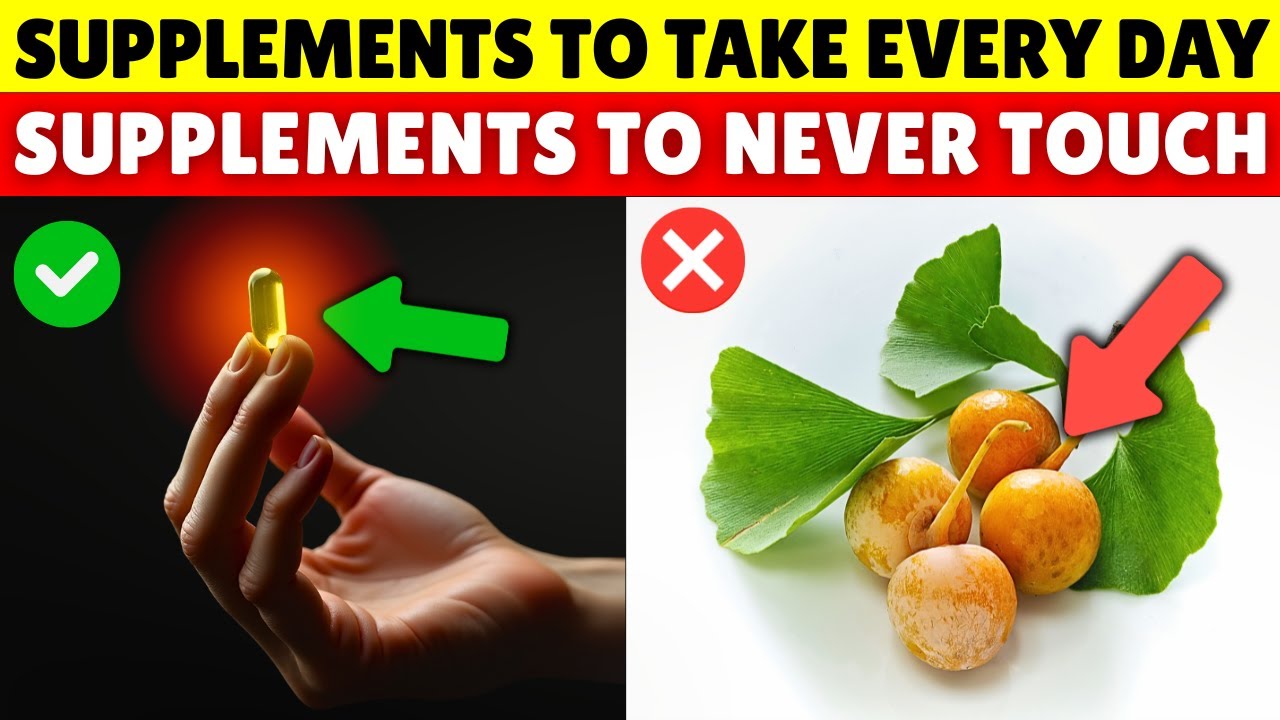
Seniors: 4 DANGEROUS Supplements You Should AVOID and 4 You MUST Take Every Day!
If you're over 60 and taking daily supplements, some may be doing more harm than good. In this video, we expose the 4 most dangerous supplements that can interfere with medications and damage your health—plus reveal the 4 essential ones every senior needs for optimal brain, bone, and heart health.
✅ Backed by medical research
✅ Ranked from most to least dangerous
✅ Safe, science-proven alternatives that actually work
📊 87% of seniors are taking risky supplements without knowing the dangers, while missing the #1 nutrient that protects against cognitive decline!
Don't let hidden supplement risks sabotage your health—watch this complete guide now.
👇 Drop a comment: Where are you watching from today?
📌 All scientific studies are linked in the video description below.
⌛Timestamps:
⏱️ Introduction – 00:00
❌ Dangerous Supplement #4: Iron (When Not Deficient) – 00:58
❌ Dangerous Supplement #3: High-Dose Vitamin A – 01:48
❌ Dangerous Supplement #2: St. John's Wort – 02:37
❌ Dangerous Supplement #1: Ginkgo Biloba – 03:42
✅ Essential Supplement #4: Vitamin D3 + K2 – 05:04
✅ Essential Supplement #3: Magnesium (Citrate or Glycinate) – 05:55
✅ Essential Supplement #2: Omega-3 Fatty Acids (EPA/DHA) – 06:44
✅ Essential Supplement #1: Vitamin B12 (Methylcobalamin) – 07:49
💡 Smart Supplement Habits for Seniors – 08:52
#seniorhealth #seniorhealthtips #supplementsafety #supplements_for_health #healthyaging #seniorwellness
🔍Video References:
⚠️ Dangerous Supplements References:
Fleming DJ, et al. "Iron status of the free-living, elderly Framingham Heart Study cohort." Am J Clin Nutr. 2001.
Meyers DG, et al. "Safety of antioxidant vitamins." Arch Intern Med. 2006.
Hathcock JN, et al. "Evaluation of vitamin A toxicity." Am J Clin Nutr. 1990.
Fugh-Berman A. "Herb-drug interactions." Lancet. 2000.
Izzo AA, et al. "Drug interactions with St. John's Wort (Hypericum perforatum)." Drug Saf. 2004.
Jiang X, et al. "Effect of ginkgo and ginger on the pharmacokinetics and pharmacodynamics of warfarin." Br J Clin Pharmacol. 2005.
DeKosky ST, et al. "Ginkgo biloba for prevention of dementia: a randomized controlled trial." JAMA. 2008.
✅ Essential Supplements References:
Holick MF. "Vitamin D deficiency." N Engl J Med. 2007.
Theuwissen E, et al. "The role of vitamin K in soft-tissue calcification." Adv Nutr. 2012.
DiNicolantonio JJ, et al. "Subclinical magnesium deficiency: a principal driver of cardiovascular disease." Open Heart. 2018.
Volpe SL. "Magnesium in disease prevention and overall health." Adv Nutr. 2013.
Calder PC. "Omega-3 fatty acids and inflammatory processes." Nutrients. 2010.
Morris MC, et al. "Fish consumption and cognitive decline with age in a large community study." Arch Neurol. 2005.
Wolters M, et al. "Cobalamin: a critical vitamin in the elderly." Prev Med. 2004.
Allen LH. "How common is vitamin B-12 deficiency?" Am J Clin Nutr. 2009.
_______________________________________________________________
🎥 Other Videos You Might Enjoy:
🌟Drink THIS 1 Liquid & Regain Leg Strength in Just 12 Hours | Senior Health Tips
► • Drink THIS 1 Liquid & Regain Leg Strength ...
🌟5 LEG Strengthening SECRETS Seniors, Do THIS to Stay Active and Strong
► • 5 LEG Strengthening SECRETS Seniors, Do TH...
🌟Seniors? 3 TOXIC Breakfast Foods You Should NEVER Touch and 3 You MUST Eat
► • Seniors? 3 TOXIC Breakfast Foods You Shoul...
_______________________________________________________________
► Disclaimer: BETTER ELDER does not provide medical advice and the information provided throughout our videos, including but not limited to, text, graphics, images, and other materials, are entirely intended for informational purposes. The content of BETTER ELDER's videos is not intended to replace the professional medical advice that you should seek from your doctor. All the information presented in these videos is for educational purposes only.
► Copyright Disclaimer Under Section 107 of the Copyright Act 1976, allowance is made for 'fair use' for purposes such as criticism, comment, news reporting, teaching, scholarship, and research. Fair use is a use permitted by copyright statute that might otherwise be infringing. Non-profit, educational or personal use tips the balance in favor of fair use. No copyright infringement intended. ALL RIGHTS BELONG TO THEIR RESPECTIVE OWNERS.

Информация по комментариям в разработке