#orbitalassemblycorp #gatewayfoundation #space
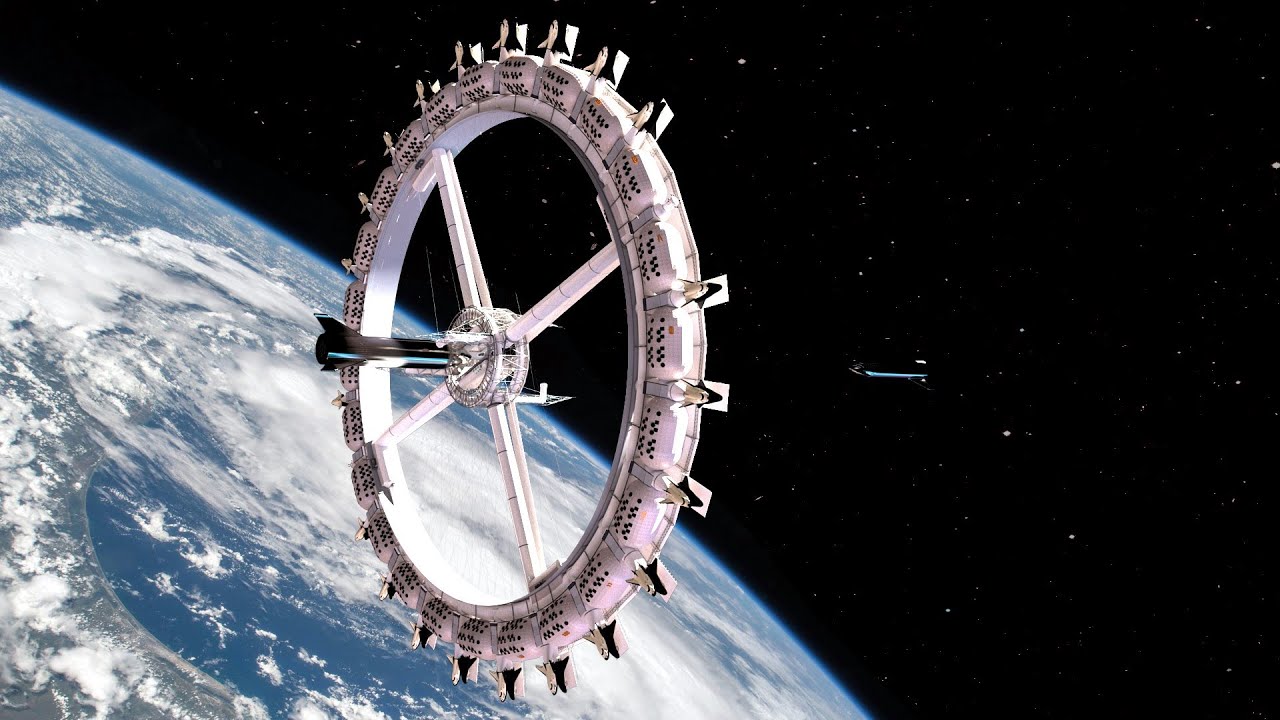
Orbital Assembly, the California-headquartered company that bills itself as “The World’s First Large Scale Space Construction Company”, is seeking global investors to facilitate its building of Voyager Station, the first habitable space station with artificial gravity before 2030.
Destined to primarily accelerate the colonisation of space and boost the billion-dollar space industry Voyager Station is being promoted as a rotating space station able to produce varying levels of artificial gravity by increasing or decreasing the rate of rotation.
The 200-metre-wide rotating space habitat will be able to host 400 people at once.
Construction of the station is expected to start in five years’ time.
While claiming to be at the forefront of space construction technology Orbital Assembly maintains that the station is designed to accommodate business, manufacturing, national space agencies conducting low gravity research, and space tourists who want to experience life on a large space station with the comfort of low gravity and the feel of a luxury hotel.
With Voyager Station, the company is offering its investment partners the chance to make history as the first humans to own real estate in orbit and is making luxury villas, commercial, retail, and industrial space available on the station. Short and long term leases are also available.
When first unveiled, the station project was named after the father of NASA’s Apollo programme that first took humanity to the Moon. However, in early 2020 the station was renamed to Voyager, to embody the spirit of what the station will mean to all those who travel there.
The planned orbit and elevation for Voyager Station is 97 deg and 500-550km (Low Earth Orbit). This orbit will reduce thermal stress and allow for almost continuous solar power generation. Orbit degradation and space debris risk will also be nominal here.
The first piece of Voyager to be built will be the Docking Hub (inner ring) an un-pressurised ring structure with docking arms and stabilisers designed to capture and lock in place a visiting spacecraft to unload passengers and cargo.
Initially, the station will have one docking port, but later, another one will be added so that two spacecraft can simultaneously dock to the station.
Passenger and cargo access to the station will be through a set of pressurised access tubes connecting the Docking Hub to the Outer Ring Truss.
After the Docking Hub the Outer Ring Truss (ORT) will be constructed next. The ORT will comprise a triangular unpressurised ring truss supported by a network of spokes to the Docking Hub. An Access Tube set inside the ORT that will allow people to move about the station freely.
The ORT will be the backbone of the station and provide mounting for habitable modules, solar panels, radiators, and a rail transport system.
The Habitation Ring, a series of large, connected, pressurised modules, will be located below the ORT.
Each Habitation Ring module will have a pressurised volume of 1,809.5m3 and have two to three internal levels.
The modules will have various configurations, including: Air Water Power Module; Gymnasium and Assembly Module; Kitchen, Restaurant, and Bar Module; Crew Quarters Module; privately owned modules for villas, hotels, or commercial activity’ and government-owned modules for scientific research, training, and staging facilities.
The station’s simulated gravity will offer amenities like toilet facilities, showers, and beds, a far cry from today’s space trips that typically cost up to US$25 million per person staying in a weightless facility, using vacuums for toilets, sleeping in a bag strapped to a wall, and living in a working laboratory.
Luxury villa modules on the station will be available to rent for a week, a month, or purchased as a vacation home. The luxury villas will feature cooking facilities, three bathrooms, and sleeping accommodations for up to 16 people.
The station’s hotel suite modules will be available to rent for a three-day trip or a month, and will feature private bathrooms, and sleeping accommodation for two people.
The station’s Gym and Activity Module will comprise of a large recreation hall with a ceiling over 23ft high and permitting jumping, running, and playing sports in the 1/6th Earth gravity environment. The lower level gym will be equipped with weights and treadmills allowing users to work out while watching the Earth and stars rotate below the station.
Voyager Station fast facts:
• 11,600 m2 of habitable space in modules and access tubes
• 200m in overall diameter (ISS is 73m long and 109m wide)
• Estimated mass: 2,418 metric tons (ISS: 419 tons)
• Estimation volume: 51,104m3 (ISS pressurised volume: 915 m3)
• 24 habitation modules (12m diameter x 20m long)
• Maximum occupancy: 316 to 440 (ISS: 7 when fully crewed)
• 44 Emergency Return Vehicles
• Solar panel area: 9,738m2 (ISS: 2,500m2)
Credit: Orbital Assembly

Информация по комментариям в разработке