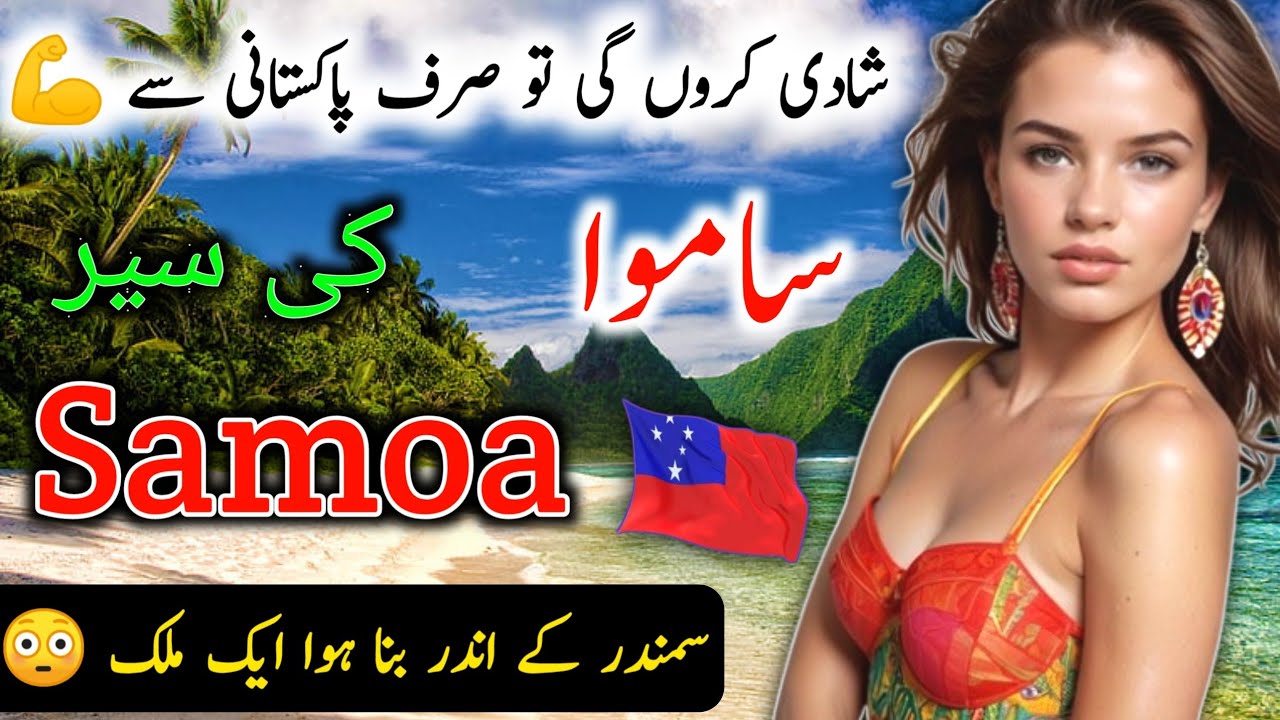
Travel to Samoa Country| documentary history Urdu Hindi about Samoa| Explore World| Facts about Samoa
Travel to Egypt
• Видео
Travel to Jordan
• Travel to Jordan |documentary history Urdu...
#exploreworld #samoa #documentary #history #travel
***************************************************************************************************
Samoa, an island nation located in the South Pacific Ocean, is renowned for its stunning natural beauty, rich cultural heritage, and intriguing history. Situated between Hawaii and New Zealand, Samoa comprises two main islands, Upolu and Savai'i, along with several smaller ones. The country, officially known as the Independent State of Samoa, has a population of around 200,000 people. The capital city, Apia, located on Upolu, is the largest city and serves as the administrative and economic hub. The official languages are Samoan and English, reflecting both the indigenous culture and historical foreign influences.
Samoa's history stretches back over 3,000 years, with the first settlers believed to have arrived from Southeast Asia. These early Polynesian people established complex social structures and engaged in trade and cultural exchanges with neighboring islands. Samoa's strategic location made it an important hub in the Polynesian Triangle, which includes Hawaii and Easter Island.
European contact with Samoa began in the early 18th century when Dutch and French explorers visited the islands. However, significant interest from European powers did not emerge until the 19th century. In the late 1800s, Germany, the United States, and Great Britain established their presence in the region, vying for control over the islands due to their strategic importance and economic potential. In 1899, the Tripartite Convention was signed, dividing the Samoan islands between Germany and the United States. Western Samoa (now Samoa) became a German colony, while Eastern Samoa (now American Samoa) fell under U.S. control. German Samoa experienced significant economic development during this period, with the introduction of large-scale plantations and infrastructure projects.
During World War I, New Zealand forces occupied German Samoa, and in 1920, the League of Nations granted New Zealand a mandate to administer the territory. The New Zealand administration continued until Samoa gained its independence. Despite improvements in infrastructure and education, the New Zealand administration faced resistance from Samoans who sought greater autonomy and independence.
Samoa achieved independence from New Zealand on January 1, 1962, making it the first Pacific island country to gain independence in the 20th century. The nation adopted a democratic system of government with a parliamentary democracy. The head of state, known as the O le Ao o le Malo, is elected for a five-year term, and the legislative assembly consists of members elected by universal suffrage. In the years following independence, Samoa focused on developing its economy and infrastructure while preserving its cultural heritage. The country relies heavily on agriculture, with coconut, taro, and bananas being key exports. Additionally, remittances from Samoans living abroad play a significant role in the economy.
Samoan culture is deeply rooted in Fa'a Samoa, or "The Samoan Way," which emphasizes community, family, and respect for tradition. The matai system, a traditional form of governance led by chiefs, continues to play a vital role in Samoan society. Traditional ceremonies, dance, music, and tattooing (tatau) are integral aspects of Samoan culture.
Samoa's natural beauty attracts tourists from around the world. The islands boast pristine beaches, lush rainforests, and stunning waterfalls. Visitors can explore the Piula Cave Pool, To Sua Ocean Trench, and the scenic Lalomanu Beach. Ecotourism and cultural tourism are growing sectors, providing economic opportunities for local communities.
In conclusion, Samoa's rich history, cultural heritage, and breathtaking landscapes make it a unique and captivating destination. From its ancient Polynesian roots to its modern democratic government, Samoa offers a fascinating journey through time and tradition.
------------------------------------------------------------------------
Copyright Disclaimer: - Under section 107 of the copyright Act 1976, allowance is mad for FAIR USE for purpose such a as criticism, comment, news reporting, teaching, scholarship and research. Fair use is a use permitted by copyright statues that might otherwise be infringing. Non- Profit, educational or personal use tips the balance in favor of FAIR USE.

Информация по комментариям в разработке