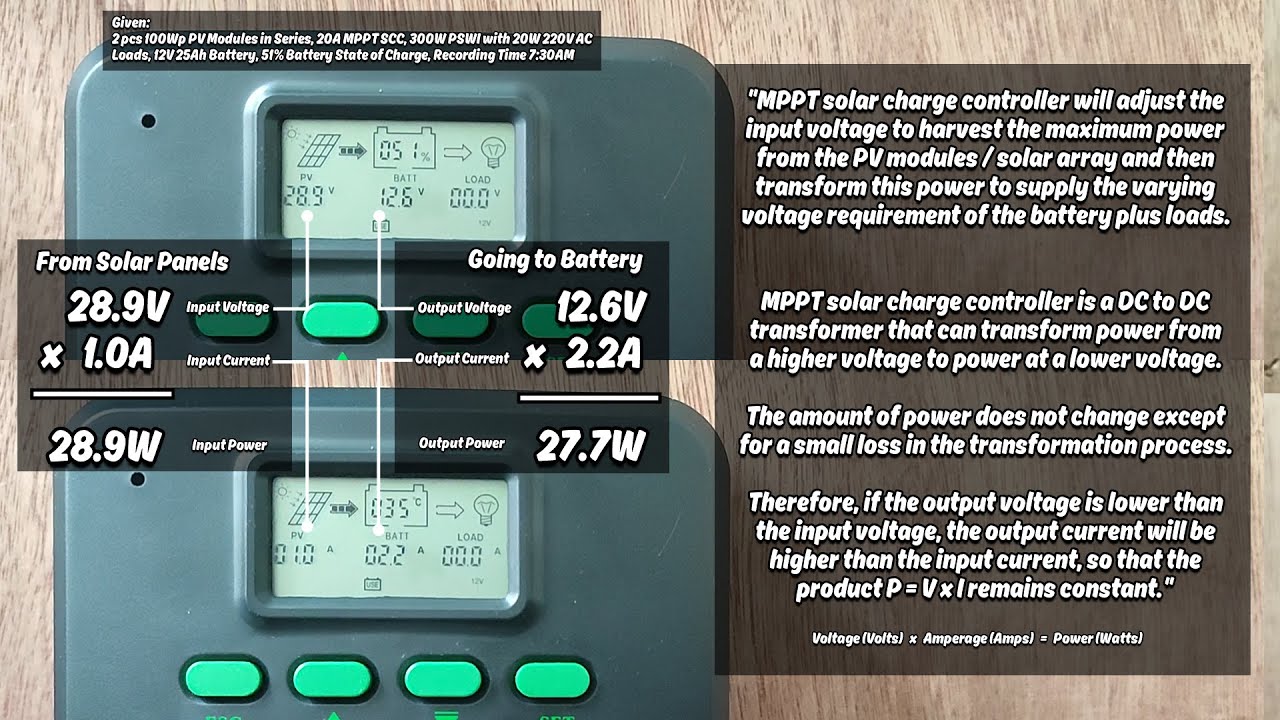
This very short clip mainly demonstrates the concept of 'DC to DC Conversion' within an MPPT Solar Charge Controller.
MPPT stands for Maximum Power Point Tracking. "MPPT charge controller will adjust the input voltage to harvest the maximum power
from the PV modules / solar array and then transform this power supply the varying voltage requirement of the battery plus loads."
As for its DC to DC conversion capability: "The MPPT charge controller is a DC to DC transformer that can transform power from a higher voltage to power at a lower voltage.
The amount of power does not change except for a small loss in the transformation process.
Therefore, if the output voltage is lower than the input voltage, the output current will be higher than the input current, so that the product P = V x I remains constant."
Source (Victron Energy):
https://www.victronenergy.com/upload/...
💡Ang hindi ko makita sa CM-D20 SCC na ito ay ang multi-stage charging at multiple configurable battery charging parameters na katulad ng MPPT SCC na ito (Epever Tracer 2215BN) ↓↓↓
• 3 Steps to Full Charge with MPPT SCC from ...
Para sakin, importante na makapag configure ang end-user nung Boost Voltage setpoint, Boost Charging Time at iba pa.
Sa CM-D20, itong tatlo lang ang configurable voltage parameters na pwedeng i-set ng end-user ↓↓↓
https://b.link/LimitedSettings
● Question:
If I have 2 pieces 100Wp PV module wired in Series then connected to a 20A MPPT solar charge controller, will I get a constant 200 Watts regardless of the time of the day, the intensity of sunlight, and battery State of Charge?
● Answer:
The short answer is No. You won’t get a constant 200 Watts output at all times - the power from your PV module will vary based on multiple factors such as sunlight intensity, temperature, and the battery’s state of charge.
● Why Power Is Not Constant
1. Sunlight Intensity (Irradiance):
The amount of sunlight hitting your PV module fluctuates throughout the day due to the sun’s position, weather conditions (clouds, fog), and seasonal changes.
When the sunlight is more intense, the PV module produces more current and voltage, hence more power.
During cloudy periods or early morning/late afternoon, the power output drops significantly.
2. Temperature:
PV modules are affected by temperature: higher temperatures generally lower the voltage output, reducing overall power.
Cooler conditions often increase voltage, potentially increasing power output (up to a point).
3. Battery State of Charge (SoC):
When batteries are nearly full, the charge controller may reduce the current flow to prevent overcharging, thus reducing power transfer.
If the battery is full or in a maintenance mode, the PV output could be diverted or limited, causing fluctuations.
4. Maximum Power Point (MPP):
The MPPT charge controller continuously tracks the MPP of the PV array.
Because the MPP shifts with changing sunlight and temperature, the controller adjusts its internal parameters to extract the maximum possible power at any given moment, which may be less than the theoretical maximum.
● What Does 100 Wp Mean?
The 100 Wp (Watts peak) rating indicates the maximum rated power under standard test conditions (STC), which are typically 1000 W/m² irradiance, cell temperature of 25°C, and an air mass of 1.5.
In real-world conditions, the actual power output will often be less than 100 Watts, varying throughout the day and weather.
● In conclusion:
Your 100 Wp PV modules will not produce a constant 100 Watts at all times. Instead, its power output fluctuates based on environmental conditions and system states. The MPPT controller helps to maximize the power extracted during these fluctuations, but the actual delivered power will vary throughout the day.
What is MPPT
MPPT
Maximum Power Point Tracking
SCC
Solar Charge Controller
DC to DC Conversion
MPP
Maximum Power Point
Irradiance
STC
Standard Test Conditions
PV Module
Cell Temperature
Air Mass
PhotoVoltaic Module
Solar Panel
SOC
State of Charge
CM-D20 MPPT
Aoyang
Aoyong
LairtPow
Sunsky
Philippines

Информация по комментариям в разработке