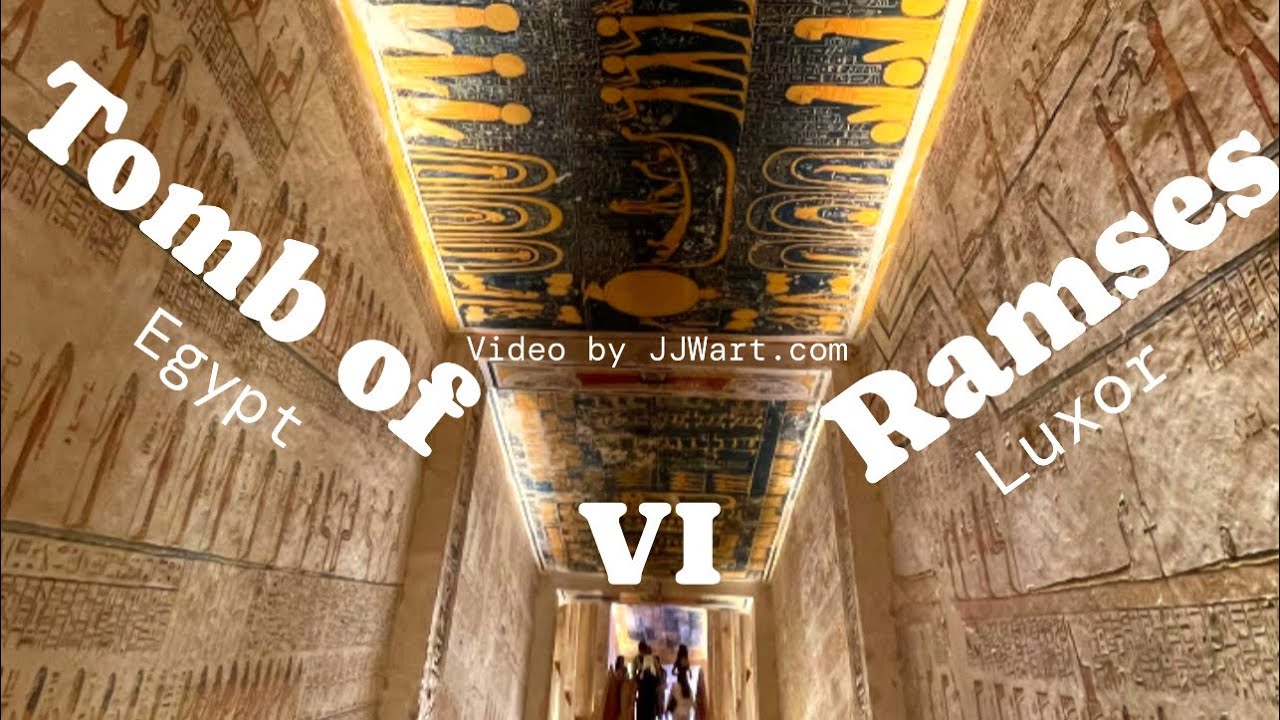
With some of the broadest corridors, longest shafts (117m) and greatest variety of decoration, KV 9 is one of the most spectacular tombs in the valley. Started by Ramses V and finished by Ramses VI, it is a feast for the eyes, much of its surface covered with intact hieroglyphs and paintings. The burial chamber has an unfinished pit in the floor and a magnificent figure of Nut and scenes from the Book of the Day and Book of the Night.
Tutankhamun’s tomb remained intact until 1922 largely thanks to the existence of the neighbouring tomb of Ramses VI, which acted as an unwitting cloak for the older tomb's entrance. KV 9 was begun for the ephemeral Ramses V (1147–1143 BC) and continued by Ramses VI (1143–1136 BC), with both pharaohs apparently buried here; the names and titles of Ramses V still appear in the first half of the tomb. Following the tomb’s ransacking a mere 20 years after burial, the mummies of both Ramses V and Ramses VI were moved to Amenhotep II’s tomb where they were found in 1898 and taken to Cairo.
Although the tomb’s plastering was not finished, its fine decoration is well preserved, with an emphasis on astronomical scenes and texts. Extracts from the Book of Gates and the Book of Caverns cover the entrance corridor. These continue into the midsection of the tomb and well room, with the addition of the Book of the Heavens. Nearer the burial chamber the walls are adorned with extracts from the Book of Amduat. The burial chamber itself is beautifully decorated, with a superb double image of Nut framing the Book of the Day and Book of the Night on the ceiling. This nocturnal landscape in black and gold shows the sky goddess swallowing the sun each evening to give birth to it each morning in an endless cycle of new life designed to revive the souls of the dead pharaohs. The walls of the chamber are filled with fine images of Ramses VI with various deities, as well as scenes from the Book of the Earth, showing the sun god’s progress through the night, the gods who help him and the forces of darkness trying to stop him reaching the dawn. Look out for the decapitated kneeling figures of the sun god’s enemies around the base of the chamber walls and the black-coloured executioners who turn the decapitated bodies upside down to render them as helpless as possible.
Ramesses VI Nebmaatre-Meryamun (sometimes written Ramses or Rameses, also known under his princely name of Amenherkhepshef was the fifth ruler of the Twentieth Dynasty of Egypt. He reigned for about eight years in the mid-to-late 12th century BC and was a son of Ramesses III and queen Iset Ta-Hemdjert. As a prince, he was known as Ramesses Amunherkhepeshef and held the titles of royal scribe and cavalry general. He was succeeded by his son, Ramesses VII Itamun, whom he had fathered with queen Nubkhesbed.
After the death of the ruling pharaoh, Ramesses V, who was the son of Ramesses VI's older brother, Ramesses IV, Ramesses VI ascended the throne. In the first two years after his coronation, Ramesses VI stopped frequent raids by Libyan or Egyptian marauders in Upper Egypt and buried his predecessor in what is now an unknown tomb of the Theban necropolis. Ramesses VI usurped KV9, a tomb in the Valley of the Kings planned by and for Ramesses V, and had it enlarged and redecorated for himself. The craftsmen's huts near the entrance of KV9 covered up the entrance to Tutankhamun's tomb, saving it from a wave of tomb robberies that occurred within 20 years of Ramesses VI's death. Ramesses VI may have planned and made six more tombs in the Valley of the Queens, none which are known today.
Egypt lost control of its last strongholds in Canaan around the time of Ramesses VI's reign. With construction projects increasingly hard to fund, Ramesses VI usurped the monuments of his forefathers by engraving his cartouches over theirs. Yet he boasted of having "[covered] all the land with great monuments in my name [...] built in honour of my fathers the gods". He was fond of cult statues of himself; more are known to portray him than any Twentieth-Dynasty king after Ramesses III.
The pharaoh's power waned in Upper Egypt during Ramesses VI's rule. Though his daughter Iset was named God's Wife of Amun, the high-priest of Amun, Ramessesnakht, turned Thebes into Egypt's religious capital and a second center of power on par with Pi-Ramesses in Lower Egypt, where the pharaoh resided. In spite of these developments, there is no evidence that Ramessesnakht's dynasty worked against royal interests, which suggests that the Ramesside kings may have approved of these evolutions. Ramesses VI died in his forties, in his eighth or ninth year of rule. His mummy lay untouched in his tomb for fewer than 20 years before pillagers damaged it. The body was moved to KV35 during the reign of Pinedjem I, and was discovered in 1898 by Victor Loret. His mummy is currently kept in the National Museum of Egyptian Civilization.
#travel #travelvideo

Информация по комментариям в разработке