(9 Dec 2025)
RESTRICTIONS SUMMARY:
ASSOCIATED PRESS
Sao Paulo, Brazil – 23 November 2025
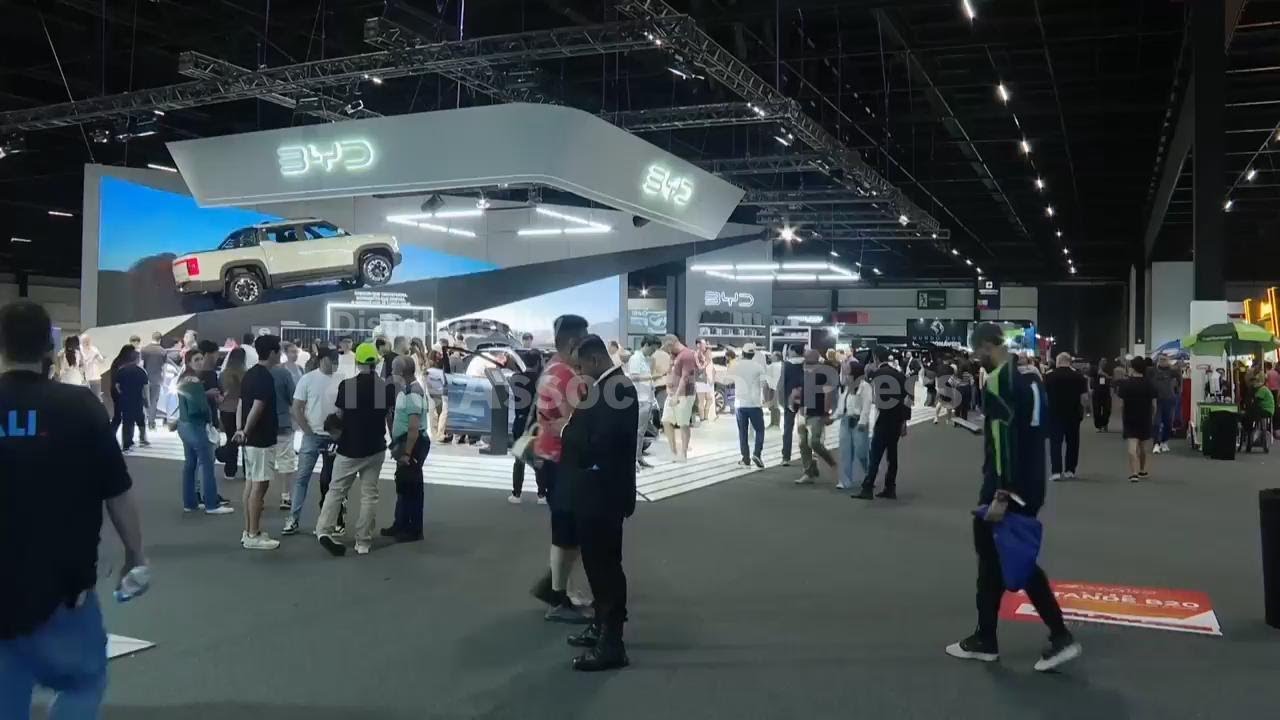
1. BYD car manufacturerbooth at the auto show in Sao Paulo
2. Various of attendees examining a Chinese car model
3. SOUNDBITE (Portuguese) Renato Soares, 37, Entrepreneur:
“I’m finding it amazing. And the Chinese have really taken over the event. Everywhere you go there’s a new Chinese brand, and it’s spectacular.”
4. Visitors inspecting Chinese car models
6. Visitor inside a car demonstrating the rotating screen feature
7. SOUNDBITE (Portuguese) João Carlos Gondim, 52, real state developer:
"In the past, what was an exception has now become the rule with Chinese cars from various brands and several new brands as well, right? They're already saying they'll come to Brazil in 2026-2027. So, I think it's an irreversible reality."
8. Attendees observing a display on car technology
ASSOCIATED PRESS
Sao Paulo, Brazil – 5 December 2025
9. SOUNDBITE (Portuguese) Joel Leite, Automotive analyst :
"I think China sees a great opportunity in South America to bring these cars where they don't have, and won't have the taxation issues that exist in the United States."
10. GWM booth
11. Diego Fernandes, Chief Operating Officer of GWM Brazil talking to visitors
12. SOUNDBITE (Portuguese) Diego Fernandes, COO of GWM Brazil:
"Brazil is a hub for GWM for all of Latin America. This is our investment in the factory. The goal is obviously to serve the Brazilian market, but also to export to the entire region. GWM Global sees Brazil as the center of business in Latin America."
ASSOCIATED PRESS
ARCHIVE: Rio de Janeiro, Brazil - 27 July 2025
13.Various of cargo ships at the port of Rio de Janeiro
ASSOCIATED PRESS
ARCHIVE: Rio de Janeiro, Brazil - 30 July 2025
14. Cargo ship sailing passing by the beach
STORYLINE:
Brazil, the world’s sixth-largest auto market, is seeing a surge in EV sales, and Chinese brands are leading the charge.
The sales of EV in Latin America’s most populous nation have jumped from 19,310 units in 2023 to 61,615 in 2024, an increase of 219%, according to the Brazilian Association of Electric Vehicles.
Of this total, 81.6% came from the Chinese brands BYD and GWM, the association reports.
This shift is occurring in the context of global trade tensions, especially between the United States and China, which also affects the electric-vehicle market.
In recent years, the U.S. has imposed steep tariffs on Chinese EVs, while unstable trade negotiations between Brazil and the U.S. have also influenced the country’s business environment.
In this context, Brazil has deepened its commercial ties with China, creating opportunities for Chinese automakers to expand operations in Latin America’s largest economy.
The region has become increasingly attractive for Chinese manufacturers, a trend that could be further reinforced by steep U.S. tariffs, according to automotive analyst Joel Leite.
“China sees a great opportunity in South America, where it does not face the taxation problems that exist in the United States,” said Leite.
An auto show held in São Paulo in late November showcased the rise of Chinese EVs.
While major traditional brands such as Volkswagen, Chevrolet, and Ford skipped the event, Chinese automakers dominated the show floor.
Nine Chinese automakers participated, compared with only two in 2018.
“The Chinese have really taken over the event. Everywhere you go, there’s a new Chinese brand, and it’s spectacular,” said visitor Renato Soares.
AP Video by Thiago Mostazo, Maycron Abade, Mario Lobao and Diarlei Rodrigues
Find out more about AP Archive: http://www.aparchive.com/HowWeWork
Twitter: / ap_archive
Facebook: / aparchives
Instagram: / apnews
You can license this story through AP Archive: http://www.aparchive.com/metadata/you...

Информация по комментариям в разработке