Disclaimer: This channel does not promote or encourage Any illegal activities, all contents provided by this channel.
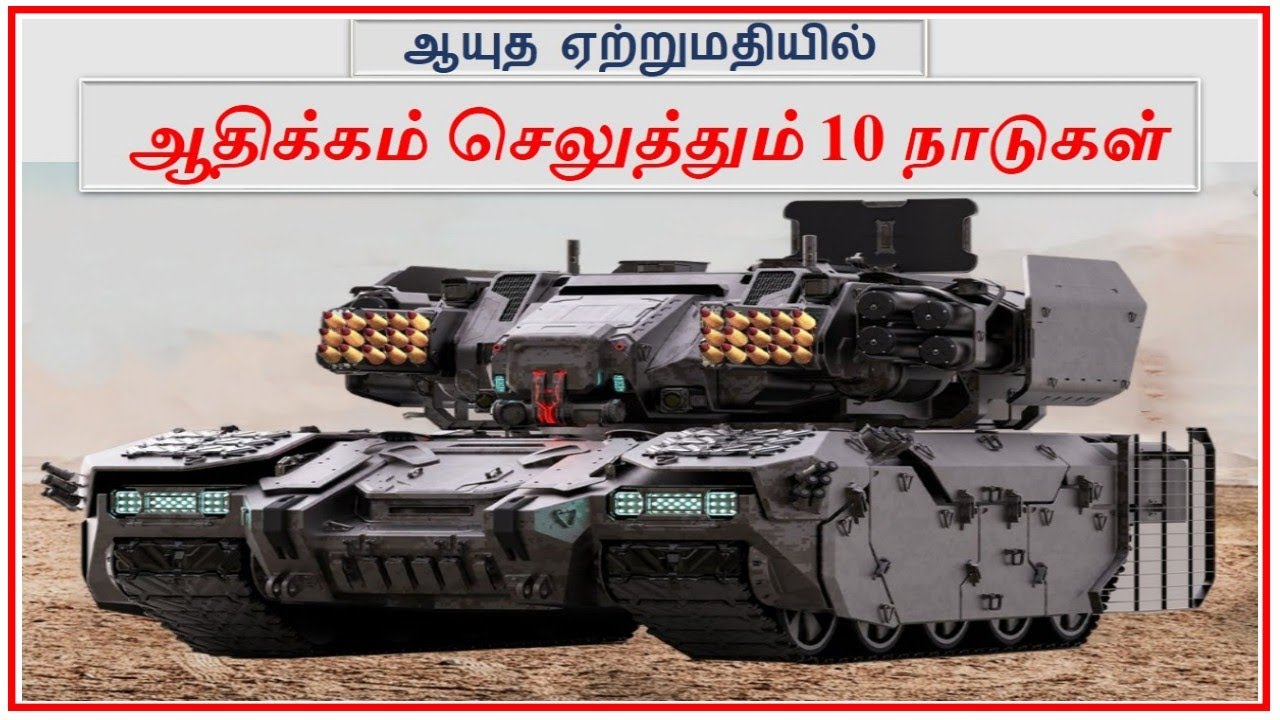
ஆயுத ஏற்றுமதியில் ஆதிக்கம் செலுத்தும் 10 நாடுகள்
Top 10 Biggest Arms Exporting Countries in the World | Tamil Zhi | Ravi
The arms industry, also known as the arms trade, is a global industry which manufactures and sells weapons and military technology, and is a major component of the military–industrial complex. It consists of a commercial industry involved in the research and development, engineering, production, and servicing of military material, equipment, and facilities. Arms-producing companies, also referred to as arms dealers, or as the military industry, produce arms for the armed forces of states and for civilians. Departments of government also operate in the arms industry, buying and selling weapons, munitions and other military items. An arsenal is a place where arms and ammunition - whether privately or publicly owned - are made, maintained and repaired, stored, or issued, in any combination. Products of the arms industry include guns, artillery, ammunition, missiles, military aircraft, military vehicles, ships, electronic systems, night-vision devices, holographic weapon sights, laser rangefinders, laser sights, hand grenades, landmines and more. The arms industry also provides other logistical and operational support.
The Stockholm International Peace Research Institute (SIPRI) estimated military expenditures as of 2018 at $1822 billion. This represented a relative decline from 1990, when military expenditures made up 4% of world GDP. Part of the money goes to the procurement of military hardware and services from the military industry. The combined arms-sales of the top 100 largest arms-producing companies and military services companies (excluding China) totaled $420 billion in 2018, according to SIPRI. This was 4.6 percent higher than sales in 2017 and marks the fourth consecutive year of growth in Top 100 arms sales. In 2004 over $30 billion were spent in the international arms-trade (a figure that excludes domestic sales of arms). According to the institute, the volume of international transfers of major weapons in 2014–18 was 7.8 percent higher than in 2009–13 and 23 percent higher than in 2004–2008. The five largest exporters in 2014–18 were the United States, Russia, France, Germany and China whilst the five biggest importers were Saudi Arabia, India, Egypt, Australia and Algeria.
This is a list of the world's largest arms manufacturers and other military service companies who profit the most from the War economy, their origin is shown as well. The information is based on a list published by the Stockholm International Peace Research Institute for 2020. The list provided by the SIPRI The numbers are in billions of US dollars.
Units are in Trend Indicator Values expressed as millions of U.S. dollars at 1990s prices. These numbers may not represent real financial flows as prices for the underlying arms can be as low as zero in the case of military aid.
Overall global arms exports rose of about 6 per-cent in the last 5 years compared to the period 2010-2014 and increased by 20 per-cent since 2005–2009.[16]
Note that rankings for exporters below a billion dollars are less meaningful, as they can be swayed by single contracts. A much more accurate picture of export volume, free from yearly fluctuations, is presented by 5-year moving averages.
Next to SIPRI there are several other sources that provide data on international transfers of arms. These include national reports by national governments about arms exports, the UN register on conventional arms and an annual publication by the U.S. Congressional Research Service that includes data on arms exports to developing countries as compiled by U.S. intelligence agencies. Due to the different methodologies and definitions used different sources often provide significantly different data.

Информация по комментариям в разработке