Found at The AHRC Research Centre for the History and Analysis of Recorded Music (CHARM) which was established on 1 April 2004, supported by a 5-year grant of just under £1m from the Arts and Humanities Research Council.
The Violin Sonata in G minor, more familiarly known as the Devil's Trill Sonata is a work for solo violin (with figured bass accompaniment) by Giuseppe Tartini (1692–1770).
1Larghetto affettuoso
2Allegro moderato
3Andante
4Allegro assai-Andante-Allegro assai
Giuseppi Tartini was born in Piran, a town on the peninsula of Istria, in the Republic of Venice (now in Slovenia) to Gianantonio – native of Florence – and Caterina Zangrando, a descendant of one of the oldest aristocratic Piranian families.
It appears Tartini's parents intended him to become a Franciscan friar and, in this way, he received basic musical training. He studied law at the University of Padua, where he became skilled at fencing. After his father's death in 1710, he married Elisabetta Premazone, a woman his father would have disapproved of because of her lower social class and age difference. Unfortunately, Elisabetta was a favorite of the powerful Cardinal Giorgio Cornaro, who promptly charged Tartini with abduction. Tartini fled Padua to go to the monastery of St. Francis in Assisi, where he could escape prosecution. While there, Tartini took up playing the violin.
Legend says when Tartini heard Francesco Maria Veracini's playing in 1716, he was impressed by it and dissatisfied with his own skill. He fled to Ancona and locked himself away in a room to practice, according to Charles Burney, "in order to study the use of the bow in more tranquility, and with more convenience than at Venice, as he had a place assigned him in the opera orchestra of that city."
Tartini's skill improved tremendously and, in 1721, he was appointed Maestro di Cappella at the Basilica di Sant'Antonio in Padua, with a contract that allowed him to play for other institutions if he wished. In Padua he met and befriended fellow composer and theorist Francesco Antonio Vallotti.
Tartini was the first known owner of a violin made by Antonio Stradivari in 1715, which Tartini bestowed upon his student Salvini, who in turn bestowed it to Karol Lipiński upon hearing him perform, from which it derives its moniker, the Lipinski Stradivarius. He also owned and played the Antonio Stradivarius violin ex-Vogelweith from 1711.
In 1726, Tartini started a violin school which attracted students from all over Europe. Gradually, Tartini became more interested in the theory of harmony and acoustics, and from 1750 to the end of his life he published various treatises.
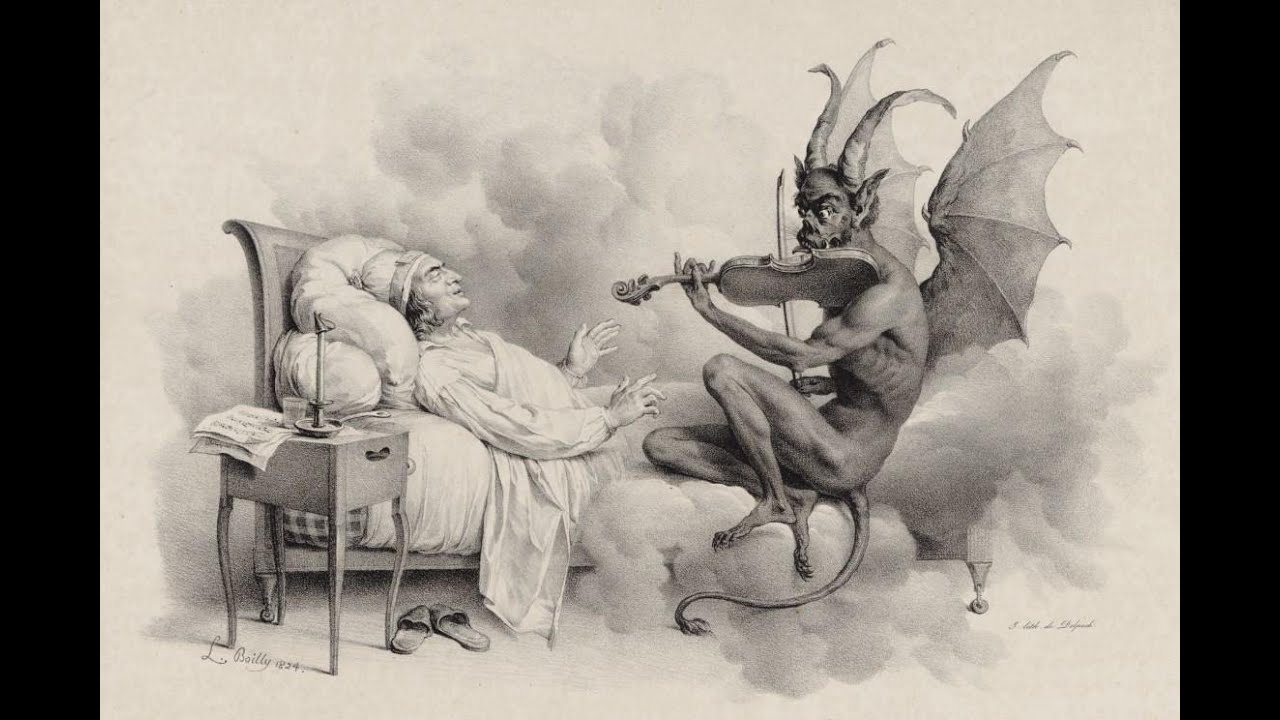
Today, Tartini's most famous work is the "Devil's Trill Sonata," a solo violin sonata that requires a number of technically demanding double stop trills and is difficult even by modern standards. (One 19th-century myth had it that Tartini had six digits on his left hand, making these trills easier for him to play.) According to a legend embroidered upon by Madame Blavatsky, Tartini was inspired to write the sonata by a dream in which the Devil appeared at the foot of his bed playing the violin.
Almost all of Tartini's works are violin concerti (at least 135) and violin sonatas. Tartini's compositions include some sacred works such as a Miserere, composed between 1739 and 1741 at the request of Pope Clement XII, and a Stabat Mater, composed in 1769. He also composed trio sonatas and a sinfonia in A.
In addition to his work as a composer, Tartini was a music theorist, of a very practical bent. He is credited with the discovery of sum and difference tones, an acoustical phenomenon of particular utility on string instruments (intonation of double-stops can be judged by careful listening to the difference tone, the "terzo suono"). He published his discoveries in a treatise "Trattato di musica secondo la vera scienza dell'armonia'" (Padua, 1754). His treatise on ornamentation was eventually translated into French— though when its influence was rapidly waning, in 1771— by a certain "P. Denis," whose introduction called it "unique"; indeed, it was the first published text devoted entirely to ornament and, though it was all but forgotten, as only the printed edition survived, has provided first-hand information on violin technique for modern historically informed performances, once it was published in English translation by Sol Babitz in 1956.

Информация по комментариям в разработке