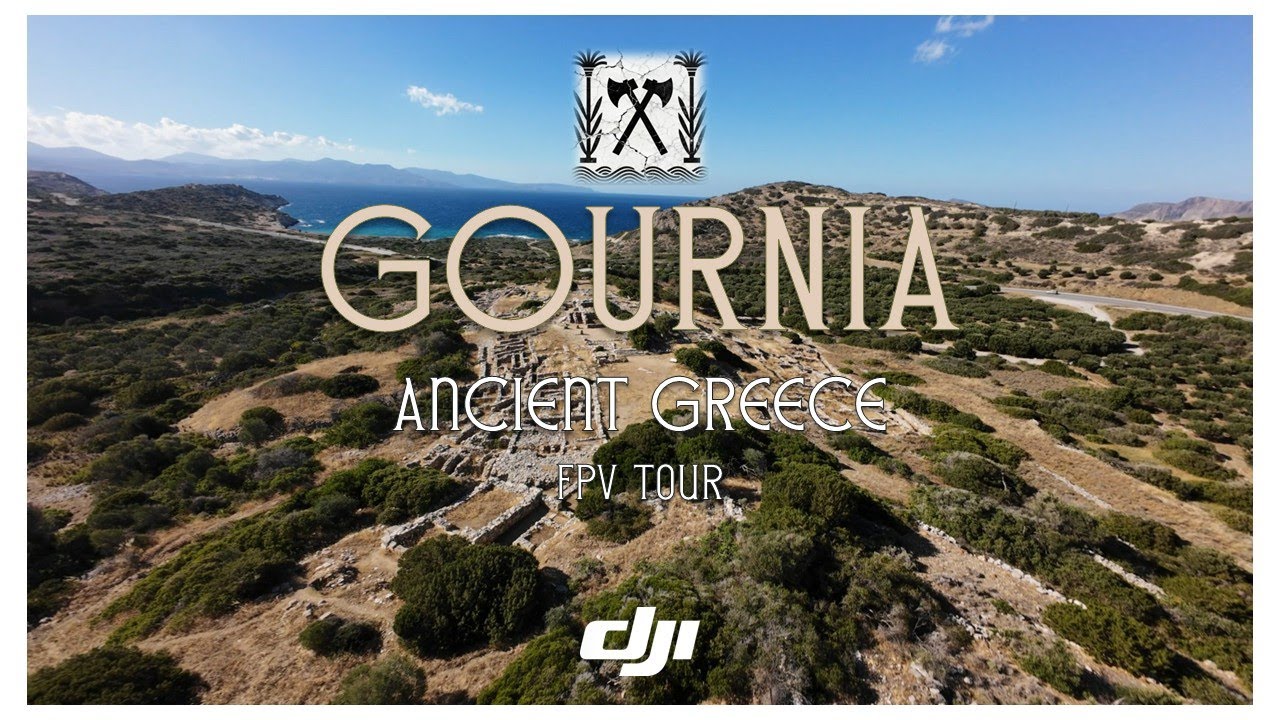
Perched on twin summits overlooking the Gulf of Mirabello, Gournia represents the most complete Minoan town ever excavated. Discovered by Harriet Boyd Hawes in 1901, the multi-level settlement covers 1.68 hectares with over 64 interconnected buildings, half a kilometer of paved streets, and sophisticated drainage systems—urban planning unmatched among Minoan sites outside palaces.
The central palace complex anchors the upper summit, comprising a courtyard surrounded by storage magazines, cult rooms, and archive areas where Middle Minoan III Linear A tablets recorded economic transactions. These pithoi-filled magazines held olive oil, grain, and wine—resources redistributed through palace-controlled networks linking inland Crete to Cycladic and Levantine trade routes.
Below the palace, residential quarters spread across terraces on the northern slopes. Houses followed a formal grid adapted to topography, each featuring ground-floor workshops—pottery kilns, metalworking areas, and textile looms—and living quarters above. This integration of craft and domestic spaces underscores Gournia’s role as both administrative center and artisan hub.
The most striking discovery is the shipshed installations along the west coast—Π-shaped rock-cut buildings that housed Bronze Age warships and trading vessels. These early naval facilities predate Piraeus’s famed sheds, reflecting Gournia’s maritime ambition and strategic value in controlling sea lanes between Crete’s east and west.
Religious life at Gournia included multiple shrine rooms within the palace—offering tables, columns, and snake goddess figurines reveal rituals honoring deities of fertility and renewal. The town’s central courtyard doubled as festival ground, where communal ceremonies reinforced social cohesion among residents drawn from local and exiled populations.
Around 1450 BC, Gournia suffered catastrophic destruction—burned buildings preserved hearths, storage jars, and clay tablets baked hard by fire. This event aligns with widespread upheavals on Crete, possibly linked to Mycenaean incursions or seismic disasters. The settlement saw limited Late Minoan III reoccupation but never regained former prosperity.
Modern excavations by the INSTAP Study Center (2002–2014) refined understanding of Gournia’s chronological development and environmental context. Geoarchaeological studies illuminate how inhabitants harnessed springs and cisterns for water supply, while botanical analyses reconstruct their diet of cereals, legumes, olives, and wild greens—a subsistence economy balanced between agriculture and craft.
Walking through Gournia today means tracing Bronze Age streets before the Mycenaean collapse. Visitors can explore stone foundations rising just high enough to define rooms, peer into rock-cut baths, and imagine potters and merchants going about daily life 3,500 years ago. The nearby site museum in Agios Nikolaos displays exquisite pottery, bronze tools, and the enigmatic Linear A tablets—remarkable artifacts that bring this vanished city to life.
As the most intact Minoan town outside palatial centers, Gournia challenges assumptions of Bronze Age Crete’s social complexity. It demonstrates that urbanism, craft specialization, and centralized administration were not limited to grand palaces like Knossos but extended into smaller civic communities—early experiments in city planning that anticipated the polis of Classical Greece.
#MinoanCrete #BronzeAge #AncientUrbanPlanning #Gournia #HarrietBoydHawes #LinearATablets #MinoanCrafts #MaritimeHeritage #ArchaeologicalDiscovery #HiddenCrete

Информация по комментариям в разработке