@NASA
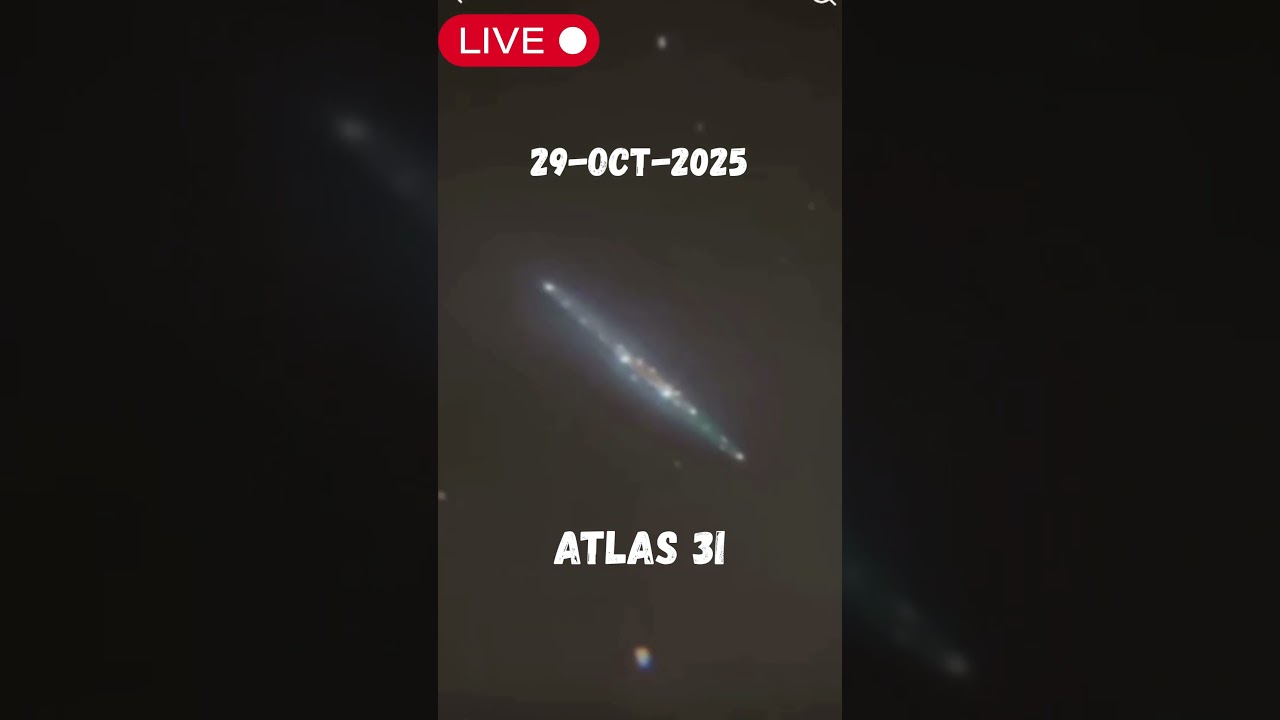
2025, astronomers discovered something extraordinary — 3I/ATLAS, the third interstellar object ever detected passing through our solar system. A traveler from beyond the stars, 3I/ATLAS has captured the attention of scientists and space enthusiasts across the world.
This isn’t just another comet. It’s a cosmic messenger carrying secrets from a distant star system — a piece of another world, passing briefly through ours.
🌌 What Is 3I/ATLAS?
3I/ATLAS, officially classified as an interstellar comet, was discovered by the Asteroid Terrestrial-impact Last Alert System (ATLAS) in mid-2025. Its name reveals its significance — “3I” means it’s the third confirmed interstellar visitor, following the famous 1I/‘Oumuamua (2017) and 2I/Borisov (2019).
Unlike comets native to our solar system, 3I/ATLAS follows a hyperbolic trajectory, meaning it’s not gravitationally bound to the Sun — it came from deep space and will soon return to it.
Its incredible speed, estimated at over 60 kilometers per second, and its unique composition make it one of the most scientifically fascinating discoveries in recent years.
🌠 A Journey Through Our Solar System
As 3I/ATLAS races through our cosmic neighborhood, it’s expected to make its closest approach to the Sun around late 2025 — at a safe distance beyond Earth’s orbit. It will glow faintly as sunlight heats its icy surface, creating a coma and tail — the classic features of a comet.
Though it won’t be visible to the naked eye for most observers, telescopes around the world — and even space-based observatories — are tracking every move it makes.
Scientists hope to learn about its chemical makeup, structure, and origin, providing valuable clues about how comets form in other solar systems.
🪐 Why 3I/ATLAS Matters
3I/ATLAS gives humanity a rare opportunity — a glimpse into the raw material of another star system. Every observation helps scientists compare our own solar system to others across the galaxy.
Its composition — rich in carbon dioxide, dust, and frozen gases — reveals that planets and comets beyond our Sun share surprising similarities with our own cosmic neighborhood.
By studying it, researchers hope to understand how planetary systems evolve, and whether the building blocks of life — like water and organic molecules — are common throughout the universe.
🚀 A New Chapter in Interstellar Discovery
What makes 3I/ATLAS truly remarkable is how much we’ve learned from its predecessors.
1I/ʻOumuamua was a mysterious, cigar-shaped object that puzzled scientists with its unusual motion.
2I/Borisov was the first clearly visible interstellar comet, rich in gases and dust.
Now, 3I/ATLAS arrives — larger, brighter, and more complex — offering even deeper insights into the mysteries of deep space.
Each interstellar visitor brings us closer to understanding what lies beyond our solar boundaries — and perhaps even how common life might be among the stars.
🌍 What’s Next for 3I/ATLAS
Throughout 2025 and 2026, telescopes and spacecraft will continue monitoring 3I/ATLAS as it exits our solar system. Astronomers will track changes in brightness, measure its tail length, and analyze its material.
Even as it fades from view, its data will help refine our models of planetary formation, interstellar dust chemistry, and solar system dynamics.
This cosmic traveler reminds us that space is full of surprises — and that the universe is far more connected than we can imagine.
💫 A Visitor We’ll Never See Again
3I/ATLAS is not coming back. Its hyperbolic orbit ensures it will leave our solar system forever, continuing its endless journey across the Milky Way.
For astronomers and dreamers alike, it’s a humbling reminder: we are part of something vast, ancient, and mysterious. Each time one of these interstellar travelers passes by, we get a brief look into the infinite stories of the stars.
🌟 Updated 2025)
#3iatlas #interstellarobject #comet #spacediscovery #astronomy2025 #nasa #usa #cosmicvisuals #jwst #astrophysics #outerspace #galacticcouncil #sciencenews #astronomylovers #spaceexploration #cometatlas #planetaryscience #interstellarcomet #milkyway #astroscience #spacefacts #cosmos #spaceupdates #universe #cosmicjourney #today #stargazing #spacecommunity #spaceresearch #solarsystem #usa #canada #mexico #brazil #argentina #portugal #australia #australia #america #uae #viral #live #latestnews #latest #latestupdate #29october2025

Информация по комментариям в разработке