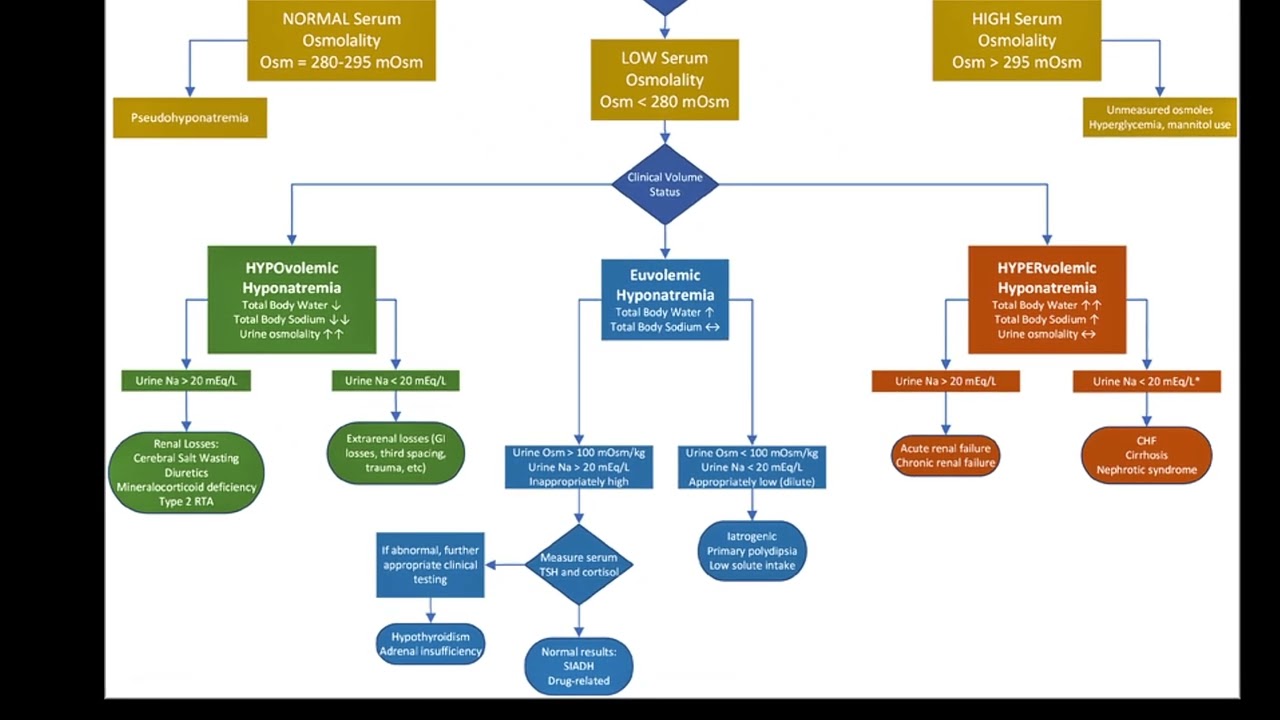
Understanding the cause of low serum sodium (\text{Na}^+) is critical for safe management. This flow chart illustrates the systematic approach: first, check serum osmolality to confirm true hypotonic hyponatremia, then assess the patient's volume status (Hypovolemic, Euvolemic, or Hypervolemic), and finally, use urine sodium and osmolality to pinpoint the underlying etiology (e.g., SIADH, diuretics, or organ failure). Treatment hinges entirely on correct classification. #Hyponatremia #Nephrology #ElectrolyteImbalance #MedicalEducation
💧 What is Hyponatremia?
Hyponatremia is a condition where the level of sodium in the blood is lower than the typical range.
Definition: It is generally defined as a serum (blood) sodium concentration of less than 135 \text{ mEq/L} (milliequivalents per liter). The normal range is typically 135 \text{ to } 145 \text{ mEq/L}.
Role of Sodium: Sodium is a key electrolyte that helps regulate the amount of water in and around your cells, and is vital for proper nerve and muscle function.
The Problem: When blood sodium is low, water tends to move into your cells, causing them to swell. This is particularly dangerous in the brain, where swelling can lead to severe neurological symptoms.
🤒 Common Symptoms
Symptoms can vary based on how quickly the sodium level drops (acute vs. chronic) and how low it is.
Mild/Moderate Symptoms
Nausea and vomiting
Headache
Loss of energy, drowsiness, or fatigue
Restlessness and irritability
Muscle weakness, spasms, or cramps
Severe Symptoms (Require Emergency Care)
Confusion or altered mental status
Seizures
Decreased consciousness or coma
🩺 Main Causes
Hyponatremia is often caused by an imbalance between total body water and total body sodium, leading to a dilution of sodium. Causes are typically classified based on the patient's fluid status (volume):
**Hypovolemic Hyponatremia (Low Volume): Loss of both wate and sodium, but sodium loss is greater.
Severe vomiting or diarrhea
Excessive sweating
Diuretic medications (water pills)
Hypervolemic Hyponatremia (High Volume): Increase in both water and sodium, but water gain is greater.
Congestive heart failure
Cirrhosis (severe liver disease)
Kidney disease
Euvolemic Hyponatremia (Normal Volume): Total body water increases while total body sodium stays the same.
Syndrome of Inappropriate Antidiuretic Hormone (SIADH): The body releases too much Antidiuretic Hormone (ADH or Vasopressin), causing it to retain water.
Certain medications (e.g., some antidepressants, pain medicines)
Drinking excessive amounts of water (e.g., during endurance exercise without electrolyte replacement).
🔬 Diagnosis and Treatment
Diagnosis: A simple blood test measures the serum sodium level. Further tests (like urine sodium and osmolality) are then used to determine the underlying cause and the specific type of hyponatremia.
Treatment: Treatment focuses on correcting the sodium level and, most importantly, addressing the underlying cause.
Fluid Restriction: Often a first-line treatment for chronic, milder cases.
Medication Adjustment: Stopping or adjusting drugs that may be causing the problem (like diuretics).
Intravenous (IV) Fluids: For acute or severe hyponatremia, an IV solution (often hypertonic saline) is given to slowly raise the blood sodium levels. Note: The correction must be done slowly, as rapid correction can cause a severe neurological complication called osmotic demyelination syndrome.
If you suspect you or someone else has symptoms of hyponatremia, especially severe ones like confusion or seizures, seek immediate medical attention.

Информация по комментариям в разработке