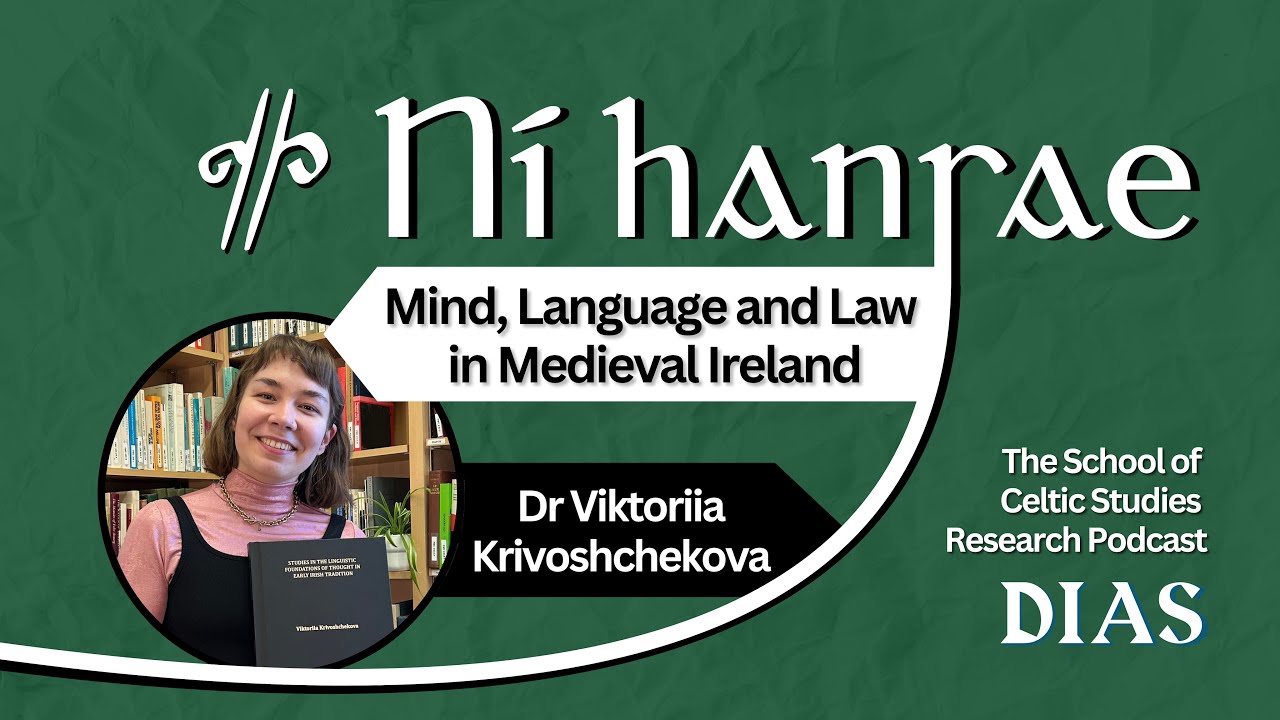
Today we are talking to Dr Viktoriia Krivoshchekova who is an O’Donovan postdoctoral scholar in the School of Celtic Studies at the Dublin Institute for Advanced Studies. She tells us all about her research on medieval Irish philosophy of language, the use of cognitive linguistics to study Irish texts and her recent interest in the role of the mind in early Irish law. Thanks for listening!
Episode recorded on 10.04.2025.
People, texts and topics mentioned:
Ferdinand de Saussure, Course in General Linguistics, trans. Wade Baskin. New York: Fontana, 1977 (theory of the linguistic sign)
Gottlob Frege, ‘On Sinn and Bedeutung,’ trans. Max Black. In The Frege Reader, ed. by Michael Beaney, 151–171. Oxford: Blackwell, 1997 (distinction between sense and reference)
Auraicept na nÉces ‘The Scholars’ Primer’, the vernacular grammar of Irish (c. 700–1200)
The Würzburg glosses on the Pauline Epistles (c. 750)
The Milan glosses on the Psalms (c. 800)
The Sapir-Whorf hypothesis, linguistic relativity
Bernhard Bischoff, ‘Turning-Points in the History of Latin Exegesis in the Early Middle Ages’, trans. Colm O’Grady. In Biblical Studies: The Medieval Irish Contribution 1, ed. by Martin McNamara, 74–160. Dublin: Dominican Publications, 1976.
Isidore of Seville, Etymologiae (c. 600–625)
Leabhar Breac ‘The Speckled Book’: Royal Irish Academy, MS 23 P 16 (early 15th cent.), https://www.isos.dias.ie/RIA/RIA_MS_2...)
Theory of conceptual metaphor: George Lackoff and Mark Johnson, Metaphors We Live By. Chicago: The University of Chicago Press, 1980.
Bretha Éitgid ‘Judgements of Inadvertence’ / ‘Judgements Concerning Irresponsible Acts’
The Book of Armagh: Trinity College Dublin, MS 52 (c. 800)
Select publications by Viktoriia:
‘Poetic Knowledge and Christian Exegesis in the Mongán Tales: A Metalanguage of Multiple Meanings’. Celtica 33 (2021): 1–32.
(with Bernhard Bauer) ‘Definitions, Dialectic and Insular Grammatical Theory in Carolingian Glosses on Priscian: A Case Study Using a Close and Distant Reading Approach’. Language and History 65 no. 2 (2022): 85–112. DOI: 10.1080/17597536.2022.2055960.
Studies in the Linguistic Foundations of Thought. PhD thesis, Maynooth University, 2023.
‘Early Irish Grammarians and the Study of Speech Sound’. Language and History 66 no. 1 (2023): 1–32. DOI: 10.1080/17597536.2022.2050983.
‘Early Irish Literature and the Embodied Mind.’ In Medicine in the Medieval North Atlantic World: Vernacular Texts and Traditions, ed. by Deborah Hayden and Sarah Baccianti, 143–165. Turnhout: Brepols, 2025. DOI: 10.1484/M.KSS-EB.5.143984.
Reading recommendations:
Mary Carruthers, The Craft of Thought: Meditation, Rhetoric, and The Making of Images, 400–1200. Cambridge: Cambridge University Press, 1998.
Martin Irvine, The Making of Textual Culture: Grammatica and Literary Theory, 350–1100. Cambridge: Cambridge University Press, 1994.
Leslie Lockett, Anglo-Saxon Psychologies in the Vernacular and Latin Traditions. Toronto: University of Toronto Press, 2011.
Fergus Kelly, A Guide to Early Irish Law. Early Irish Law Series 3. Dublin: Dublin Institute for Advanced Studies, 1988.
Liam Breatnach, A Companion to the Corpus Iuris Hibernici. Early Irish Law Series 5. Dublin: Dublin Institute for Advanced Studies, 2005.
The School’s projects and publications:
Celtica: https://www.dias.ie/celt/celtica/
Annual conference (Tionól): https://www.dias.ie/celt/celt-confere...
Statutory Lectures & other Celtic Studies lectures (YouTube): • Dr Nike Stam presents Maartje Draak
DIAS Bookshop: https://shop.dias.ie/
Irish Script on Screen (ISOS): https://www.isos.dias.ie/
Follow the School of Celtic Studies on social media:
BlueSky: @scs-dias.bsky.social
Instagram: @scs.dias
Website: https://www.dias.ie/celt/
To be added to our mailing list, contact [email protected]
Copyright details
Sound and music remixed by Robert Scuta. Jingle produced by Silvan van der Zwaag of Studio Galassasa; the Irish fragment of Annie Uí Annluain is taken from the DIAS Glór recordings, with thanks to Dr Andrea Palandri. Logo designed by Nina Cnockaert-Guillou.
Production team: Dr Nina Cnockaert-Guillou, Dr Viktoriia Krivoshchekova, Robert Scuta.

Информация по комментариям в разработке