Learn how to efficiently extract unique gene IDs and their corresponding gene lengths from two MySQL tables using grouping techniques.
---
This video is based on the question https://stackoverflow.com/q/65079288/ asked by the user 'DumbledoreTheGrey' ( https://stackoverflow.com/u/14710291/ ) and on the answer https://stackoverflow.com/a/65079970/ provided by the user 'Milda' ( https://stackoverflow.com/u/14622320/ ) at 'Stack Overflow' website. Thanks to these great users and Stackexchange community for their contributions.
Visit these links for original content and any more details, such as alternate solutions, latest updates/developments on topic, comments, revision history etc. For example, the original title of the Question was: MYSQL: Issue with table querying
Also, Content (except music) licensed under CC BY-SA https://meta.stackexchange.com/help/l...
The original Question post is licensed under the 'CC BY-SA 4.0' ( https://creativecommons.org/licenses/... ) license, and the original Answer post is licensed under the 'CC BY-SA 4.0' ( https://creativecommons.org/licenses/... ) license.
If anything seems off to you, please feel free to write me at vlogize [AT] gmail [DOT] com.
---
Introduction
MySQL, a popular relational database management system, is often a central part of data analysis in various fields, including bioinformatics. One common issue users face involves querying tables with unique and duplicate data points. In this guide, we will explore a specific case involving the extraction of unique gene IDs and their corresponding lengths from two tables. This problem arises when dealing with gene isoforms and lengths while trying to maintain database integrity. Let's dive into the problem and its solution.
Understanding the Problem
Imagine you have two tables:
Table 1: Contains 8000 entries, all of which are unique gene IDs. For example, one of the entries might be HxC4233.
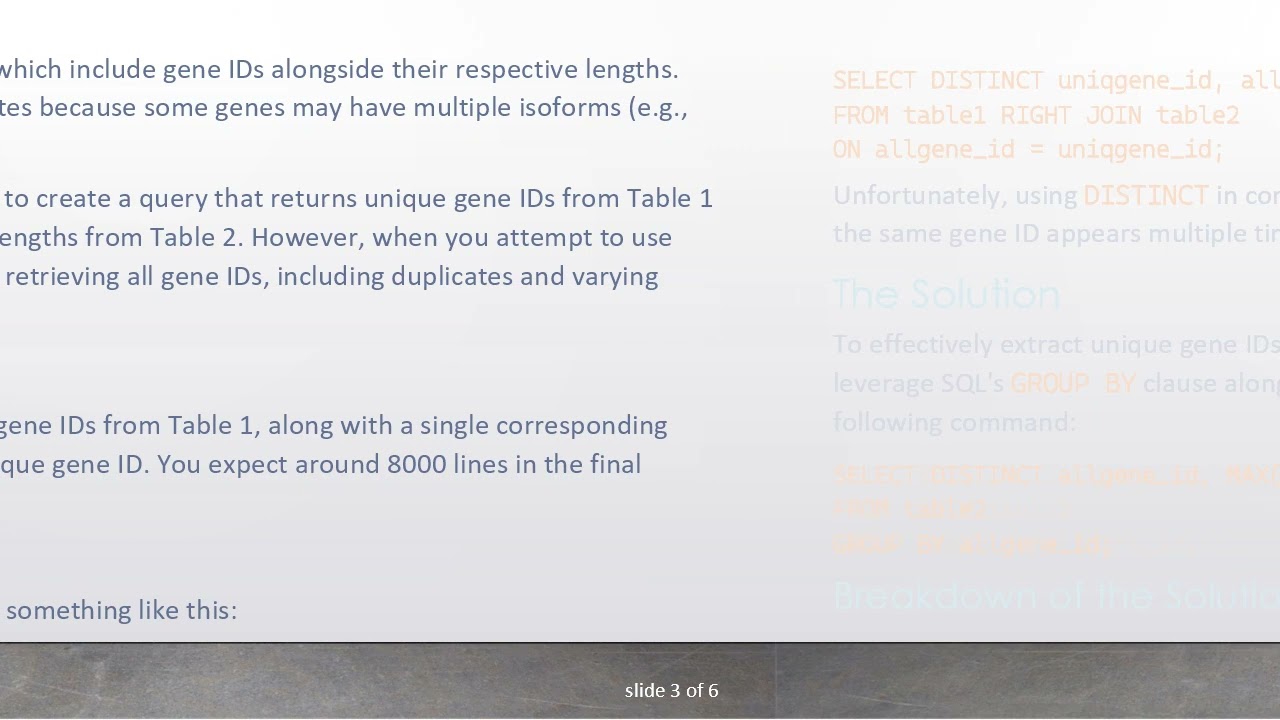
Table 2: Contains 20000 entries, which include gene IDs alongside their respective lengths. Note that this table holds duplicates because some genes may have multiple isoforms (e.g., HxC4233_i1, HxC4233_i2).
The goal is straightforward: you want to create a query that returns unique gene IDs from Table 1 along with their corresponding gene lengths from Table 2. However, when you attempt to use the DISTINCT command, you end up retrieving all gene IDs, including duplicates and varying lengths, which is not what you want.
The Desired Output
The desired output is a list of unique gene IDs from Table 1, along with a single corresponding gene length from Table 2 for each unique gene ID. You expect around 8000 lines in the final output.
Your Attempted Query
Your initial attempt at a query looked something like this:
[[See Video to Reveal this Text or Code Snippet]]
Unfortunately, using DISTINCT in conjunction with a join doesn't guarantee unique lengths when the same gene ID appears multiple times with different values in Table 2.
The Solution
To effectively extract unique gene IDs along with a singular gene length per ID, you need to leverage SQL's GROUP BY clause along with an aggregate function. In your case, you can use the following command:
[[See Video to Reveal this Text or Code Snippet]]
Breakdown of the Solution
DISTINCT: This command ensures you only get unique allgene_id entries from Table 2.
MAX: The MAX(allgene_len) function retrieves the maximum gene length for duplicated IDs. You could also use MIN if you prefer the shortest length.
GROUP BY: This clause groups the results by allgene_id, allowing you to aggregate lengths while maintaining the uniqueness of the gene IDs.
Why No Join is Necessary
It's important to note that joining the tables isn't required for this particular query because you're solely targeting gene IDs and lengths from Table 2. Instead, this command efficiently pulls the necessary data directly based on the table that includes potential duplicates.
Conclusion
By using the suggested SQL query, you can efficiently retrieve the unique gene IDs along with their corresponding lengths without getting bogged down by duplicates. This approach provides clarity and simplicity for users dealing with large datasets, particularly in genetic research, where understanding unique identifiers is crucial.
If you're facing similar issues or have further questions about SQL querying, feel free to reach out or leave a comment below!

Информация по комментариям в разработке