यह रहा GATE (Graduate Aptitude Test in Engineering) Mechanical Engineering के syllabus के अनुसार Types of Clutches पर आधारित एक Long Answer Writing with Questions – जिसमें detailed explanation है, diagrams के लिए placeholders हैं और conceptual clarity को ध्यान में रखा गया है:
---
📝 GATE Exam Based Long Answer
Q: Explain the various types of clutches used in mechanical power transmission systems with neat sketches. Discuss their working principles, applications, advantages, and disadvantages.
---
✅ Answer:
A clutch is a mechanical device used to connect and disconnect the power transmission between the engine and the wheels or driven machinery. It is most commonly used in automobiles and industrial equipment to engage and disengage the engine from the transmission system.
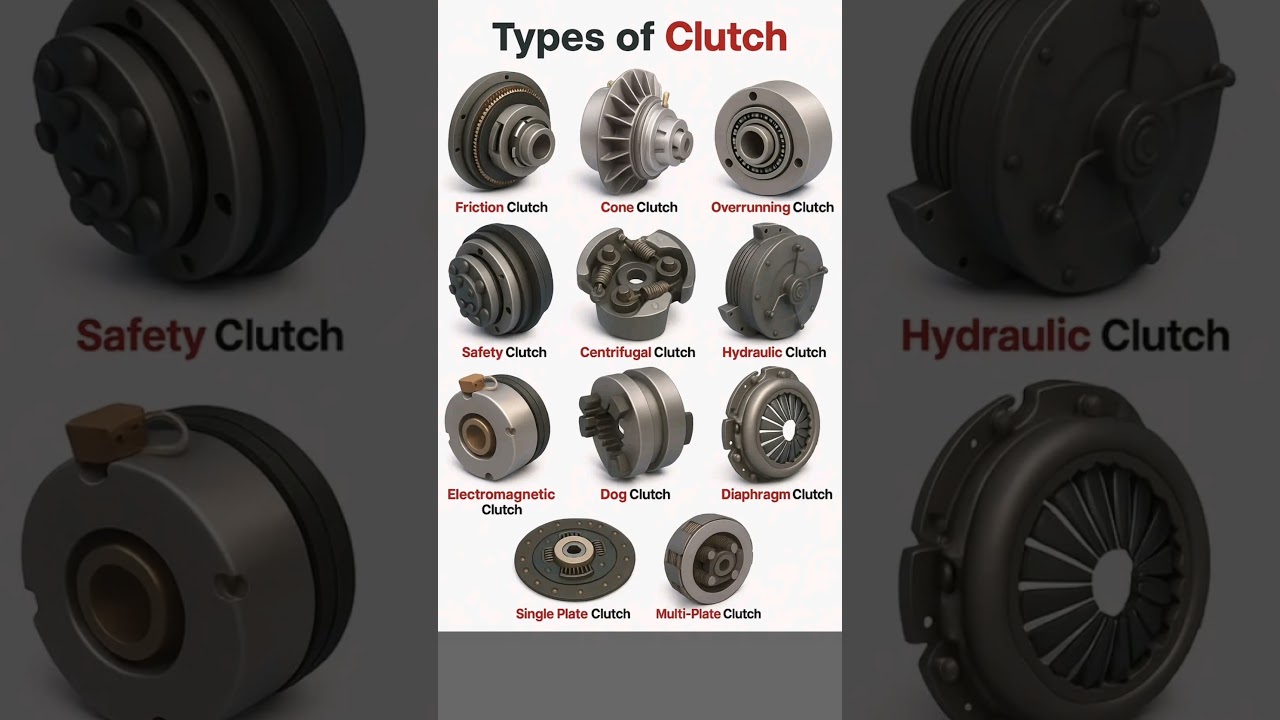
Clutches are classified based on their operating principle, construction, and application. Below are the commonly used types:
---
1. Friction Clutch
Working Principle: Uses friction between contact surfaces to transmit torque.
Construction: Comprises a flywheel, pressure plate, and clutch plate with friction lining.
Application: Cars, trucks, motorcycles.
Advantages: Smooth engagement, low cost.
Disadvantages: Heat generation, wear over time.
Diagram: (Draw single plate with pressure & clutch plates)
---
2. Cone Clutch
Working Principle: Uses conical surfaces for engaging. Friction occurs on the inner cone surface.
Advantages: Higher torque transmission due to increased contact area.
Disadvantages: Disengagement can be difficult.
Application: Earlier racing cars, some machines.
Diagram: (Cone inside female cone housing)
---
3. Centrifugal Clutch
Working Principle: Automatically engages at a certain RPM due to centrifugal force.
Application: Scooters, go-karts, lawnmowers.
Advantages: No manual operation needed.
Disadvantages: Not suitable for high torque applications.
Diagram: (Clutch shoes expanding inside drum)
---
4. Hydraulic Clutch
Working Principle: Uses hydraulic fluid to transmit pressure to clutch plates.
Application: Heavy-duty vehicles, tractors.
Advantages: Smooth operation, reduced effort.
Disadvantages: Complex, more maintenance.
Diagram: (Hydraulic master & slave cylinder setup)
---
5. Electromagnetic Clutch
Working Principle: Uses electromagnetic force to engage/disengage clutch plates.
Application: Automation, machine tools, robotics.
Advantages: Fast and remote control.
Disadvantages: Requires electrical input.
Diagram: (Electromagnetic coil and clutch plate)
---
6. Dog Clutch
Working Principle: Uses interlocking teeth to connect shafts directly. No friction used.
Application: Gear shifting in transmissions, synchromesh gearboxes.
Advantages: No slippage, full torque transfer.
Disadvantages: Cannot be engaged under load.
Diagram: (Interlocking toothed cylinders)
---
7. Overrunning Clutch (One-way clutch)
Working Principle: Allows rotation in one direction only; freewheels in the other.
Application: Starter motors, bicycle hubs.
Advantages: Prevents reverse torque.
Diagram: (Roller or sprag mechanism)
---
8. Diaphragm Clutch
Working Principle: Uses a diaphragm spring to apply pressure on the clutch plate.
Advantages: Compact, self-adjusting spring.
Application: Modern passenger vehicles.
Diagram: (Diaphragm spring pressing clutch plate)
---
9. Multi-Plate Clutch
Working Principle: Uses multiple clutch plates for higher torque transfer in limited space.
Application: Motorcycles, racing cars, F1.
Advantages: High torque in compact design.
Disadvantages: Complex and costly.
Diagram: (Multiple friction & steel plates)
---
10. Single Plate Clutch
Working Principle: Single friction plate between pressure plate and flywheel.
Application: General cars, small vehicles.
Advantages: Simple design.
Disadvantages: Lower torque capacity.
Diagram: (Single friction disc)
---
📌 Conclusion:
Different types of clutches are designed based on torque requirement, space, automation level, and application type. Friction-based clutches are common in automobiles, while electromagnetic and hydraulic clutches are used in modern and automated systems. Understanding each type's mechanism, advantages, and limitations helps engineers select the right clutch for the right job.
---
🔍 Important GATE Concepts to Focus On:
Torque transmission formula
Clutch friction force:
Uniform vs. stepped pressure theory
Design of clutch plates
Heat generation in clutches
📌 Agar aapko video pasand aaye to Like, Share aur Subscribe zarur karein.
📲 Subscribe Now 👉 The Neev Foundation (m.s)
🎯 Build your life foundation with us
👇 Aur aise videos ke liye comment karke bataaye agla topic kya ho!
#ClutchTypes #MechanicalEngineering #TheNeevFoundation #AutomobileEngineering #GATEPreparation #ITI #EngineeringShorts #ClutchMechanism #FrictionClutch #ConeClutch #CentrifugalClutch #DiaphragmClutch #DogClutch #HydraulicClutch #OverrunningClutch #ElectromagneticClutch

Информация по комментариям в разработке