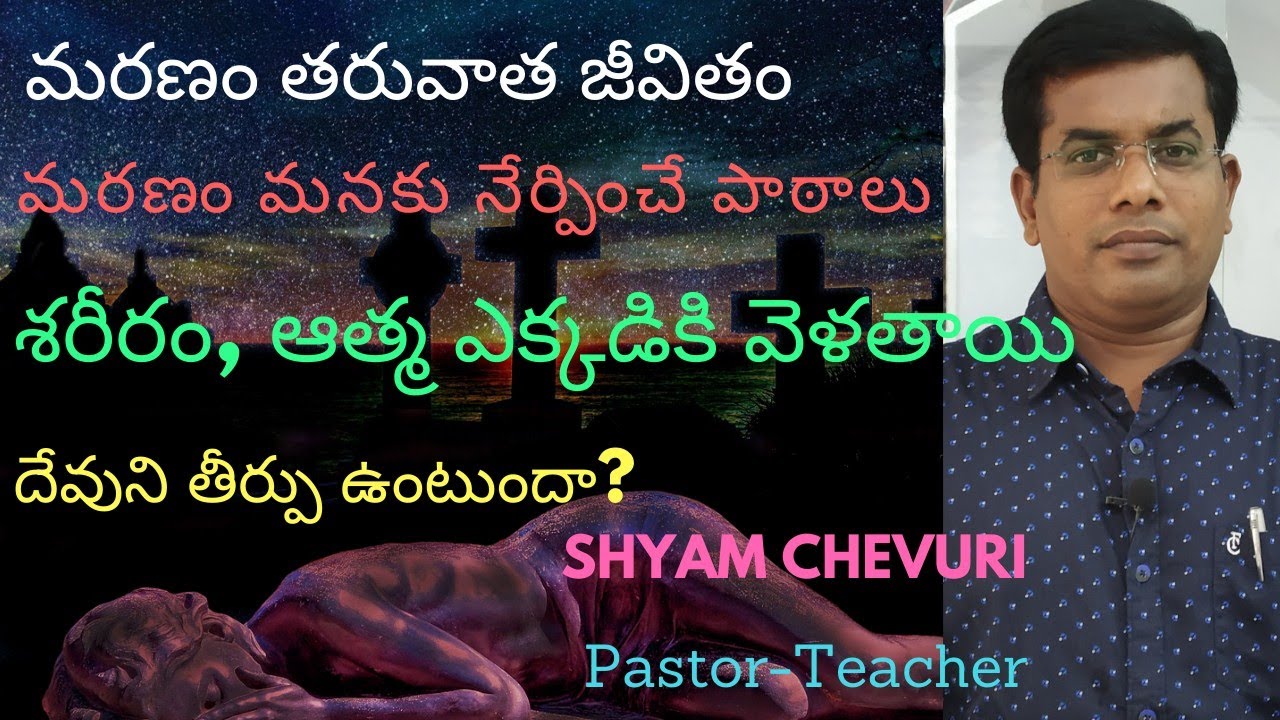
In this video we are going to explain DEATH, Death brings a completion to one part of a Chris tian’s sanctification. At death, a Christian’s soul is immediately made perfect and enters into the
presence of God. But it isn’t until Christ returns that Christians experience full perfection for both body and soul, for at that time their bodies will be raised and made perfect as well. In this chapter we will investigate what happens at both events, as well as what happens in between death and the time when Christ returns.
Why Do Christians Die?
Death is not a punishment for Christians. As was made clear in the previous four chapters, there is “no condemnation for those who are in Christ Jesus” (Rom. 8:1). The complete penalty for a Christian’s sin has been paid by Christ Jesus.
Yet God, in his wisdom, decided it best that Christians not experience all the benefits of salvation at once. For example, Christians still sin, get sick, suffer from natural disasters, and fall prey to acts of evil and injustice. And Christians still die. All of these are the results of living in a world that isn’t quite right, a world that isn’t fully free from the curse of sin.
Paul tells us that although Christ defeated death when he rose from the dead, death will be the last result of sin to be removed from this fallen world: Christ “must reign until he has put all his enemies under his feet. The last enemy to be destroyed is death” (1 Cor. 15:25 – 26).
God uses the experience of death to complete our sanctification. God uses death as a means to make us more like Christ. In fact, in the Christian life generally it is not unusual for God to use hardship and pain to bring about good. Paul tells us in Romans 8:28, “We know that for those who love God all things work together for good.” Pain and hardship are often the results of God disciplining his children, “for the Lord disciplines the one he loves. . . . He disciplines us for our good, that we may share his holiness. For the moment all discipline seems painful rather than pleasant, but later it yields the peaceful fruit of righteousness to those who have been trained by it” (Heb. 12:6, 10 – 11).
Not all discipline serves to correct us when we have done wrong. Often, God’s discipline in our lives is a way of strengthening us; it is a means of sanctification. Although Jesus never sinned, he still “learned obedience through what he suffered” (Heb. 5:8) and was made “perfect through suffering” (Heb. 2:10). As he grew from childhood to adulthood and continued through his life on earth, the task of obedience to God became harder and harder, and it included much suffering. Through all of this, Jesus increased in his strength to obey.
Since God works even through our experience of death to complete our sanctification, preserving our life and general comfort is not our highest goal. Obedience to God and faithfulness in every circumstance is far more important. That is why Paul could tell the
Ephesian elders, “I do not account my life of any value nor as precious to myself, if only I may finish my course and the ministry that I received from the Lord Jesus, to testify to the gospel of the grace of God” (Acts 20:24).
Even though God uses a hardship like death for a positive means in our life, it is important to remember that death is not merely “natural,” as people without God’s Word often think of it. Neither is sickness or evil or injustice natural. These things are not right, and in God’s world
they ought not to be. Although we live with these things now, one day all of them — even death — will finally be destroyed (1 Cor. 15:24 – 26).
When Chris tians Die:
If you are a believer in Jesus, the Bible encourages you not to view your own death with fear. Jesus died to “deliver all those who through fear of death were subject to lifelong slavery” (Heb. 2:15). Instead, you are to view your own death with joy, knowing that after death you will be with Christ. Paul demonstrates a clear understanding of this in 2 Corinthians 5:8 when he writes, “We would rather be away from the body and at home with the Lord.” He writes something similar in
Philippians 1:23:
If you fear death and find the words of Paul hard to believe, it may be helpful for you to confess that to the Lord. Ask him to increase your understanding of what happens when you die and to increase your faith in his goodness. When Christians die, their souls go immediately into God’s presence. Although their bodies remain in the ground, their souls go into the presence of their Creator. That is why Paul writes of being away from the body through death (2 Cor. 5:8) and departing in death to be with Christ (Phil. 1:23).
Watch our videos for more information about the Bible Knowledge in Telugu
Bro. Shyam Chevuri, Pastor - Teacher,
Carmel Bible Church (We Believe The BIble)
Faith BIble Seminary (We Teach The Bible)
Rajam, Srikakulam District, A.P., Cell: 8790873190
syamchevuri@gmail.com







Информация по комментариям в разработке