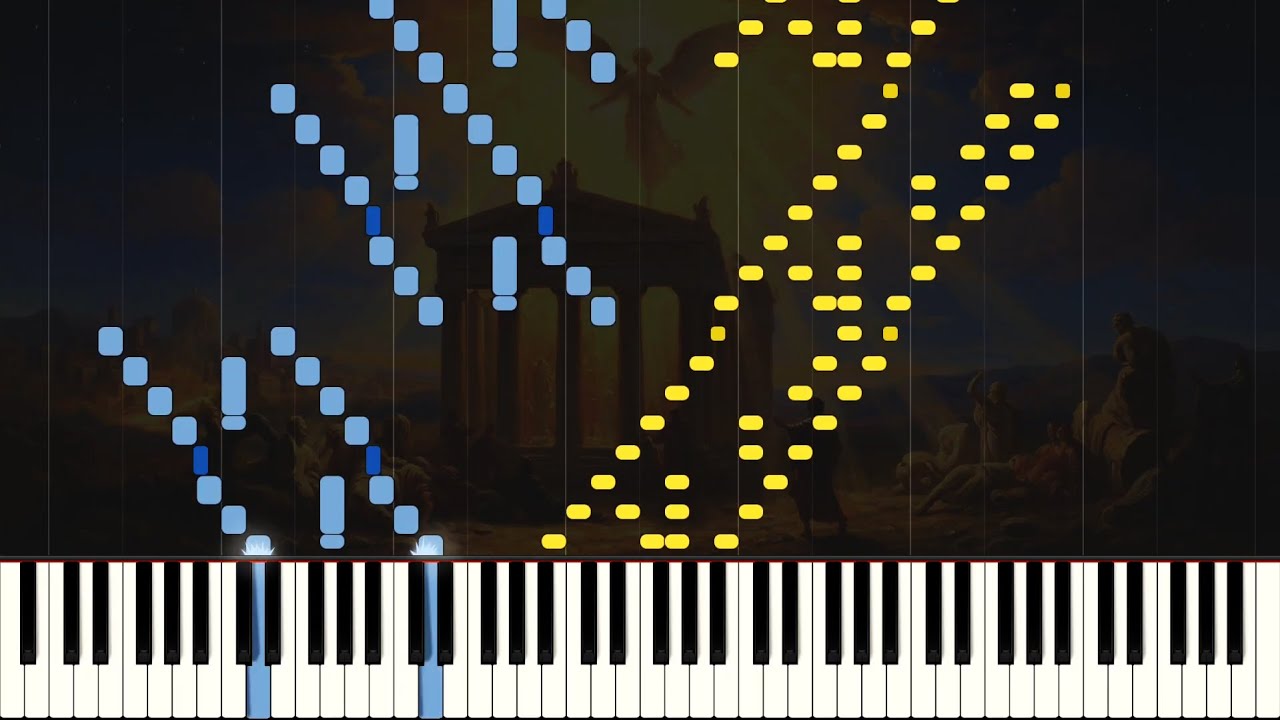
Franz Liszt: Die Ideale – Poème symphonique No.12 (transcribed for solo piano by August Stradal, slightly reworked by LisztTiles2906 from Liszthesis) [NEW YEAR 2026 SPECIAL].
00:02 - Introduction
01:57 - Aufschwung (Soaring)
17:09 - Enttäuschung (Disillusionment)
24:44 - Beschäftigung (Occupation)
27:00 - Apotheosis
The longest of Liszt’s Symphonic Poems, No. 12, Die Ideale, dates from 1857. It was inspired by a poem of Friedrich Schiller, and was premiered at Weimar in September 1857 along with the Faust Symphony, inspired by Goethe, in a double tribute to Weimar’s (and Germany’s) two great dramatic poets. In fact, Liszt planned it originally as a symphony in three movements (like the Faust), but eventually decided on the single-movement symphonic-poem form, disposed in several contrasting sections corresponding to specific parts of Schiller’s poem (the order of the verses, though, was altered by Liszt in order to create a more satisfying musical design). Harmonically and thematically the work is unified by resourceful use of the interval of a third, often disposed in chains either vertically or horizontally – a foreshadowing of the highly individual harmonic world of Liszt’s late works.
There are five principal sections, each prefaced in the score by a portion of Schiller’s poem. An Andante introduction, whose depressed, descending materials resemble to some extent – especially in Stradal’s transcription – the opening of Liszt’s B minor Piano Sonata, symbolises Schiller’s lament for vanished joys and ideals of youth. The following Allegro spiritoso, portraying the memory of youthful aspiration, and then the ideas of love, truth, fortune, fame, takes its origin from a vigorous rising motif, con impeto, founded on chains of thirds. This initiates a large, tumultuous and sometimes grandiloquent span entitled ‘Aufschwung’ (‘Soaring’), corresponding to the exposition of a sonata allegro in a much-expanded D minor. A contrasting molto espressivo idea brings about a dissipation of energy, subsiding to a D major Andante is macaronically marked Quieto e sostenuto assai, aber nicht schleppend which is to proceed at half the pace of the previous section. Stradal represents Liszt’s muted strings by directing the pianist should play una corda throughout. A warm transition in E flat links back to a further development of the Allegro spiritoso, rising eventually to a towering climax, Sehr breit und grandios.
From here the music collapses into the third principal span, ‘Enttäuschung’ (‘Disillusionment’), a depressed Andante in which Liszt recurs to the material of the introduction and creates a slow movement hovering around C sharp minor whose melodies have the characteristic marking mestoso, corresponding to Schiller’s thoughts, in the middle of life, of disillusionment, weariness and isolation – but also hope, brought by the ideal of friendship, so there is a gradual acceleration to the scherzo-like fourth section, ‘Beschäftigung’ (‘Occupation’), which leads to a sense of fulfilment. Starting Allegretto mosso, the increasing ‘activity’ of the music – which calls for a virtuoso of real physical stamina in Stradal’s transcription – quickens to a flamboyant Allegro fuocoso assai (spiritoso molto) that is itself but a preface to the fifth and final section of the work, which Liszt marks ‘Apotheose’. This grandiose finale is a kind of large-scale recapitulation, with further development, of the materials of the D minor Allegro, now displayed from the perspective of the relative major, F. Liszt himself suggested a cut in this section, but Stradal does not observe it. Celebrating Schiller’s hymning of Faith in the Ideal as Life’s highest aim, it brings the symphonic poem to a resplendent and overwhelming conclusion. (notes by Malcolm MacDonald)
Die Ideale is cast as a sort of character-portrait of the composer: Schiller’s eponymous poem is frequently cited in short quotations throughout the score, in an order that differs from Schiller, but which underlines Liszt musical structure, representing the development both of idea and ideal, and the young artist’s aspirations turning to a reflection of life’s experience and understanding. The familiar refrain of art conquering all comes to its apotheosis in the final moments, but it is the haunting joy of discovery shown when that theme first appears that is the most memorable passage in the work, and one which Liszt happily used again in his excellent Künstlerfestzug. (notes by Leslie Howard)
For this New Year's special, we present yet another underappreciated masterpiece by Liszt, with a few small parts of the arrangement discreetly modified to render it more feasible pianistically. And as usual, thank you all for enjoying our work since 2019 and helping us reach the 2,000 milestone! Let's head for the next one :-)
Künstlerfestzug zur Schillerfeier, S.520 (another piece using the same themes): • Künstlerfestzug zur Schillerfeier (for sol...
Our Discord Server: / discord








![Wagner/Liszt - Tannhäuser Overture (Audio+Sheet) [Cziffra]](https://i.ytimg.com/vi/13zFjZ7OLDw/maxresdefault.jpg)

Информация по комментариям в разработке