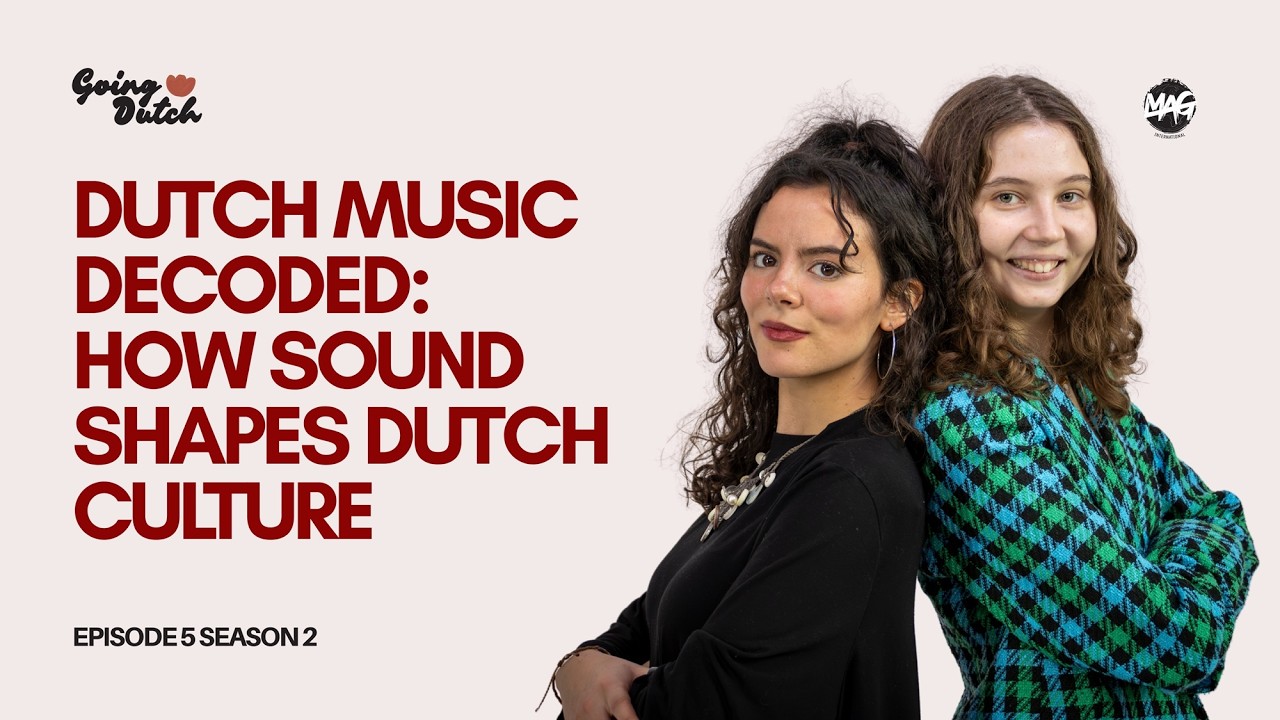
Dutch music is more than party chants and festival beats. In the latest episode of MAG Going Dutch, Luba and Salomé explore Dutch culture through sound, language and lyrics, guided by musician Bruno Storm.
Bruno Storm, a Dutch songwriter who performs primarily in Dutch, explains that the local music scene has shifted dramatically over the past decade. Ten years ago, singing in Dutch was often seen as uncool. Today, it has become mainstream. Artists like Froukje and S10 helped normalise Dutch lyrics in pop music, opening the door for a new generation of musicians who no longer feel the need to switch to English.
That doesn’t mean there is one clear Dutch sound. Bruno describes the scene as fragmented. On one end, there is stereotypical bar music: loud, chantable songs everyone seems to know once alcohol enters the equation. On the other, there is a growing wave of understated Dutch pop, with clean guitar lines, clear vocals and simple arrangements designed to be easy to digest. ‘It’s not complicated music,’ Bruno explains. ‘It’s not about showing off. It’s about clarity.’
This balance between practicality and creativity reflects a wider pattern in Dutch culture. Music is often functional: something to sing along to, something that brings people together, something that fits a moment. Only recently has there been more space for theatricality, abstraction and experimentation. Artists like Spinvis, whom Bruno names as a personal icon, are admired precisely because they break from the obvious.
For internationals, Dutch music can feel distant at first. Language plays a major role. Because Dutch people switch to English so easily, the Dutch language itself can feel less present in daily life. That makes it harder for non-Dutch speakers to develop an emotional connection to Dutch-language music. Bruno compares it to listening to music in a language you have no reference point for. Without understanding, the connection is limited.
Still, Luba recognises music as a powerful learning tool. She explains that when she started learning Dutch, her instinct was to look for Dutch songs. Melodies and rhythm helped her get used to pronunciation and structure in a way textbooks never could. Bruno agrees, recalling how his own Spanish teacher used music to teach grammar and vocabulary. ‘It works,’ he says. ‘Music sticks.’
The episode also touches on the Netherlands’ global reputation for music production. While Dutch lyrics may not travel far, Dutch producers certainly do. From EDM to pop, Dutch producers have shaped international charts for years. According to Bruno, Dutch beats are often where the country’s musical confidence really shows.
In the rapid-fire round, Bruno reveals himself as a homebody who prefers staying in, names the Hoornsemeer as his favourite place in Groningen, identifies his Spotify taste as ‘bedroom pop’, and admits that what really makes him laugh are small, unexpected moments in public. ‘It reminds you that everyone is just a weird little guy,’ he says.









Информация по комментариям в разработке