Among the thousands of folktales that have graced Chinese history over the millennia, a handful, dubbed “the four great folktales” stand apart as having significant cultural importance.
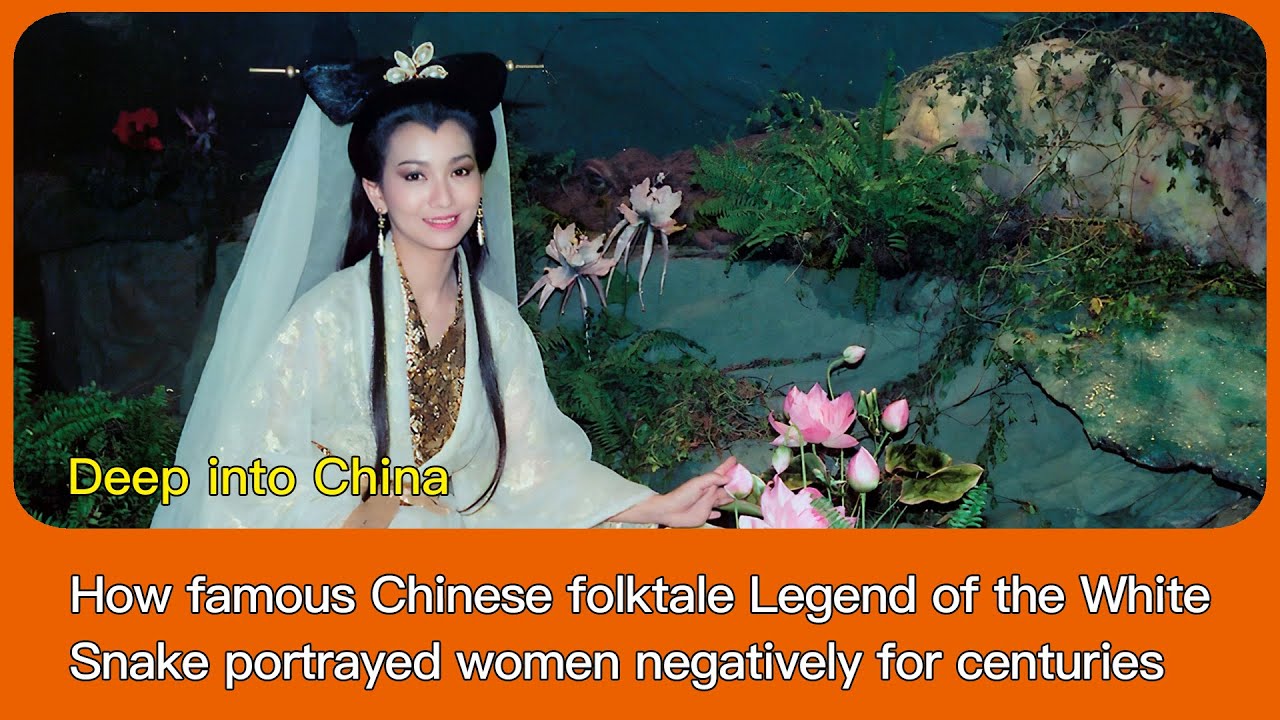
One of them, *The Legend of the White Snake*, tells the story of a man, Xu Xian, who falls in love with a female snake spirit, Bai Suzhen.
According to a paper published in June by Dean and Francis Press, the tale has been used throughout the centuries to reinforce negative stereotypes about women.
“In China’s feudal society, capable women — the White Snake — were seen as negative images. Although their human nature continued to strengthen, they still could not escape the oppression of patriarchal society, which fully symbolised the low status and lack of discourse power of Chinese women in traditional society,” wrote Tang Meng, the author.
The earliest versions of the folktale often depict women as treacherous, even homicidal. While newer tellings of The Legend of the White Snake have softened the characters, the plot always ends with the female snake imprisoned inside a pagoda for decades or centuries.
The folktale first emerged during the Tang dynasty (618-907), and various forms of the legend were told for centuries until Emperor Qianlong (r.1735-1796) finalised an official version during the Qing dynasty (1644-1911).
In an early version from the 9th century, a man (by a different name) has sex with a woman before becoming ill and transforming into water. His family later tracks the woman down and discovers she is a white snake.
This tale came during a major development in feudal China during the middle centuries, when women emerged “on the surface of history.” In other words, according to Tang, they became noticed for the first time in official history.
Later, during the Ming dynasty (1368-1644), another version of the folktale featured a man who met three generations of women and fell in love with the mother, who happens to have killed all of her previous suitors. A Taoist exorcist then performs on the women, and the mother turns into a white snake(her daughter transforms into a chicken and the grandmother an otter). The three women are imprisoned in stone pagodas.
The popularity of the Legend of the White Snake grew during the Qing dynasty when the story became widely performed at Chinese operas, elevating it to the status of a “powerful cultural presence”.
As the story begins to solidify, Xu Xian, the husband, evolves as a character and, by the end of the story, no longer cares that his wife is a snake. However, the White Snake is still considered a threat by an abbot named Fahai, who imprisoned the woman in a pagoda for centuries.
“The Legend of the White Snake” is a popular Chinese folktale that has been adapted into various forms of literature, including books, plays, and poems.
The Tang-era and Ming dynasty versions of The Legend of the White Snake present female sexuality as a threat to men. Although other versions of the tale present the White Snake as more sympathetic, they inevitably result in the same conclusion: the woman poses a threat to men, which ends in her imprisonment.
“Even if she is kind-hearted, she should still be seen as a curse, let alone a companion to humanity. This concept is a requirement of Confucian tradition for women to have a gentle personality and a good family background, with the meaning of oppressing women,” wrote Meng Teng, the author of the Dean and Francis Press paper.
The Chinese operas also solidified the presence of a secondary character: the Green Snake. She is the best friend of the White Snake, and they transform into humans together.
She typically plays a supporting role in the tale, but a more modern interpretation of the story brings the Green Snake to the fore.
The 1993 Hong Kong film *The Green Snake*, based on the Lilian Lee novel of the same name, centres the mischievous best friend who interferes with the relationship between Xu Xian and the White Snake.
In the film, the Green Snake was played by Maggie Cheung Man-yuk, a retired Hong Kong actress. Taiwan actress Joey Wong Cho-yee played the White Snake.
The movie grossed US$77.4 million at the box office.
Yuhan Chen, while at Fudan University in China, wrote in a paper published in 2022 for Atlantis Press that the film stands apart from tradition for its homoerotic portrayal of the two female leads.
“By accentuating the emotional entanglement among the White Snake, Xu Xian, the Green Snake, and abbot Fahai, the film discusses questions like, what is human nature? What are love and lust? And do humans really have love?” she wrote.
However, she added that, as the White Snake has been softened throughout the centuries due to the popularity of the folktale, the Green Snake “carries on the nature of the aggressive snake, which is unrestrained and has dichotomous attitudes towards love and hatred.”















Информация по комментариям в разработке