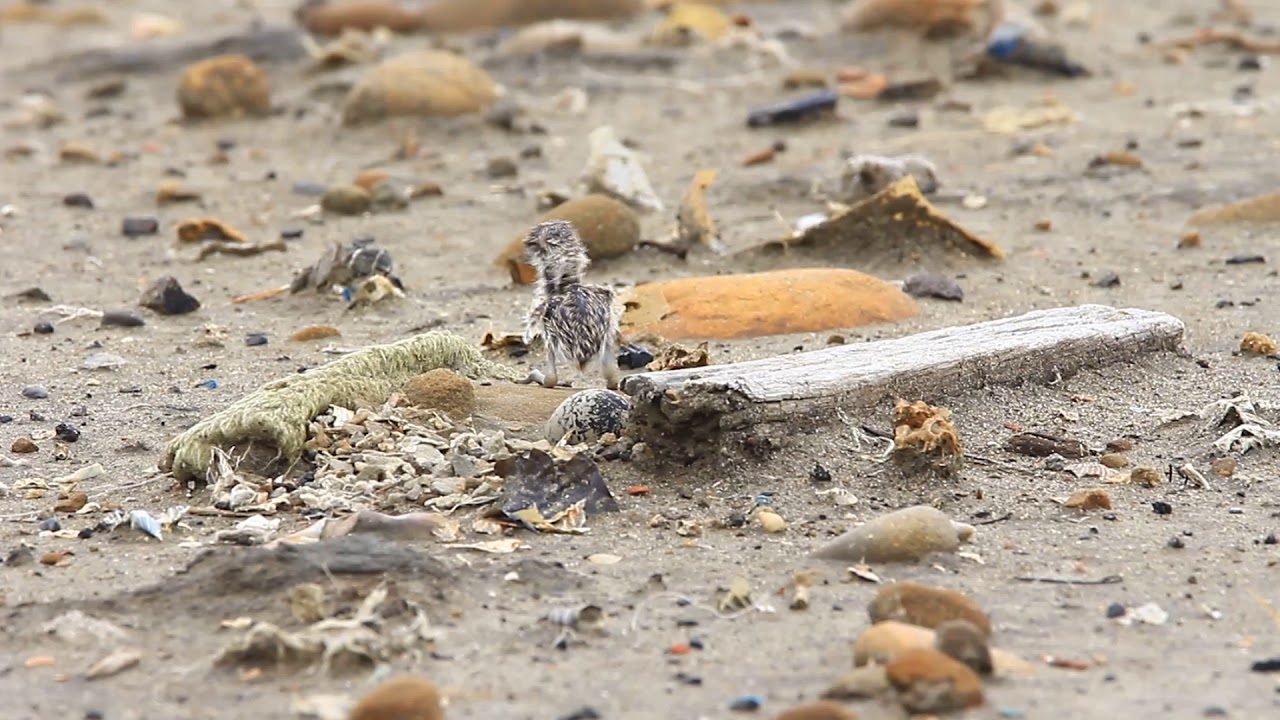
The Kentish plover (Charadrius alexandrinus) is a small cosmopolitan shorebird (40-44 g) of the family Charadriidae that breeds on the shores of saline lakes, lagoons, and coasts, populating sand dunes, marshes, semi-arid desert, and tundra.[2][3] Both male and female birds have pale plumages with a white underside, grey/brown back, dark legs and a dark bill, however additionally the male birds also exhibit very dark incomplete breast bands, and dark markings either side of their head, therefore the Kentish plover is regarded as sexually dimorphic. The Kentish plover is a small shorebird weighing around 40g as an adult. Both male and female birds have black bills and dark legs, however adults have dimorphic plumage. During the breeding season, males have a black horizontal head bar, two incomplete dark breast-bands on each side of their breast, black ear coverts and a rufous nape and crown (although there is some variation between breeding populations), whereas the females are paler in these areas, without the dark markings.[12][13] In the early breeding season, it is easy to distinguish between males and females since the ornaments are very pronounced, but as the breeding season progresses, the differences between the two sexes decrease. Moreover, males have longer tarsi and longer flank feathers than females.[13][14] Longer flank feathers are thought to be an advantage for incubation and brood care, as the quality of feathers is associated with heat insulation.[15] There are multiple significant predictors of plumage ornamentation in Kentish plovers. Firstly, the interaction between the advancement of the breeding season and rainfall seem to affect ornamentation. Male ornaments become more elaborated over the course of a breeding season in regions with high rainfall, whereas in regions with low rainfall, male ornaments become lighter. Secondly, the interaction between the breeding system and the sex can predict the degree of plumage ornamentation. In polygamous populations, the sexual ornaments are more pronounced, generating a stronger sexual dimorphism than in monogamous populations. The difference is especially witnessed in males, whereby the ornaments are darker and smaller in polygamous populations compared to monogamous populations, where males have lighter and larger ornaments. This is thought to be the result of a trade-off between the size and intensity of the ornaments. Kentish plovers have an extremely wide geographical distribution and their habitats vary not just spatially but environmentally too. They are known to reside and breed in multiple types of habitat, from desert with ground temperatures reaching 50 °C to tundra. The distribution of this species’ breeding areas covers Europe, Asia and Africa,[6][17]). In Europe, populations are typically found in the west, however there was once a breeding population in Hungary, however Kentish plovers no longer breed there.Kentish plovers either forage individually or in loose flocks of 20-30 individuals (outside the breeding season), and occasionally can incorporate into larger flocks of up to 260 individuals of multiple species.[34][35] Their main source of food consists of miniature aquatic and terrestrial invertebrates such as insects and their larvae (e.g. beetles, grasshoppers or flies), molluscs, crustaceans, spiders and marine worms.[34] They are obligate visual foragers and often feed at the shoreline of lakes, lagoons or ponds in invertebrate-rich moist-soil areas.
https://en.wikipedia.org/wiki/Kentish...
東方環頸鴴(學名:Charadrius alexandrinus)為鴴科鴴屬的鳥類。該物種的模式產地在埃及。
https://zh.wikipedia.org/zh-tw/%E7%8E...

Информация по комментариям в разработке