digitalized in @pinkcarpetstudioarchive/live/recording studio
1984
Ocora
France
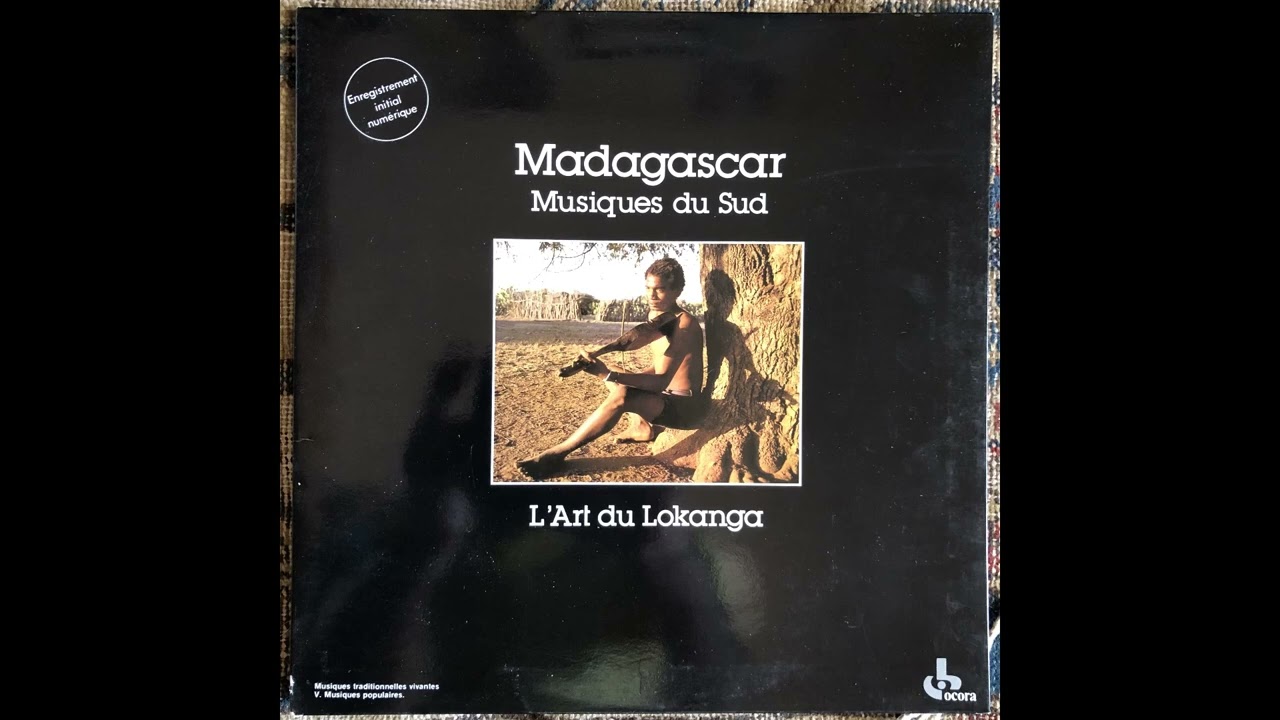
Madagascan shepherds regularly travel great distances across country on foot. Some of them, like the Antandroy, do not hesitate to walk hundreds of kilometers from the southern coast to the high plateau. This explains their presence at Analavory, in Merina country, where we recorded these two musicians.
The young Koto and his wife Mananasy left their village several months earlier to play their music for Antandroy communities that had migrated to the high plateau in order to raise hogs and grow rice and cassava. In exchange for their services, Koto and Mananasy hope to obtain a certain number of zebus, little by little, before returning to the south. Koto's lokanga, a three-string bowed fiddle, is essentially an accompaniment instrument. The vocal duo and instrumental part are punctuated by rapid, rhythmic glottal stops produced by the fiddle player. His songs often concern the present moment, when he is not addressing the participants directly.
The island of Madagascar, the largest in the Indian Ocean, is separated from the southeast coast of Africa by the Mozambique Channel. From the central high plateau to the luxuriant eastern slopes and the great stretches of savanna dotted with forests, the country offers an astonishing variety of landscapes. Although Madagascar is geographically close to the African continent, the cultural origins of many of its ethnic groups stem from a common Austronesian source. Contributions from African, Arabic and, as of the 16th century, European countries, superimposed themselves thereupon to form a unique culture which retains the vestiges of its past. Thus, the language and dialectal variants spoken in the Malagasy are related to the linguistic families of Southeast Asia. Other similarities, in ritual practices for example, recall those faraway lands. Over twenty ethnic groups may be distinguished throughout the island, and they can be classified into three major groups the peoples of the tropical forests that cover the eastern slopes, such as the Betsimisiraka and the Antambahoaka, those from the mountains and the moors of the central high plateau, including the Merina and the Bezanozano, and thirdly, the peoples of the south-western and southern coasts, such as the Sakalava and the Mahafaly, who live in vast semi-arid expanses. It is in this third region, crossed by the Tropic of Capricorn, that we collected the music presented on this album. The selections are performed primarily by Bara and Antandroy musicians who, just as their Antanosy, Karimbola, Mahafaly, and Masikoro neighbors, live in small villages built out of earth or other natural materials, such as wood, sisal, and filao. Animal husbandry in this semi-arid region is the most widespread activity, concentrating on the zebu, which occupies an overvvhelming place in economic, social, and religious life. The zebu, considered to be a sign of wealth, is required for ritual sacrifices and is the basis of all important trade. Ancestor cult is widespread practice, as throughout the rest of the island. Among the Antandroy, the construction of remarkable funeral monuments topped by wooden sculptures reflects the respect and importance attached to the departed. This is particularly true for personnages with royal status who receive funerals beyond compare.
During our visit, we attended one of these ceremonies on the occasion of the burial of the wife of a king. The ceremony had been prepared for over a year and the body of the deceased, skilfully preserved with plants, lay in a hut in the village. Over one thousand persons participated in the festivities in which over one hundred animals were sacrificed.
Music is an important part of the ceremonies. In fact, it accompanies all essential rites and ceremonies, such as that of circumcision. Music is the main feature in seances, it encourages young men in their ritual wrestling, accompanies cattle thieves in their wild races, and provides rhythm for daily activities. It is interpreted using instruments as diverse as the lute (kabosa) of Arabic origin, the board zither (marovany) and its close relative the valiha (tube zither). Ubiquitous rattles (koritsa, katsa) accompany the majority of the instruments. Polyphony is developed over sustained drum (amponga) rhythms. The diatonic accordeon (gorodao), the fiddle, the viol, and the violin, introduced by European navigators who frequented the Mascarenes in the past, are today utilized in a very unusual type of playing that is surprising both for its variety and beauty. Among the instruments that hold an important place in the musical traditions of southern Madagascar, we have collected an unedited repertoire from among Bara and Antandroy shepherds playing the fiddle and the viol. In Madagascar these instruments are called lokanga, a term which is also used in different regions of Africa to designate string instruments that are plucked or bowed.

Информация по комментариям в разработке