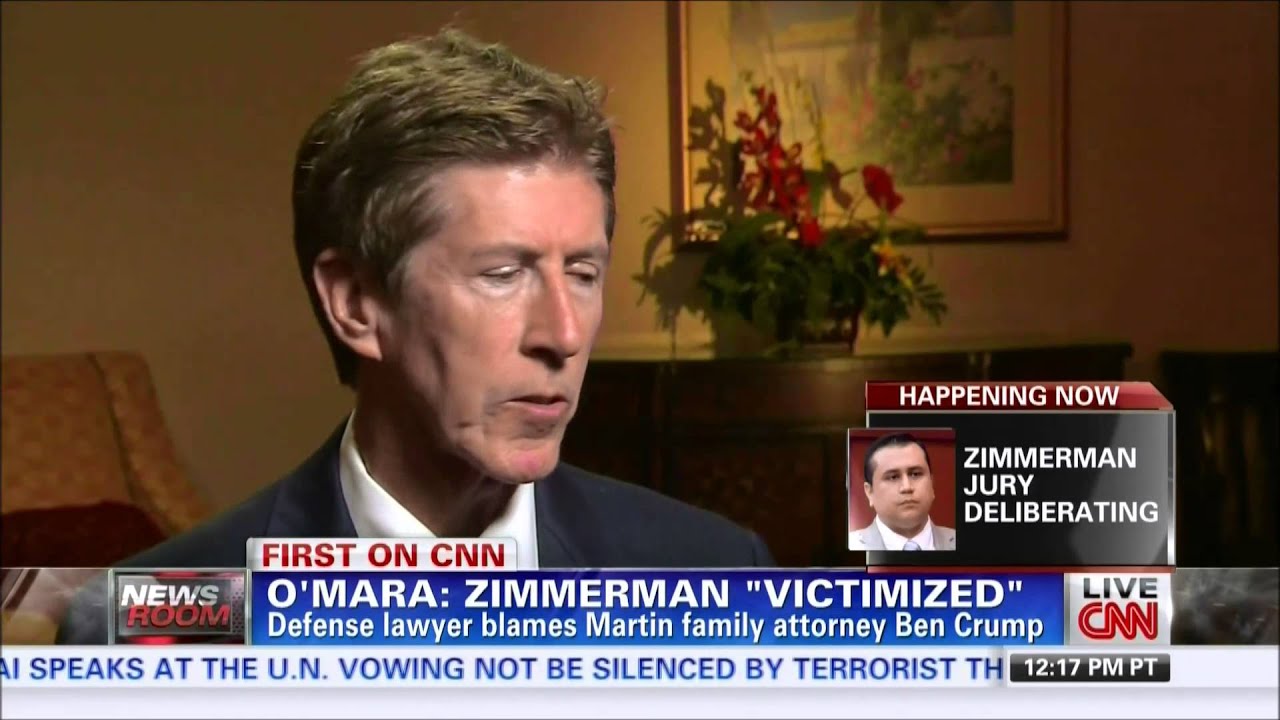
O'Mara calls his current assignment "an amazingly interesting case." Allegations of racism, huge protests organized by the likes of the Rev. Al Sharpton, threats of riots, calls for business boycotts, the forced resignation of the local police chief, and a state attorney's request to be removed from the case to help "tone down the rhetoric." It is, O'Mara acknowledges, "a perfect case for my skill set."
On April 11, 2012, the day Zimmerman was taken into custody, O'Mara took over the case. The charge: second-degree murder. Angela Corey of the 4th Judicial Circuit was named to prosecute the case after Norm Wolfinger, the state attorney whose jurisdiction included Seminole County, asked to be removed.
O'Mara himself worked with the State Attorney's Office in Seminole for two years after law school. In nearly 30 years of practicing criminal law, O'Mara—a past president of the Seminole County Bar Association—has handled more than 130 jury trials.
His friends and colleagues urged him to take Zimmerman's case.
Mark NeJame, an Orlando-based attorney and legal analyst for CNN and other news outlets, turned the case down and suggested O'Mara.
"I'd recently come off of working on three very high-profile cases that were exhausting and time-consuming," NeJame says. He had also recently signed another contract with CNN and Headline News 13.
O'Mara discussed taking on the case with his wife and his staff. Then he spoke with his buddy Flood. "I told him I thought he should take it," Flood says. "You need to be more than a great courtroom lawyer. You have to be able to be in front of a camera a lot. ... That calm is such a critical thing."
This time around, Zimmerman and O'Mara are trying to use the Internet to their advantage. Websites have been used to raise funds for Zimmerman's expenses. The first one brought in more than $200,000 in two weeks. The current one involves a trust fund, with the money going specifically toward Zimmerman's legal defense.
And, in what is considered the first effort of its kind, O'Mara is using the web—Facebook, Twitter and a website called GZLegalCase.com—to humanize his client. O'Mara also hired a digital-media manager to map out strategy for online efforts and keeps two interns busy monitoring social media and blogs.
"You have to know what people are saying," he says. "It could contain some nugget of truth."
The prosecutor asked for a gag order on O'Mara's pro-Zimmerman informational website, claiming potential jurors could be influenced. O'Mara countered that it was only fair that his client have an outlet, since the state was benefiting from anti-Zimmerman news headlines. The judge sided with the defense.
Overall, O'Mara finds that both traditional and social media can be sloppy and sensationalistic. "There's no Walter Cronkite anymore," he says.
The Zimmerman case is widely considered to be a test of Florida's controversial "stand your ground" law, but O'Mara says it's simpler than that: It's just straight self-defense.
"Stand your ground" became law in 2005, and 16 other states have adopted similar statutes. It differs from the traditional standard of self-defense in significant ways. People have always had the right to defend themselves if they have a reasonable fear of imminent death or great bodily harm to themselves or others. But traditionally, they were required to try to avoid such a confrontation by negotiating or retreating, if necessary.
The "stand your ground" law eliminated the requirement for people outside their homes to back off in the face of potential danger. Proponents argue that the law gives people the right to protect themselves. Critics have called it a license to murder.
O'Mara says Zimmerman and Martin's encounter quickly moved beyond standing one's ground. According to O'Mara, Martin smashed Zimmerman's nose and was smacking his head on the concrete sidewalk when Zimmerman fired his gun. The identity of the person screaming for help on the 911 tape for 40 seconds before Martin was shot has been hotly debated; O'Mara says it was his client. Forensics show that Zimmerman was on the ground shooting up, O'Mara says, and thus had no opportunity to negotiate or get away.
A hearing that potentially could have cleared Zimmerman under the "stand your ground" law was set for April, but O'Mara surprised many by waiving the hearing, saying there was time to focus on only one hearing—the trial—and that he wanted Zimmerman to have his day in court, before a jury. The trial was scheduled for June.
O'Mara always KIND OF knew he was destined for the legal life. When he was 7, his uncle asked him what he wanted to be when he grew up. The good Catholic boy from Queens said a priest—or maybe a lawyer.
"They both were responsible, and they helped people," O'Mara says. "Those were qualities that I admired and wanted to emulate."

Информация по комментариям в разработке