“These high-set courtesies are not for me.”
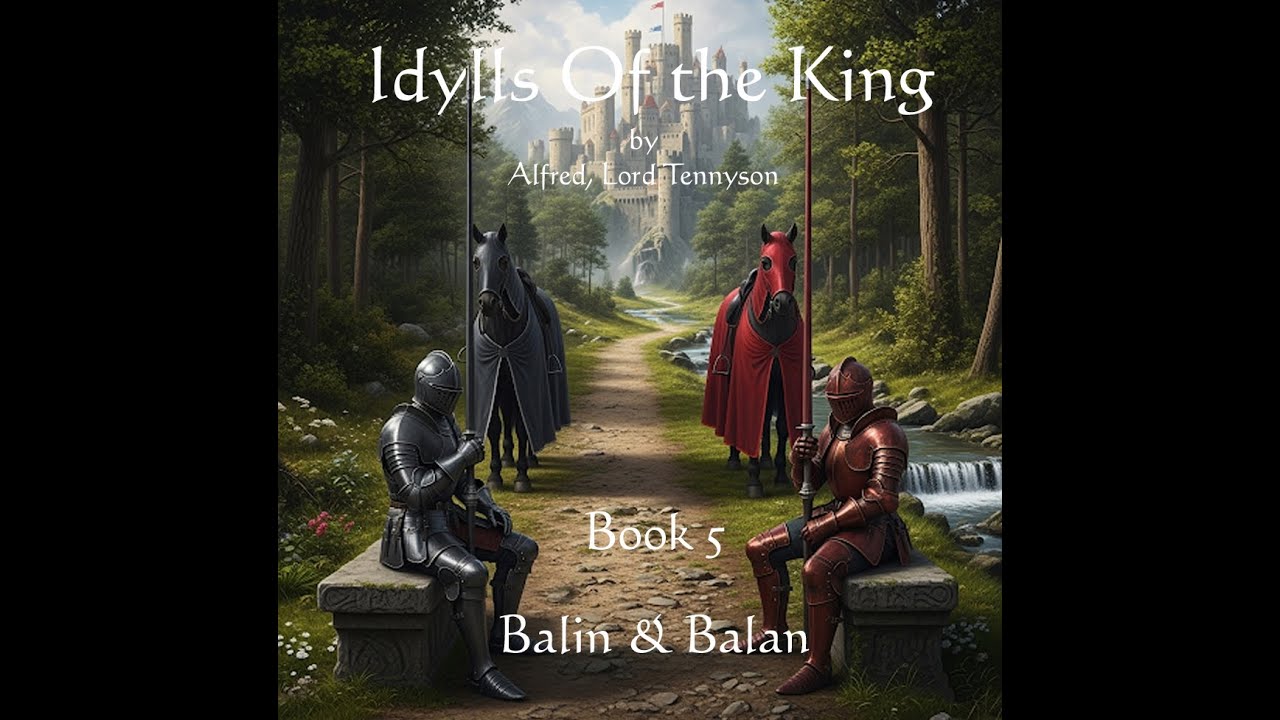
Balin and Balan was the last of the twelve books of Idylls of the King to be written. It was publishd in 1885, nearly thirty years after the first, Merlin and Vivien, was published in 1859. Such a timeline is emblematic of the lengths Tennyson was willing to go to to create and preserve the thematic unity of the twelve poems.
Balin and Balan is the major inflection point in the long trajectory of the dissolution of Arthur's Table Round. Like the previous four books, it begins on a note of optimism as Balin is welcomed back to to the community of knights after a three year exile for nearly killing a thrall. And now, given a second chance, he’s determined to suppress his inner fury and become the kind of noble warrior that King Arthur’s code demands. His brother Balan believes in him, and Balin himself is full of hope that he can rise above his past and embody the ideals of loyalty, truth, and self-control. Balan acts as a brother should, helping Balin control his urges and his melancholy, but when Balan is called away on a quest to find and kill an evil fiend, Balin's doubts get the better of him and this hope begins to unravel when Balin stumbles upon a secret meeting between Lancelot and Queen Guinevere. Balin, who has placed his faith in the honor and purity of the court, is crushed and what he hears and sees shakes him to his core. Suddenly, the dream of Camelot looks like a lie.
Vivien, the manipulative figure in the poem and the most provocative and controversial female figure in Idylls of the King, plays a key role in Balin’s descent. Two thirds of the way through the poem, she bursts onto the scene in a blaze of fury and resentment. In the highly moral and male-dominated world of Camelot, Vivien's actions challenge the restrictive roles traditionally assigned to women in Arthurian legend and Victorian society. She is cunning, outspoken, and sexually assertive—qualities that, in the context of the poem, are portrayed as dangerous. She is an ardent enemy of what she considers to be the pale and passionless sterility of Arthur's Christian court and vows to “beat the cross to earth, and break the King/And all his Table.” She is no heroine in the classic sense of the word. She has no intention of bringing order out of chaos, rather she does all she can to sow dissension and distrust among the court. Like Scarlett O'Hara in Gone With The Wind, Vivien is not driven by love, duty, or moral conviction—qualities often imposed on women in literature. Instead, she operates for her own purposes, navigating a world that doesn't offer her power unless she seizes it. She is self-serving, yes, but also independent, clever, and fearless. These traits make her threatening within the moral framework of the poem, but they also reveal a woman who refuses to be controlled or ignored. Vivien’s refusal to be silenced or confined can also be read as a form of rebellion against a system that grants power almost exclusively to men. She uses intelligence and language as her tools. In her interactions with Balin, she plays on his inner turmoil, amplifying his doubts and feeding his rage. Her aim is not physical domination but psychological control. In this, she subverts the traditional power dynamic—Balin is the armoured knight, yet it is Vivien who ultimately directs his path. In Balin and Balan, Vivien stands as a dark mirror to the traditional female role. She doesn’t need to convince Balin of anything drastic—he is already broken by what he has seen. If he had more self-esteem and was less prone to listen to the opinions of others, he would be immune to her wiles but Vivien whispers doubts and fans the flames of his anger and disappointment, confirming his worst fears about the hypocrisy at court. With his trust shattered and his emotions spiraling, Balin finds himself unable to contain the violence he once tried so hard to control.
Although his journey begins with hope and loyalty, it ends in bitter disillusionment and senseless violence. He desperately wants to live up to the ideals of Camelot, but those very ideals are what betray him. As he tries to hold onto his identity and honor, he is slowly consumed by the corruption and hypocrisy around him—especially within Arthur’s court—and eventually, by his own rage and despair. His brother, riding nearby, hears his yells and thinking he has found the fiend, engages Balin in a joust. They both die, each slain by his brother. Vivien, having goaded Balin, watches unconcerned and rides away with her squire, intent on further mischief amongst the knights in Arthur's court.










Информация по комментариям в разработке