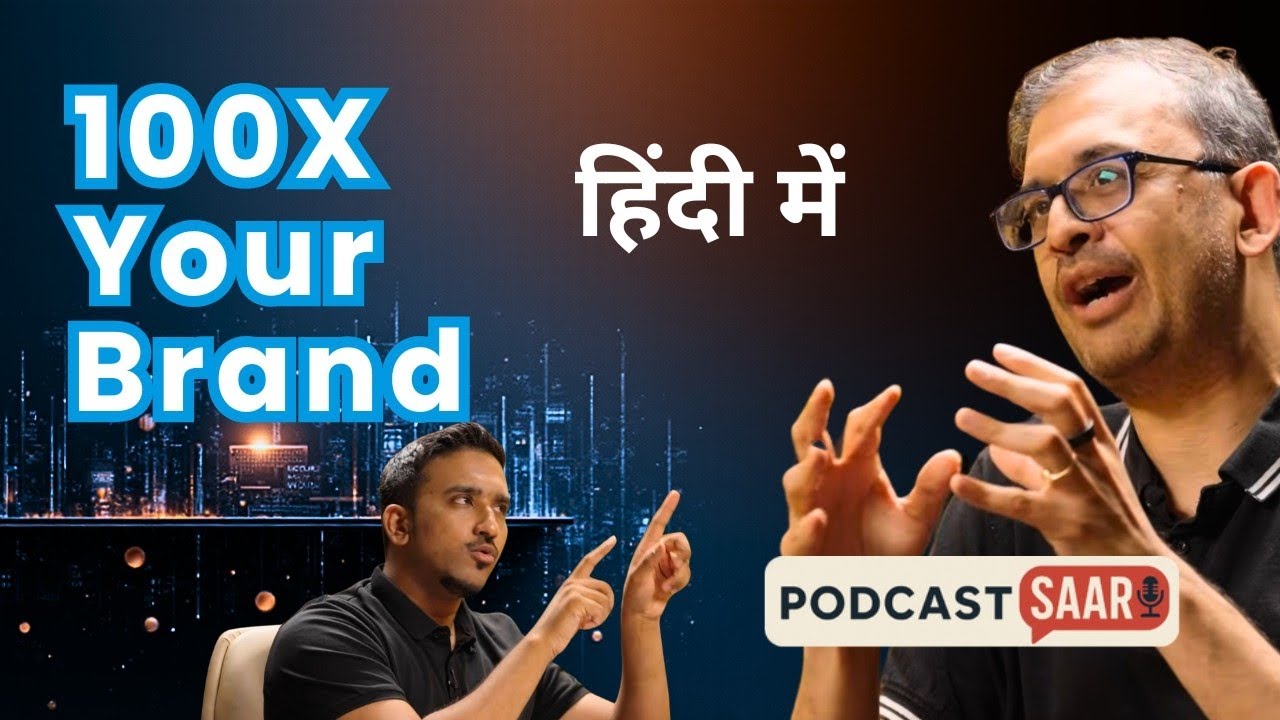
Join Anand Naran, a highly seasoned entrepreneur who built a ₹1,500 crore empire, for a masterclass on how to build an epic consumer brand in India and sell it to the world. Drawing on 20 years of wisdom, including his time as CEO of Myntra and co-founder of Medlife, Anand shares his framework for navigating the D2C revolution and scaling a business,,.
The discussion focuses on the massive opportunity—potentially worth billions of dollars—for Indian consumer brands to go global,,. Anand explains how he is building BrandMē with the ambition to create the next new modern consumer brands company by leveraging India's manufacturing, design, and sourcing advantage, complemented by technology as a great equaliser,,.
Key Learnings on Scaling and Finding Gaps:
Niche Focus: Founders should generally compete in the least competed spaces,. This approach allows for better unit economics and investment in brand building. BrandMē focuses on only two spaces: lifestyle and health and wellness.
Case Studies in Niche Domination:
My Fitness (Healthy Snacking): Dominated the peanut butter niche (achieving 22% market share) by focusing on the insight that Indians want "health, tasty partner," leading to innovations like no oil separation and chocolate peanut butter with low sugar,. The brand is now expanding globally to markets like the Middle East to increase its Total Addressable Market (TAM).
Party Props (Party Celebration): Addresses the unorganized space of celebrations, offering an 80% gross margin business based on quality, design, and on-time delivery.
Botanic Hearth (Value Added Haircare): Built by following global trends showing consumers search for ingredients (like rosemary oil) rather than just brands, capitalizing on clean beauty and efficacy claims,,.
Operational Excellence and Technology: To scale from ₹100 crores to ₹1,000 crores, operational excellence is critical, balancing technology and culture,,.
Tech Backbones: BrandMē has built internal tech agents for functions like ads, pricing, consumer insighting, and demand forecasting, enabling cost leadership and efficiency,,. These agents automate "boring" but impactful areas, such as reconciliation (referred to as Vasul Raja),.
AI for Efficiency: Using AI to generate images for product catalogs can reduce costs drastically—from ₹1,200–₹1,400 per catalog shot to ₹25—making a dramatic difference to unit economics.
Marketing for Pull: To achieve large scale (₹1,000 crores), 25% of marketing should be allocated to display advertising to increase brand awareness and shift from a "push" model (relying on ads) to a "pull" model (people searching directly for the brand),.
Consumer Insights Methodology: Direct questions yield little result because consumer behaviour is very different from their answers,. Insights are best gained by observing consumers using the product (e.g., watching a gym-goer eat peanut butter with a spoon),. Data sources like Search Query reports (looking for terms growing over 25% month-on-month) and AI tools like ChatGPT are essential for initial research,,.
Brand Storytelling: Telling a good story is essential because human brains respond better to stories than facts. Functional stories don't work; instead, focus on an emotional plot. People don't buy what you sell; they buy why you sell it,.
The discussion also covers important founder lessons, including hiring for hustle, learnability, and energy, and avoiding mistakes like chasing valuation instead of ownership. The biggest thing a startup can do for success is to not die, making cash flow management paramount.

Информация по комментариям в разработке