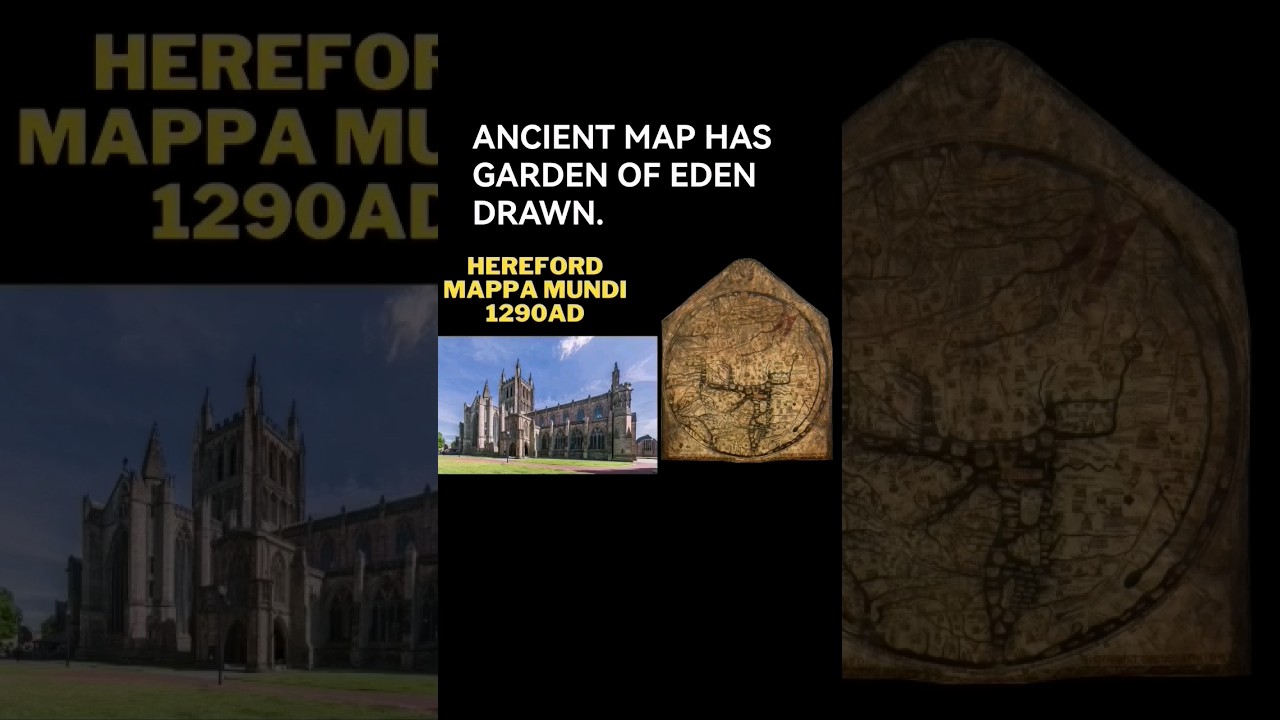
The Hereford Mappa Mundi is a medieval world map that dates back to around 1300. It is currently on display at Hereford Cathedral in Hereford, England. Here are key points about its history:
1. *Creation Date:*
The Hereford Mappa Mundi is believed to have been created around 1300, possibly by a group of artists and scholars.
2. *Purpose and Design:*
Unlike modern maps, the Mappa Mundi is a complex, circular map that combines geographic, historical, and theological elements.
It is more than just a geographical representation; it also serves as a visual encyclopedia of medieval knowledge.
3. *Materials and Size:*
The map is large, measuring about 1.58 by 1.34 meters (5.2 by 4.4 feet).
It is drawn on a single sheet of vellum (calfskin), which was a common material for medieval manuscripts.
4. *Geographical Representation:*
The Mappa Mundi depicts the known world of the time, including regions of Europe, Asia, Africa, and parts of the Middle East.
It features cities, biblical events, legendary creatures, and other elements, often not to scale or with distorted proportions.
5. *Theological Significance:*
The map includes depictions of biblical events, figures, and creatures, highlighting the strong connection between medieval geography and theology.
Jerusalem is typically placed at the center of the map, emphasizing its religious significance.
6. *Annotations and Labels:*
The Mappa Mundi is densely annotated with text in Latin, providing explanations and details about various locations, events, and creatures.
Labels often include descriptions of exotic animals, legendary places, and historical events.
7. *Survival and Preservation:*
Despite its age, the Hereford Mappa Mundi has survived remarkably well. It was preserved in the cathedral's library and archives.
Over the centuries, it underwent some restoration efforts to address wear and tear.
8. *Public Display:*
Today, the Hereford Mappa Mundi is on public display at Hereford Cathedral, where visitors can view this unique medieval artifact.
The cathedral also houses a chained library, which contains other rare manuscripts and books.
9. *Historical Context:*
The map offers valuable insights into medieval perceptions of the world, blending scientific knowledge, religious beliefs, and classical traditions.
The Hereford Mappa Mundi is not only a historical document but also a cultural and artistic treasure, providing a glimpse into the medieval worldview and the ways in which knowledge was visualized and transmitted during that period.
The Garden of Eden is a biblical concept that appears in the Book of Genesis, the first book of the Hebrew Bible and the Christian Old Testament. It is a significant narrative in the creation story and holds cultural and theological importance. Here is an overview of the Garden of Eden's history based on biblical accounts:
1. *Biblical Narrative:*
The story of the Garden of Eden is primarily found in Genesis chapters 2 and 3.
According to the narrative, God created the first man, Adam, and placed him in the Garden of Eden, a paradisiacal environment with abundant vegetation, rivers, and trees, including the Tree of Life and the Tree of the Knowledge of Good and Evil.
2. *Creation of Adam and Eve:*
God created Eve, the first woman, from one of Adam's ribs, making them companions and partners in the garden.
3. *Divine Command:*
God gave Adam and Eve the freedom to eat from any tree in the garden except for the Tree of the Knowledge of Good and Evil. They were warned that eating from this tree would lead to death.
4. *The Serpent and Temptation:*
The serpent, often identified as Satan or a representation of evil, tempted Eve to eat from the forbidden tree, questioning God's command and suggesting that eating the fruit would make them like gods, knowing good and evil.
5. *Disobedience and Consequences:*
Eve succumbed to the temptation and ate the fruit, and Adam followed suit. This act of disobedience, known as the Fall, led to a loss of innocence and brought sin into the world.
As a consequence, God expelled Adam and Eve from the Garden of Eden, placing cherubim and a flaming sword to guard the way to the Tree of Life.
6. *Theological Significance:*
The story of the Garden of Eden is foundational to Christian and Jewish theology, addressing themes of free will, disobedience, and the consequences of sin.
The Fall is often interpreted as humanity's separation from God and the introduction of suffering and mortality.
7. *Artistic and Cultural Depictions:*
The narrative of the Garden of Eden has been a source of inspiration for art, literature, and cultural references throughout history.
Artists have depicted scenes of Adam and Eve in the garden, the temptation, and the expulsion in various forms.
#ancient #ancientmaps #gardenofeden

Информация по комментариям в разработке