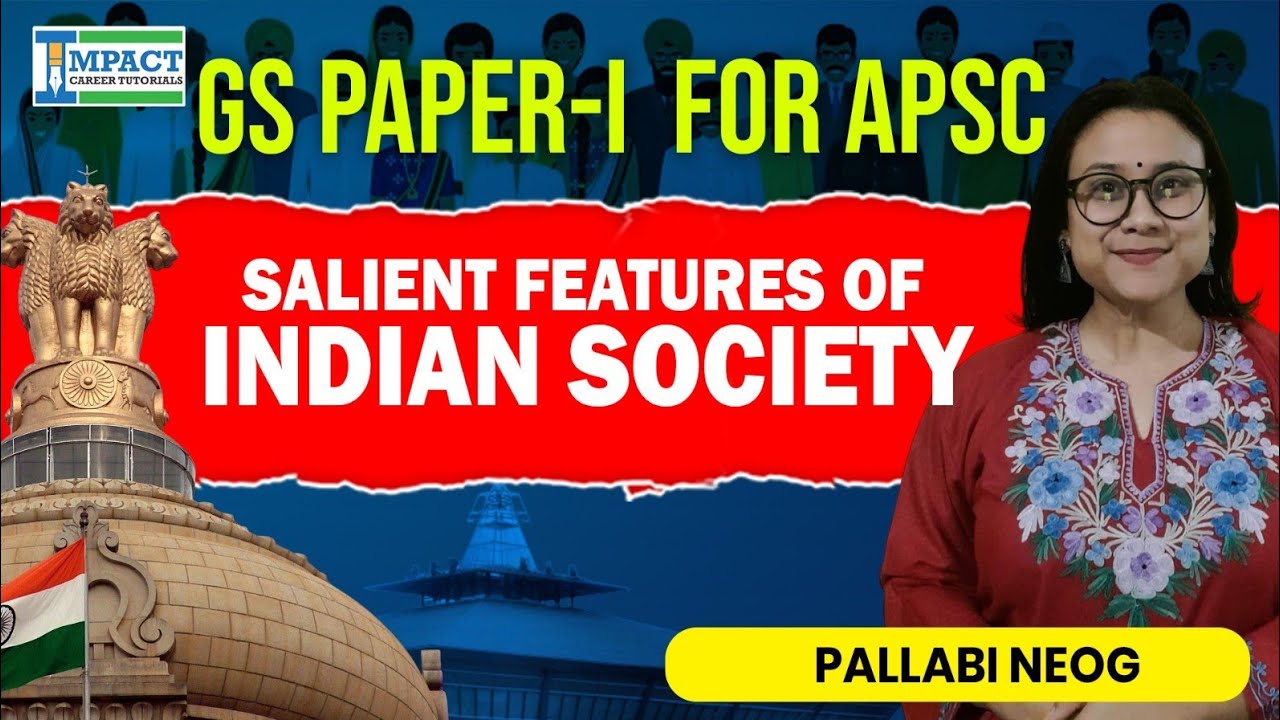
This video, part of the APSC CCE 2026 preparation series, focuses on the salient features of Indian society for GS Paper-I, presented by Pallabi Neog. The session emphasizes understanding the topic from a mains examination perspective, highlighting its importance for APSC Mains, UPSC, and other State PSC exams (3:10).
Key takeaways from the video include:
Characteristics of Indian Society (1:38): The video describes Indian society as a blend of change and continuity, emphasizing its traditional yet evolving nature (7:22-7:44). It also highlights the concept of peaceful coexistence (9:40).
Diversity and Unity (37:02): India is characterized by immense cultural, linguistic, and ethnic diversity (38:06), yet it maintains a strong sense of unity.
Defining Society (40:22): Society is not merely a collection of people, but encompasses relationships, institutions, values, and customs.
Relationships (42:45): Examples include teacher-student, husband-wife, and parent-child relationships.
Institutions (45:10): These are organized systems of relationships that regulate behavior, such as family, economic, and social institutions (51:11).
Values (53:45): Shared ideas of right and wrong, including respect for elders, gender roles, and community feelings.
Customs (55:38): Routine and traditional practices followed over time, like dress patterns and rituals.
Unique Aspects of Indian Society (1:05:24): The video discusses features like cultural diversity (1:05:53), patriarchy (1:06:01), joint family systems (1:06:04), and the caste system (1:06:06).
Accommodative Nature (1:11:00): Indian society has a remarkable capacity to accommodate and absorb external influences while retaining its core identity (1:12:49).
Patriarchy (1:14:04): Traditionally, Indian society has been patriarchal with male dominance in decision-making and gender-specific roles, though this is changing (1:14:10).
Coexistence of Multiple Religions (1:15:45): India is the birthplace of major world religions, promoting tolerance, pluralism, and mutual respect, which forms the basis of Indian secularism (1:16:21).
Spiritual Orientation (1:17:34): Spirituality and religion play a central role in the everyday lives of many Indians, influencing both personal and public life (1:20:39).
Caste System (1:22:36): A distinctive social institution based on birth and occupation, it continues to influence marriage, politics, and social identity, and acts as a means of social mobilization (1:24:36).
Joint Family System (1:31:57): Traditionally, multiple generations live together. While structural
jointness (common roof, kitchen) is transforming, functional jointness (emotional bonding) still prevails (1:33:22-1:36:49). Joint families are transforming rather than disappearing (1:38:00).
Strong Family Values (1:39:32): Emphasizing respect for elders and cultural practices.
Social Change and Current Trends (1:41:13): Indian society is a dynamic entity, with ongoing social issues and evolving trends, such as changes in women's workforce participation (1:44:16) and the impact of urbanization (1:49:00).
Conclusion (1:56:36): Indian society is profoundly diverse yet remarkably resilient, adapting to change without breaking its core identity (1:58:26). It is shaped by various factors, including geography (2:00:09).
Are you preparing for APSC CCE 2026?
In this video, Pallabi Neog ma’am explains the Salient Features of Indian Society for GS Paper-I in a simple, exam-oriented and structured manner.
📌 In this class, you will learn:
• Characteristics of Indian Society
• Diversity & Unity in India
• Role of Women and Social Empowerment
• Caste System & Social Stratification
• Regionalism, Secularism & Communalism
• Globalization and Social Change
• Previous Year Question (PYQ) discussion
• Answer Writing Structure for 10/20 Marks
🎯 This topic is extremely important for APSC Mains GS Paper-I and also helpful for UPSC & other State PSC exams.
📚 Join Impact Career Tutorials for:
✔ Complete APSC Foundation Course
✔ 50+ Mock Tests
✔ Structured Notes & Answer Writing Practice
✔ Live + Recorded Classes
📍 Offline: Lakhimpur, Assam
🌐 Online: Available Across Assam & India
👉 Like | Share | Subscribe for more APSC quality content.
APSC
#APSC2026
#APSCCCE
#IndianSociety
#GSPaper1
#APSCMains
#ImpactCareerTutorials
#PallabiNeog
#AssamStudents
#APSCPreparation
#UPSCStatePSC
#IndianSocietyNotes
#APSCGS
#AssamCompetitiveExams
APSC
#APSC2026
#APSCCCE
#IndianSociety
#GSPaper1
#APSCMains
#ImpactCareerTutorials
#PallabiNeog
#AssamStudents
#APSCPreparation
#UPSCStatePSC
#IndianSocietyNotes
#APSCGS
#AssamCompetitiveExams














Информация по комментариям в разработке