Johann Sebastian Bach (1682-1750)
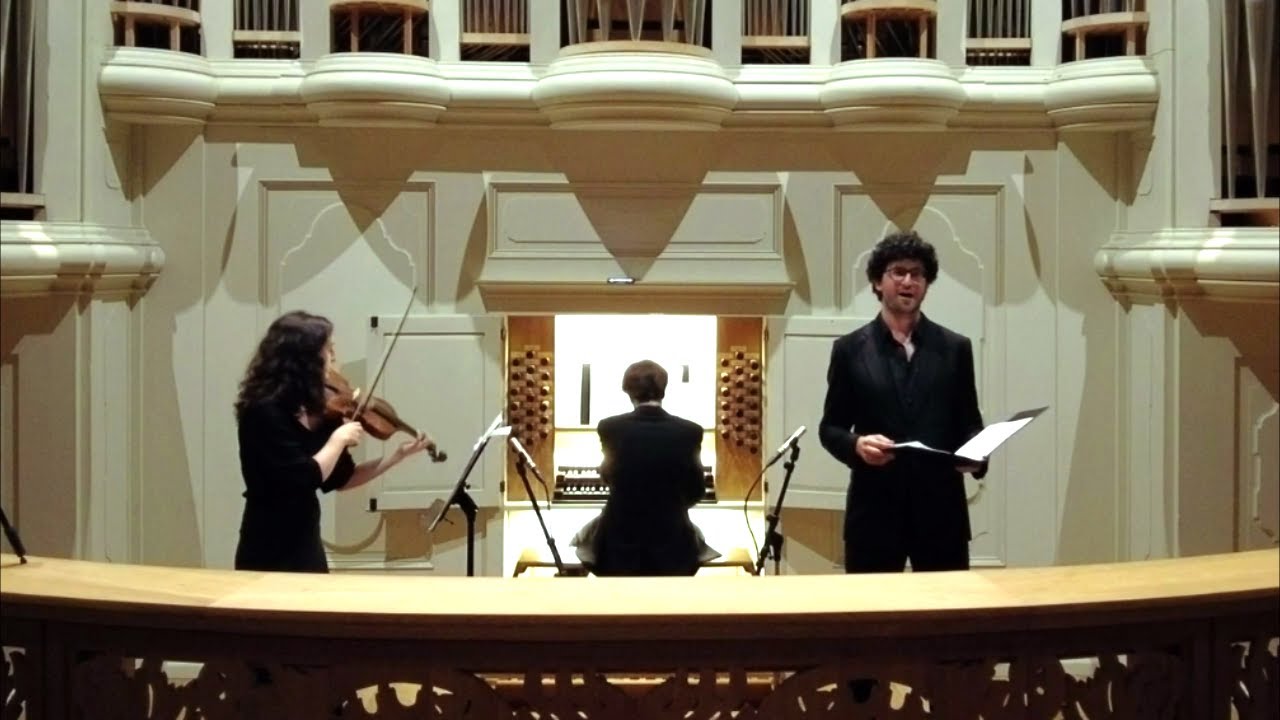
Der Friede sei mit dir - Cantata BWV 158, version for bass, violin and continuo
Paula Peréz Romero, baroque violin
Ben Kazez, baritone
Laurens de Man, organ (continuo)
Recorded at St.-Michiels Vredeskerk, Leuven, Belgium, September 27th, 2023
This cantata is unique in many ways: it is one of Bach’s shortest and written for a very compact ensemble. It may, in fact, be a fragment of a larger work, as no autograph manuscript survives. The title page of the surviving manuscript associates the cantata with two moments in the liturgical year: Easter Tuesday (the Third Day of Easter) and the Feast of the Purification of Mary (Candlemas).
The Easter connection is especially evident in the final chorale, which is taken from Luther’s hymn Christ lag in Todesbanden, traditionally associated with the resurrection. The Candlemas connection relates to the presentation of Jesus at the temple by Joseph and Mary, as described in Luke 2:22–40. There, they encountered the aged, devout Simeon, who, according to the Gospel, had been promised by the Holy Spirit that he would not see death before seeing the Messiah. Upon recognizing Jesus, he took the child in his arms and proclaimed the words of the Nunc Dimittis:
"Lord, now let your servant depart in peace, according to your word;
for my eyes have seen your salvation, which you have prepared in the presence of all peoples—
a light for revelation to the Gentiles, and for glory to your people Israel."
This theme of peace through Christ resonates throughout the cantata, particularly in the opening recitative.
The second aria incorporates a chorale melody, sung by a soprano. In our version, the organ plays this chorale melody using a Sesquialtera registration, a sound combination reminiscent of Bach’s own instructions in the opening chorus of the St. Matthew Passion.
Since no chorus was available, we replaced the last choral with the organ solo version BWV 625 (Christ lag in Todesbanden) from the Orgelbüchlein, maintaining the work’s thematic unity.
Full text in English translation:
I. Recitative
Peace be with you,
You anxious conscience!
Your Mediator stands here,
He has reconciled and torn up
Your book of debts
And the curse of the Law.
Peace be with you!
The prince of this world,
Who laid snares for your soul,
Has been conquered and struck down
By the blood of the Lamb.
My heart, why are you so troubled,
When God loves you through Christ?
He Himself speaks to me:
Peace be with you!
II. Aria
Farewell, world, I am weary of you,
Salem’s dwellings call to me.
(chorale; melody played by the organ:) Farewell, world, I am weary of you,
I long for heaven,
Where in peace and rest
I may behold God in eternal bliss.
There will be true peace
And everlasting, glorious rest.
There I will remain,
There I find joy in dwelling.
World, with you there is war and strife,
Nothing but sheer vanity,
But there I shall shine, adorned with heavenly crowns.
In heaven, forevermore,
Peace, joy, and blessedness!
III. Recitative
Now, Lord, govern my mind,
So that in this world,
For as long as it pleases You to let me stay,
I may be a child of peace.
And let me, from my suffering,
Depart in peace to You,
Like Simeon!
There I will remain,
There I find joy in dwelling,
There I shall shine, adorned with heavenly crowns.
IV. Chorale
Here is the true Easter Lamb,
As God has commanded,
Which on the cross’s lofty stem
Was roasted in fervent love.
Its blood marks our door,
Which faith holds up against death,
The Destroyer can harm us no more.
Hallelujah!
https://paulaperezromero.wordpress.com
https://www.benkazez.com
https://www.laurensdeman.com
About the organ:
In 1748, Johann Sebastian Bach wrote a letter of recommandation for the organ builder Heinrich Andreas Contius (1708-1795). Few of his instruments, which represented a sound world that is very suitable for Bach's music, survive today.
The Contius Foundation realised a magnificent copy of the Contius organ in Liepaja, of which case and some pipework are preserved. After meticulous research, the organ was built by Joris Potvlieghe (Tollembeek, Belgium), in collaboration with Flentrop Orgelbouw (Zaandam, The Netherlands). The instrument is located in the baroque St.-Michielskerk in Leuven, Belgium, which provides a monumental ambience and rich acoustic.
Stop list: see https://contiusfoundation.org

Информация по комментариям в разработке