Exterior & Styling
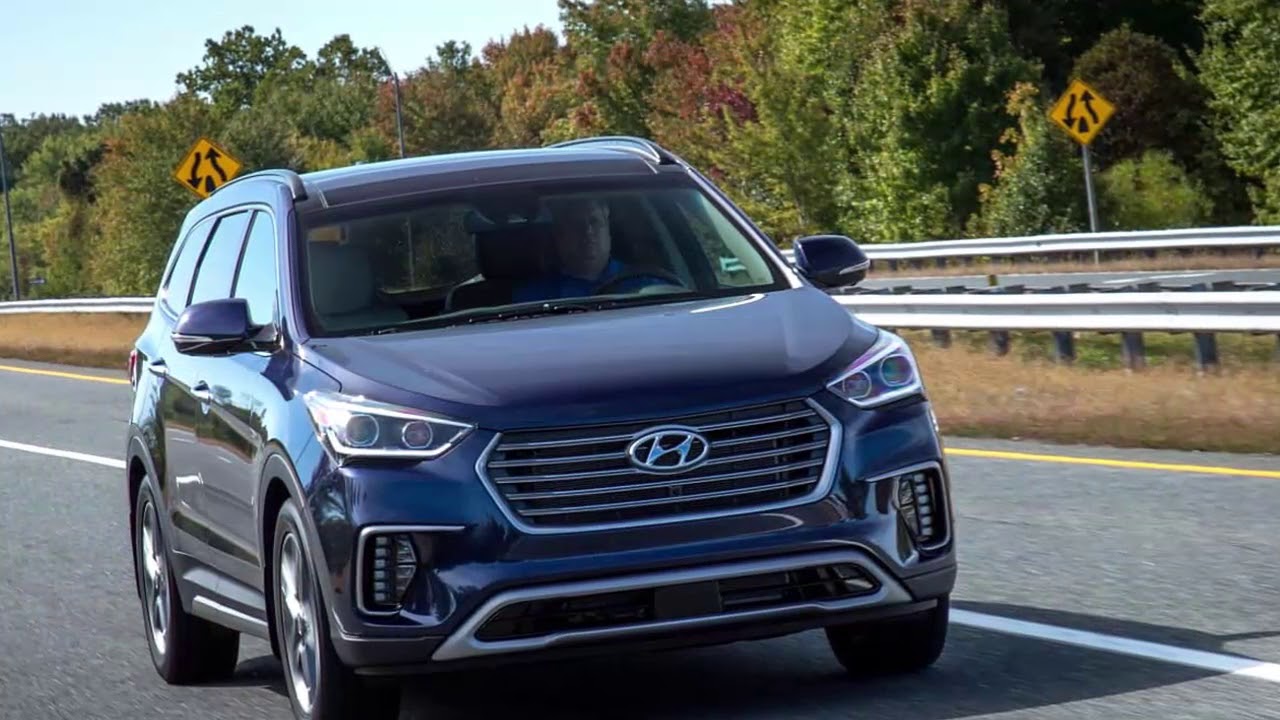
Up front, the 2017 Hyundai Santa Fe has a new bumper, a bigger Hyundai grille, revised headlight pods and Elantra-like vertical LED daytime running lights. New taillights (LED on Limited trims) and dual exhaust outlets now grace the back end, and new 17-, 18- and 19-inch wheels are available. The changes are subtle, but the overall effect makes the SUV more premium. The sloping roof and tapered rear side windows that carry over from last year continue to contribute to a pleasing, sporty look — and to sacrifice third-row headroom and rear visibility.
How It Drives
Most of all, the Santa Fe is easy to drive, car-like and comfortable, but it’s not unsettled when driven hard. No one buys a three-row SUV expecting a sports car, but, for this class, the Santa Fe offers confidence-inspiring handling with restrained body motion and lean. Braking is firm and linear, and steering offers reasonable — though not outstanding — feedback.
The sole powertrain is the previous version’s 290-horsepower, 3.3-liter V-6 and six-speed automatic transmission, with front- or all-wheel drive. The setup gives the SUV plenty of torque scoot around town and adequate highway power for passing and merging, but the V-6 needs to be wound up to really deliver. The capable six-speed is less busy in highway cruising than some competitors — notably the Honda Pilot, which has nine speeds to juggle — and is far more pleasant and responsive than the continuously variable automatic transmission in the Nissan Pathfinder.
A new drive mode selector, with its button oddly located on the lower left of the dashboard, offers Normal, Sport and Eco modes that alter throttle and transmission response as well as steering feel. Eco imparted a lazy quality. Sport offered better steering, but its stronger throttle response made it harder to modulate the somewhat stiff accelerator pedal and drive smoothly at low speeds. Normal was, well, normal, likely the most pleasing compromise for most drivers and situations.
Ride quality is firm. It’s stable on uneven pavement and not unpleasant, but you feel the bumps. Smaller wheels, with their more compliant tire sidewalls, might offer more ride comfort (our test car had the 19-inchers). The tires may also have contributed to the higher level of highway road noise I heard in the Santa Fe than in several of its rivals when driven back-to-back.
The Hyundai Santa Fe’s fuel economy is comparable to its three-row V-6 rivals, which is to say it’s not their strength. The 2017 Santa Fe with front-wheel drive is EPA-rated 17/23/20 mpg city/highway/combined for Ultimate trims and 18/25/21 for lower trims. All-wheel drive drops combined ratings by 1 mpg.
Several of the Hyundai’s competitors also offer a regular four-cylinder or turbocharged-four option for mileage-conscious buyers, and the Highlander also offers a hybrid. The 2017 Santa Fe with front-wheel drive is EPA-rated 17/23/20 mpg city/highway/combined for Ultimate trims or 18/25/21 for the lower trims. All-wheel drive drops combined ratings by 1 mpg.
image source www.cars.com
article source https://www.cars.com/reviews/our-view...

Информация по комментариям в разработке