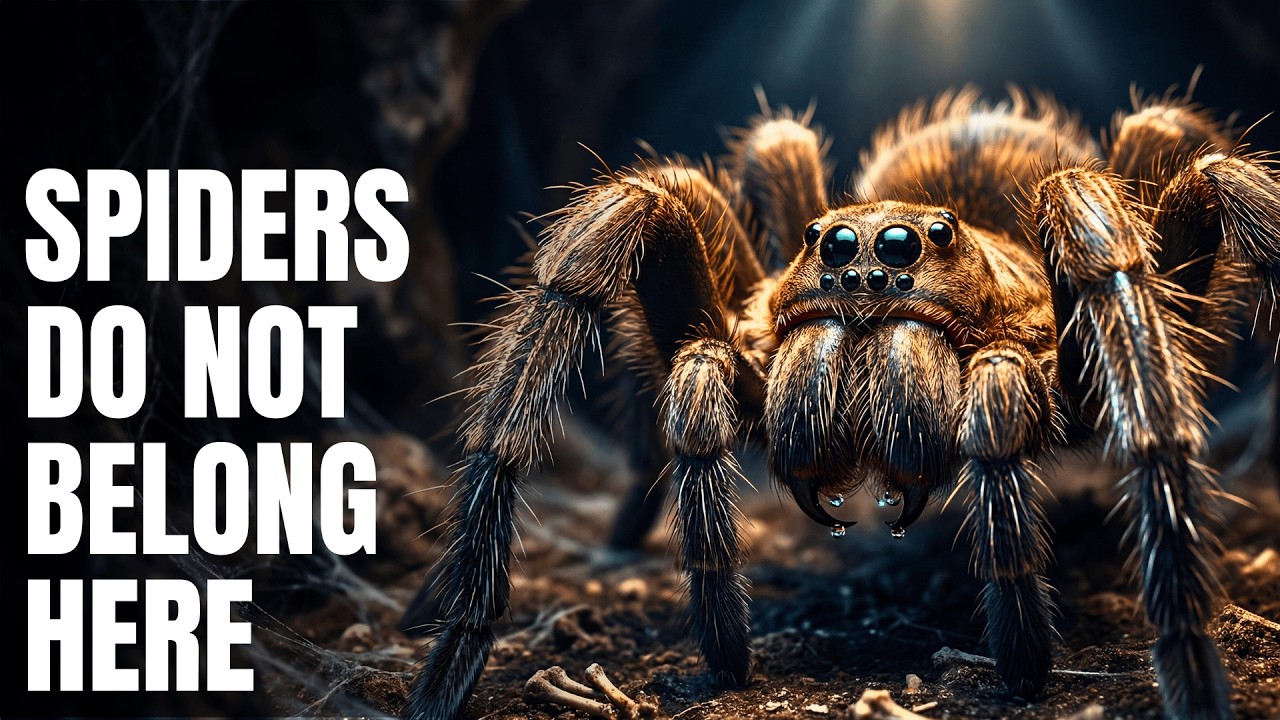
What if I told you that the most alien creatures on Earth aren't buried in ocean trenches or hidden in remote jungles—they're living in your home right now? This documentary explores the genuinely unsettling biology of spiders: creatures with copper-based blue blood, brains that extend into their legs, and the ability to produce materials stronger than anything human engineering has achieved.
You'll discover why spider silk remains impossible to replicate despite decades of research, how these eight-eyed predators perceive reality through sensory systems we can barely comprehend, and why their 380-million-year evolutionary success story challenges everything we think we know about biology. From external digestion that liquefies prey alive to cognitive abilities that shouldn't exist in brains smaller than grains of sand, spiders represent nature's most successful experiment in alien design.
This isn't sensationalism. Every fact presented is drawn from peer-reviewed research in arachnology, evolutionary biology, materials science, and behavioral neuroscience. We've synthesized decades of scientific investigation into a narrative that reveals the profound strangeness hiding in plain sight.
🔬 WHAT YOU'LL LEARN:
• Why spider blood chemistry fundamentally differs from almost all complex life on Earth
• The mathematical precision behind web construction that rivals human engineering
• How jumping spiders achieve visual acuity comparable to humans with pinhead-sized eyes
• The evolutionary mystery that continues to puzzle leading arachnologists
• Why 40 million spiders per acre represent the most successful predator strategy on land
This documentary is designed for viewers who want to understand the natural world beyond surface-level facts—those who appreciate that true education means confronting how little we actually understand about life on our own planet.
🎓 EDUCATIONAL VALUE:
Perfect for students of biology, materials science, evolutionary theory, and anyone fascinated by the intersection of the familiar and the genuinely alien. The content maintains scientific accuracy while remaining accessible to general audiences, making complex concepts understandable without oversimplification.
📚 BIBLIOGRAPHIC REFERENCES:
• Foelix, R.F. (2011). Biology of Spiders. Oxford University Press.
• Craig, C.L. (2003). Spiderwebs and Silk: Tracing Evolution from Molecules to Genes to Phenotypes. Oxford University Press.
• Nyffeler, M., & Birkhofer, K. (2017). An estimated 400-800 million tons of prey are annually killed by the global spider community. The Science of Nature, 104(3-4), 30.
• Harland, D.P., & Jackson, R.R. (2004). Portia perceptions: the umwelt of an araneophagic jumping spider. In Complex Worlds from Simpler Nervous Systems (pp. 5-40). MIT Press.
• Quesada, R., et al. (2011). Darwin's bark spider (Caerostris darwini): giant prey in giant orb webs. Journal of Arachnology, 39(2), 287-295.
• Vollrath, F., & Knight, D.P. (2001). Liquid crystalline spinning of spider silk. Nature, 410(6828), 541-548.
• Strausfeld, N.J., et al. (2012). Arthropod brains: Evolution, functional elegance, and historical significance. Harvard University Press.
⚠️ AI DISCLOSURE:
This content was created and produced with the assistance of artificial intelligence for educational and documentary purposes. All scientific information presented is based on peer-reviewed research and established scientific literature. AI technology was utilized to synthesize complex research into an accessible narrative format, ensuring accuracy while optimizing educational engagement. The use of AI allows us to process vast amounts of scientific literature efficiently and present it in compelling documentary formats that make cutting-edge research accessible to broader audiences.
🔔 SUBSCRIBE for more explorations into the unreal aspects of nature that challenge our understanding of biology, evolution, and what's possible on Earth. New documentaries weekly.
💬 What aspect of spider biology shocked you most? Share your thoughts in the comments.
#Spiders #Arachnology #EvolutionaryBiology #NatureDocumentary #ScienceEducation #BiomaterialsScience #AnimalCognition #UnrealNature #EducationalContent #WildlifeBiology

Информация по комментариям в разработке