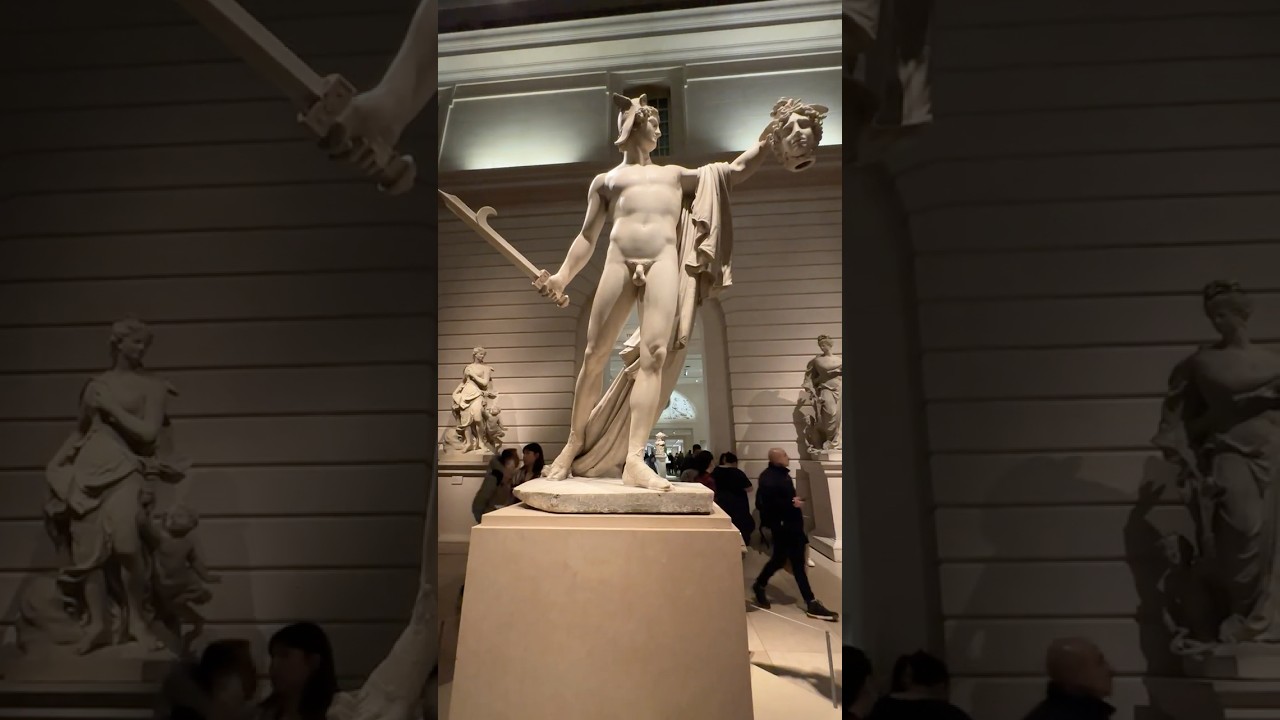
Perseus with the Head of Medusa by Antonio Canova @ The Met Metropolitan Museum of Art NYC New York City
Link to art;
https://www.metmuseum.org/art/collect...
Perseus with the Head of Medusa
Antonio Canova Italian
Patron Commissioned by Count Jan and Countess Valeria Tarnowski
1804–6
On view at The Met Fifth Avenue in Gallery 548
When Countess Valeria Tarnowska first met the sculptor Antonio Canova, on December 5, 1803, she recorded the event in her diary: "I saw the great Canova! I saw him amidst his glory, surrounded by his masterpieces — simple, modest, he seems to ignore the fact that he has become immortal." [1] Canova was universally acknowledged to be the preeminent sculptor — for many, the dominant artist — of his era. Determined to have a work from his hand, the countess negotiated a contract, signed by Canova on April 14, 1804, for a version of the artist’s marble Perseus with the Head of Medusa (1797–1801).[2]
The composition proved to be one of the most important of Canova’s career. It closely reflects his admiration for the art of antiquity and signals his fame as the rival of ancient masters. It was obviously, if freely, based on the Apollo Belvedere, whose loss had been widely mourned in Italy ever since Napoléon’s troops carted it off from the Vatican to Paris in 1797. In its frontality and majestic motion, Perseus’s stance recalls the antique Apollo, but Canova’s hero’s gaze is focused on the severed head of the monster Medusa, which in turn was based on another famous antiquity, the marble mask known as the Rondanini Medusa (Glyptothek, Munich). When finished, Canova’s marble was purchased by Pope Pius VII, who placed it in the niche where the Apollo Belvedere had once stood. Implicit in this act was a championing of contemporary Italian art and defiance of the French conquerors of Italy. The following year, Canova was further rewarded with the post of inspector-general of antiquities and works of art in Rome and the Papal States.
That the sculptor undertook scrupulous, even pedantic, research when planning the Perseus is evident in the label he placed by the finished statue in his studio:
It is said that when Perseus, son of Jupiter and Danaë, was sent by King Polydectes to fight the Gorgons, he received the sandals and the wings from Mercury who loved him especially. These wings he attached to the prodigious helmet he received from Pluto, which made invisible whoever was wearing it. Many authors describe this helmet as a Phrygian cap, with two ears; in fact, one sees one like it worn by a Pallas (once in the collection of Cardinal Gualtieri) because this goddess also wanted to use it on several occasions. It is also said that he received from Vulcan a diamond sickle, which as Hyginus tells, he used to cut off the head of Medusa. The shape of this pointed and hooked weapon is found on many ancient monuments and Homer and other ancient writers call it probably harpé. To explain the meaning of this term, Suidas applied to it the Greek word lancodrépanon, which means sickle-shaped and pointed knife. [3]
Interestingly, Canova omitted the polished shield, in whose reflective surface the hero could view safely the fearsome Medusa, whose face turned men to stone. The sculptor’s label suggests both the zeal with which he combed ancient visual and literary sources for authentic details and background material and also the keen interest of his audience in such facts.
Countess Tarnowska requested a marble version of the Perseus, "in all similar to the other one now in the Vatican Museum" (according to the contract), and the resulting statue was likely based on a plaster cast in Canova’s studio. It was Canova’s practice to model his sculptures in clay and then make plaster copies, which could withstand the rigors of sculptural work. For example, the Museum possesses a lifesize plaster model of Canova’s Cupid and Psyche, which he used as a guide for carving the marble versions now in the State Hermitage Museum, Saint Petersburg, and the Musée du Louvre, Paris.[4] The contract further stipulates that the countess’s version should be "a statue of Carrara marble carved by [Canova]." By this point in his career, Canova had a large workshop to assist him, but most patrons presumed that the sculptor would finish the work himself (in most cases, assistants would work the marble up to a certain point, copying the plaster model, and the master would give it the finishing touches). The Museum owns a lifesize version of Canova’s Paris, for instance,[5] which Canova left unfinished in his studio at his death; the following year it was completed by a studio assistant for Robert, Viscount Castlereagh, second Margrave of Londonderry. In a list of his best-known works that Canova dictated in 1816, he refers to the present sculpture as "Perseus — replica of the first one, with some small variations, shipped to Poland to Countess Tarnowska." [6]

Информация по комментариям в разработке