The Transalpin was first introduced in 1958, it was operated by the Austrian Federal Railways (ÖBB) and the Swiss Federal Railways (SBB-CFF-FFS). For most of its life, it ran between Wien Westbf in Vienna, Austria, and Basel SBB in Switzerland. In 1987, it was designated a EuroCity train.[2] In 2008, it was cut back from Basel SBB to Zürich HB, Switzerland. It was discontinued in June 2010, and replaced by a Railjet service.[3]
From 1 June 1958 until 13 June 2010, the Transalpin was a showpiece of the ÖBB and the SBB. Introduced the year after the Trans Europ Express (TEE) network was set up in 1957, it had both first- and second-class accommodation, and therefore did not meet the "first class only" requirements to be a TEE.
Throughout its history, the Transalpin ran daily in both directions. Until the 2000s, it was always one of the fastest railway connections, with the fewest intermediate stops, in its area of operation.
The initial train numbers of the Transalpin were TS 11/12, and its original route was Wien Westbf to Zürich HB. In 1959, the route was extended to Basel (SBB station). When it became a EuroCity train, in 1987, its train numbers became EC 62 westbound and EC 63 eastbound.[2]
To save time and the need for the train to reverse direction during its journey, the Transalpin did not stop at Salzburg Hauptbahnhof initially, but ran via the curve from Elixhausen to Salzburg-Gnigl, and stopped at Salzburg Aigen. Even today, this curve, which is now used mainly by goods trains, is known by the name Transalpin-Schleife (Transalpin curve).
In 1969, the route was changed. From then onwards, the Transalpin ran from the Western Railway at Salzburg Hbf to Wörgl via the Deutsche Bundesbahn (DB)–owned Rosenheim–Salzburg and Rosenheim–Kufstein railways, instead of along the previous route via Bischofshofen and Zell am See (Gisela railway).[4][5] As the Transalpin had no scheduled stops in Germany, it was operated there as a so-called Korridorzug or "privilege train",[5] a train in which (in the period before the Schengen Agreement) the passport and customs checks that would otherwise be required were not applicable.[5] Until the construction of the "Rosenheim Curve [de]" in 1982, the train had been reversed at Rosenheim.
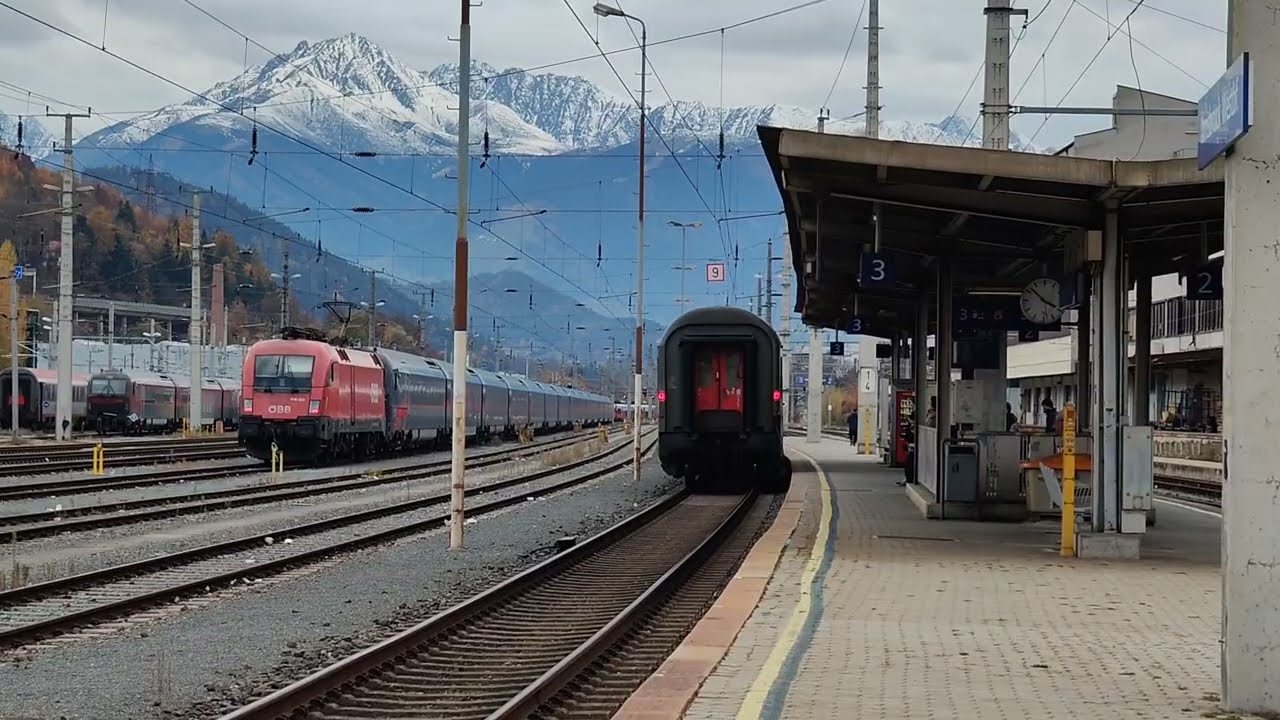
In 1975, a writer for Fodor's travel guides described the Transalpin as "one of the best trains in Europe for mountain scenery".[6]
In 1980, a trip on the Transalpin from Zürich to Vienna was featured in "Changing Trains", the final episode in Series 1 of Great Railway Journeys of the World, a BBC TV travel documentary. The "Changing Trains" trip, which formed part of a longer journey from Paris to Budapest, was also described in the book published to complement the TV series. In the book, Eric Robson, the presenter and author of "Changing Trains", commented that the Transalpin, as of 1980, was simply the best train that the ÖBB had to offer, "... the star of this single main line to the east."[7]
When the EuroCity network was launched on 31 May 1987, the Transalpin was among the previously existing international express trains to be redesignated as EuroCity trains.[2]
In June 2010, the Transalpin was replaced by the "Railjet 162" and "Railjet 163", which run to approximately the same timetable.[3][8] In the timetable period 2013/2014, five pairs of Railjets connect Zürich and Vienna
Wikipedia

Информация по комментариям в разработке