http://www.ppschicago.com/pain-disord...
Hello, this is Dr. David Green education director for premier pain specialists in Chicago. Today's topic is what you need to know about joint arthritis. Joint arthritis is the number one leading cause of disability in America affecting over 50 million Americans. It involves inflammation of one or more of your joints, but the main symptoms being joint pain, stiffness, and typically this gets worse as a person ages. There are two main types that most common is osteoarthritis and then there's rheumatoid arthritis. Osteoarthritis is the main type of arthritis and that's basically degenerative wear and tear, DJD D degenerative joint disease. Essentially what's happening is cartilage is breaking down. We're making cartilage at the same rate as we always have. That continues throughout life, but you're breaking it down faster, so that's the crux of DJD is it becomes a ratio problem with rheumatoid arthritis, it's an autoimmune disease, so it targets the lining of the joints.
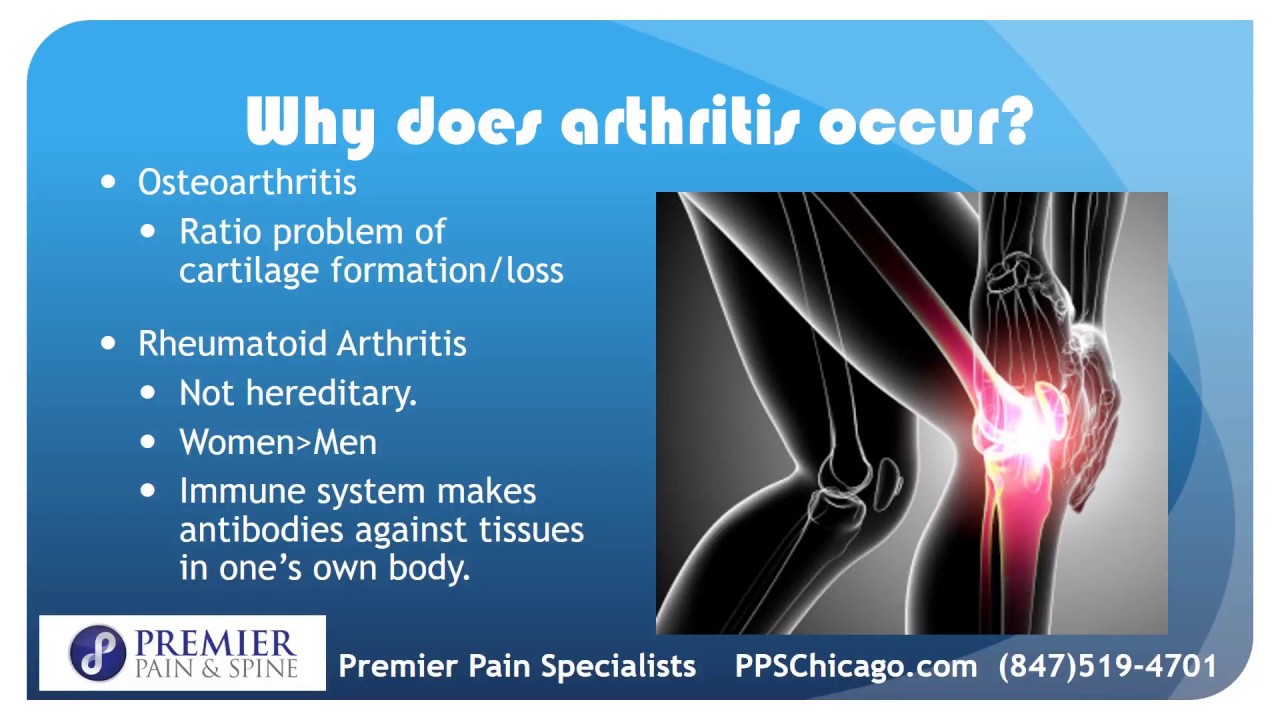
First. You're actually working against your own synovial lining to promote joint breakdown or other types of arthritis that are not as common include psoriatic lupus and Crystalyn basically, which is gout. Why has arthritis occur? We already talked about the ratio problem in a osteoarthritis. With rheumatoid arthritis, there's not a hereditary component. Women suffer more often than men and it's the immune system that's making antibodies against the tissues in one's own body. Risk factors for arthritis include a family history increasing age. Females are more common than males. For rheumatoid arthritis, males are more common than females. For gouty arthritis, post traumatic arthritis, if there's injury to a joint, it screws up the biomechanics and can promote increased and hastened, uh, arthritis. And then obesity. Multiple studies have shown the correlation between obesity and degenerative arthritis. Symptoms or arthritis are going to vary. A may include pain, stiffness, swelling, decreased range of motion, um, treatment options.
There are quite a few. Then first and foremost is activity avoidance. If you're playing golf, say six days a week and it really, really hurts, cut it back to three or four. If you're running and it's a big problem for your knees, switch over to a cross training, swimming, bicycling. So that's the first and foremost medication. Start with oral over the counter medications like antiinflammatories and Tylenol. Um, and then you can get into prescription medications, which may include for short term exacerbations, narcotics and there's prescription pancreas medications as well. Bracing and a cane can help, um, relieve joint pain, physical therapy and chiropractic treatment. Also, acupuncture has been shown in dozens of research studies to work very well for joint arthritis and tens units. Can the brain change the way it perceives pain signals from arthritis? Interventional treatments include steroid injections, which have been done for decades for joint arthritis.
It used to be thought that steroids would hurt the joint itself. That was only shown in small animal studies. It was not shown in large animal studies and it's never been shown in humans. Hyaluronic acid can work well for joint arthritis. That's the popular Synvisc and Hyalgan prolotherapy. And then regenerative medicine includes PRP and STEM cell injections. PRP stands for platelet rich plasma radio frequency ablation, uh, can work extremely well for spinal arthritis, which is where you deaden the small little sensory nerve endings and that can provide pain relief consistently for 12 to 24 months. The outcomes of non-operative arthritis treatment is that the vast majority of patients are able to avoid surgery for arthritis or delay it significantly. Joint replacements are not meant to last forever. They are a quality of life procedure. While they have a high outcome success rate, there are some significant complications that can occur.
Success rates with steroid hyaluronic acid and regenerative medicine injections are well over 75% radio frequency ablation for spinal arthritis has success rates of over 80% and also studies show that when the pain relief wears off and you have repeat procedures, you can expect to have the same outcomes. The second time around. Topical pain creams have been looked at. These have an 83% overall effectiveness rate for all types of chronic pain conditions such as arthritis. Thankfully, arthritis is not a deadly disease. It never killed anybody and that's one thing to keep in mind. Top pain management in the greater
Call (312) 274-9573 now or visit https://www.ppschicago.com
PREMIER PAIN & SPINE
233 E Erie St #310
Chicago, IL 60611
(312) 274-9573

Информация по комментариям в разработке