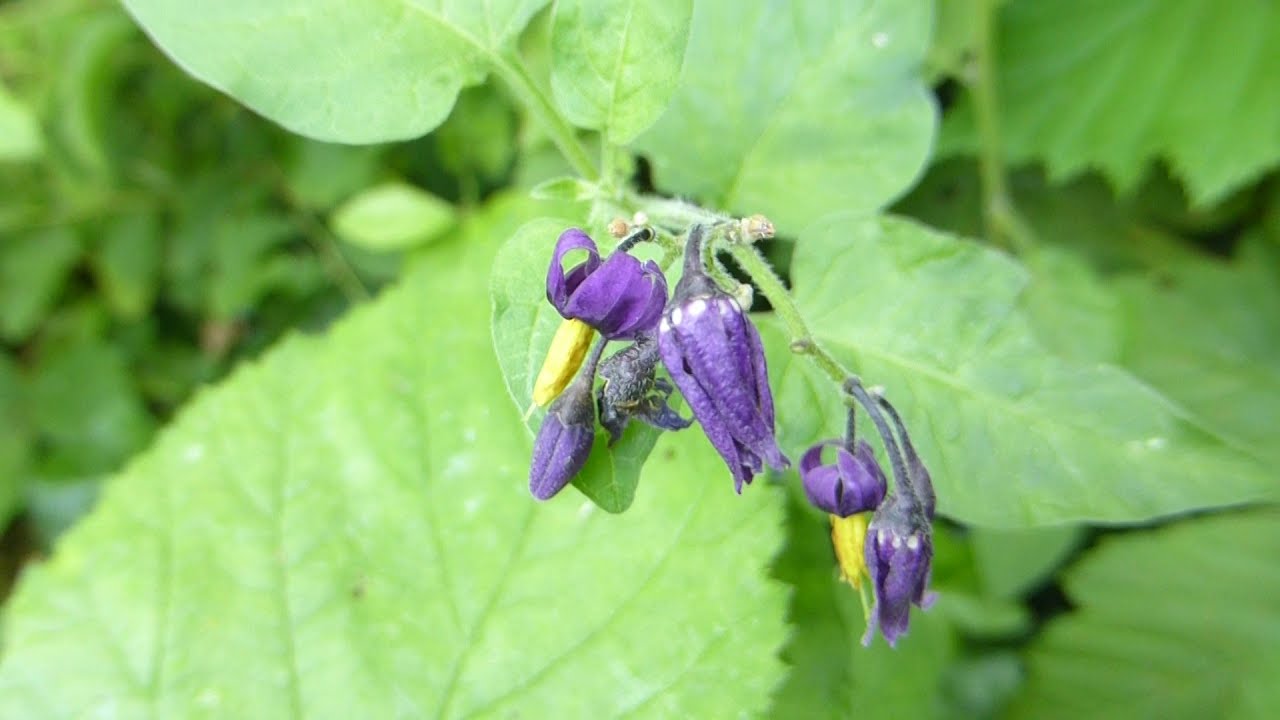
Bitter Nightshade Flowers - Solanum dulcamara - Eiturflækja - Natskygge - Náttskuggablóm - Besksöta - Douce-amère - Bittersweet - Blue bindweed - Amara Dulcis - Bittersweet nightshade - Climbing nightshade - Woody nightshade - Bittersød natskygge - Bittersüß Nachtschatten - Fellenwort - Felonwood - Poisonberry - Poisonflower - Scarlet berry - Snakeberry - Slyngsøtvier - Potatissläktet - Søtvierslekten - Náttskuggablóm - Húmskuggaplöntur - Klifurrunnar - Trailing nightshade - Kartöfluætt - Potato family - Solanum family - Solanaceae - Solanales - Poisonous Plants - Eiturjurtir - Eitraðar plöntur - Vafningplöntur - Klifurjurtir - Villijurtir. Hardy and quick growing wall shrub, flowers violet-blue. Lovely purple flowers in summer with cone of yellow stamens. The Solanum family is very large, consisting of nearly 1500 species ranging from vegetables like the potato and aubergine, to ornamental shrubs and climbers, plus a number of weeds. Some, as their common name Nightshade suggests, are toxic and need careful handling. Þessi Náttskuggaplanta vakti athyglu mina þar sem blómiun voru svo falleg svona lillablá - Villijurt sem varð á vegi mínum á göngu í englandi.
Bittersweet is a very woody herbaceous perennial vine, which scrambles over other plants, capable of reaching a height of 4 m where suitable support is available, but more often 1–2 m high. The leaves are 4–12 cm long, roughly arrowhead-shaped, and often lobed at the base. The flowers are in loose clusters of 3–20, 1–1.5 cm across, star-shaped, with five purple petals and yellow stamens and style pointing forward. The fruit is an ovoid red berry about 1 cm long, soft and juicy, with the aspect and odor of a tiny tomato, and edible for some birds, which disperse the seeds widely. However, the berry is poisonous to humans and livestock, and the berry's attractive and familiar look make it dangerous for children. The plant is relatively important in the diet of some species of birds such as European thrushes, which feed on its fruits, being immune to its poisons, and scatter the seeds abroad. See more: https://en.wikipedia.org/wiki/Solanum...
Bittersweet nightshade is a slender perennial vine or semi-woody shrub found throughout King County, especially in creeks and wetlands, as well as field edges, gardens, parks, and roadsides. This plant is toxic to people, pets, and livestock. Leaves are dark green to purple-tinged. Mid-May to September, produces star-shaped purple flowers with stamens fused in a prominent yellow cone. Flowers followed by round or egg-shaped berries that ripen from green, to orange, to bright red. All stages of berry can grow on same plant. Spreads by seed, as well as stem and root fragments. See more: https://www.kingcounty.gov/services/e...
Solanum crispum - Growing to 6 m tall, it is a semi-evergreen, woody-stemmed climbing plant. The small blue fragrant flowers, 2.5 cm in diameter, with prominent yellow ovaries, appear in clusters in summer. They resemble those of the closely related potato. Very small poisonous berries are produced in autumn. The berries start out green, then yellow-orange, and finally purple. The leaves are oval. See more: https://en.wikipedia.org/wiki/Solanum...
Solanum species show a wide range of growing habits, such as annual and perennials, vines, subshrubs, shrubs, and small trees. Many formerly independent genera like Lycopersicon (the tomatoes) and Cyphomandra are now included in Solanum as subgenera or sections. Thus, the genus today contains roughly 1,500–2,000 species. Most parts of the plants, especially the green parts and unripe fruit, are poisonous to humans (although not necessarily to other animals), but many species in the genus bear some edible parts, such as fruits, leaves, or tubers. See more: https://en.wikipedia.org/wiki/Solanum
The Solanaceae, or nightshades, are an economically important family of flowering plants. The family ranges from annual and perennial herbs to vines, lianas, epiphytes, shrubs, and trees, and includes a number of important agricultural crops, medicinal plants, spices, weeds, and ornamentals. Many members of the family contain potent alkaloids, and some are highly toxic. The family belongs to the order Solanales, in the asterid group dicotyledons (Magnoliopsida). The Solanaceae consists of about 98 genera and some 2,700 species, with a great diversity of habitats, morphology and ecology. The name Solanaceae derives from the genus Solanum, "the nightshade plant". See more: http://en.wikipedia.org/wiki/Solanum

Информация по комментариям в разработке