Information about Ancient Theatre
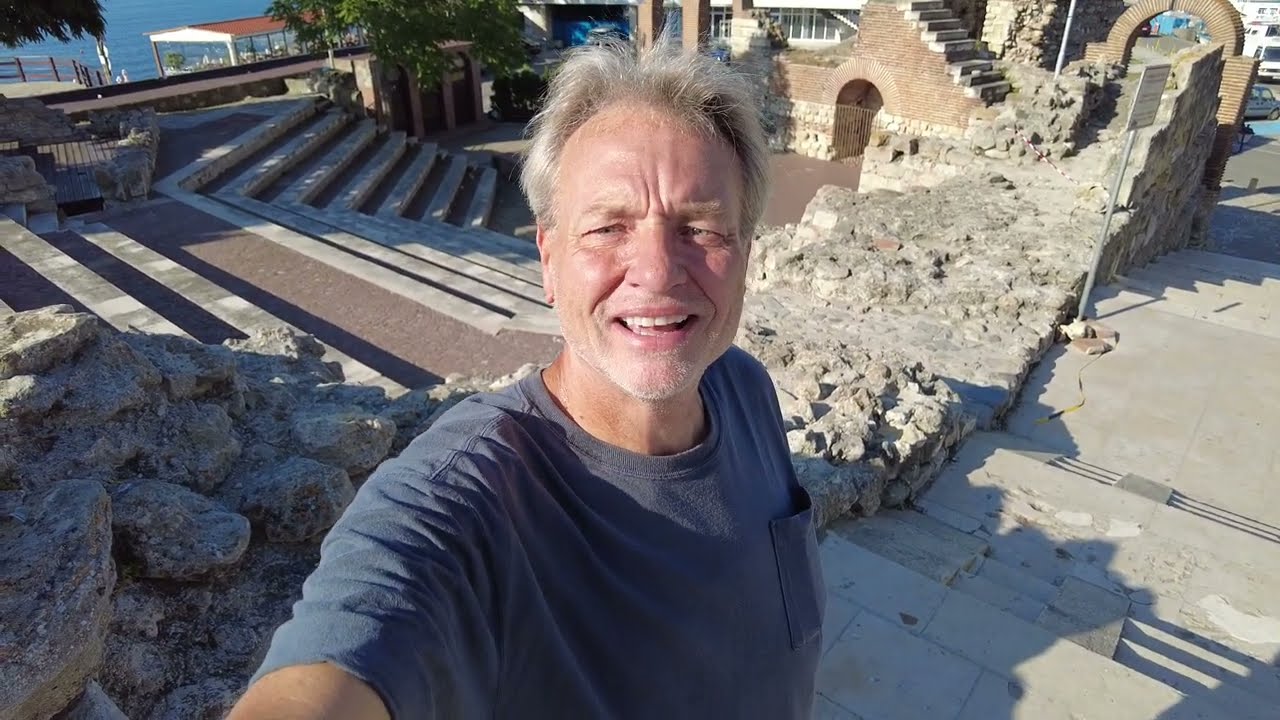
The ancient theater is located directly on the shore of the Black Sea, and is visited by many tourists every year. It also hosts many local artistic events and plays from time to time. This theater has a majestic Roman architectural character, and its view that catches the eye because of its beauty. In addition, it is an ideal place to take the most beautiful souvenir photos ever. Visit it when you come to the city, and enjoy seeing one of the most beautiful historical gems of Nessebar.
Nesebar (often transcribed as Nessebar and sometimes as Nesebur, Bulgarian: Несебър, pronounced [nɛˈsɛbɐr]) is an ancient city and one of the major seaside resorts on the Bulgarian Black Sea Coast, located in Burgas Province. It is the administrative centre of the homonymous Nesebar Municipality. Often referred to as the "Pearl of the Black Sea", Nesebar is a rich city-museum defined by more than three millennia of ever-changing history. The small city exists in two parts separated by a narrow man-made isthmus with the ancient part of the settlement on the peninsula (previously an island), and the more modern section (i.e. hotels, later development) on the mainland side. The older part bears evidence of occupation by a variety of different civilisations over the course of its existence.
It is one of the most prominent tourist destinations and seaports on the Black Sea, in what has become a popular area with several large resorts—the largest, Sunny Beach, is situated immediately to the north of Nesebar.
Nesebar has on several occasions found itself on the frontier of a threatened empire, and as such it is a town with a rich history. Due to the city's abundance of historic buildings, UNESCO came to include Nesebar in its list of World Heritage Sites in 1983.
The settlement was known in Greek as Mesembria (Greek: Μεσημβρία), sometimes mentioned as Mesambria or Melsembria, the latter meaning the city of Melsas.[3] According to a reconstruction the name might derive from Thracian Melsambria.[4] Nevertheless, the Thracian origin of that name seems to be doubtful. Moreover, the tradition pertaining to Melsas, as founder of the city is tenuous and belongs to a cycle of etymological legends abundant among Greek cities. It also appears that the story of Melsas was a latter reconstruction of the Hellenistic era, when Mesembria was an important coastal city.
Bulgarian archaeologist Lyuba Ognenova-Marinova led six underwater archaeological expeditions for the Bulgarian Academy of Sciences (BAS) between 1961 and 1972[7][8] in the waters along the Bulgarian Black Sea Coast. Her work led to the identification of five chronological periods of urbanization on the peninsula surrounding Nesebar through the end of the second millennium B.C., which included the Thracian protopolis, the Greek colony Mesambria, a Roman-ruled village to the Early Christian Era, the Medieval settlement and a Renaissance era town, known as Mesembria or Nessebar.
Engineering around the peninsula coastline was undertaken in 1980s both to preserve the coastline (and its historic significance) and to consolidate the area as a port.
Originally a Thracian settlement, known as Mesembria, the town became a Greek colony when settled by Dorians from Megara at the beginning of the 6th century BC, then known as Mesembria. It was an important trading centre from then on and a rival of Apollonia (Sozopol). It remained the only Dorian colony along the Black Sea coast, as the rest were typical Ionian colonies. At 425-424 BC the town joined the Delian League, under the leadership of Athens.
Remains date mostly from the Hellenistic period and include the acropolis, a temple of Apollo and an agora. A wall which formed part of the Thracian fortifications can still be seen on the north side of the peninsula.
Mesembria Fortress plan
It was one of the most important strongholds of the Eastern Roman Empire from the 5th century AD onwards, and was fought over by Byzantines and Bulgars, being captured and incorporated in the lands of the First Bulgarian Empire in 812 by Khan Krum after a two-week siege only to be ceded back to Byzantium by Knyaz Boris I in 864 and reconquered by his son Tsar Simeon the Great. During the time of the Second Bulgarian Empire it was also contested by Bulgarian and Byzantine forces and enjoyed particular prosperity under Bulgarian tsar Ivan Alexander (1331–1371) until it was conquered by Crusaders led by Amadeus VI, Count of Savoy in 1366. The Bulgarian version of the name, Nesebar or Mesebar, has been attested since the 11th century.
My name is Eric Clark and I am a world traveler. I have been around the world a few times and decided to help fund my travels by sharing my videos and pictures. I have been to almost every country and would be glad to give tips and pointers. Drop me a note. = )

Информация по комментариям в разработке